What is wrong with my Panther chameleon?

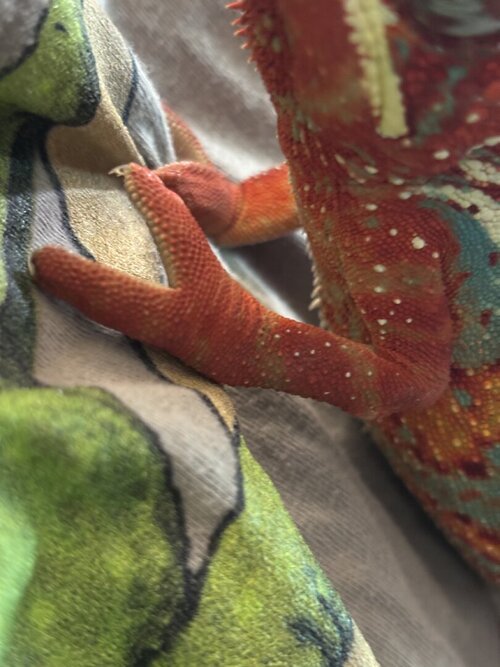
Hello! Last night, I noticed something wrong with my Panther Chameleon’s left wrist. It looks more swollen than usual. After examining him for a bit, I cannot find what could be. I do have a possible cause of what might have made his wrist look like this. Also, he has an eye issue. He keeps rubbing and cleaning it out by how chameleons usually do it. They roll and bulge their eyes to get the irritant out. He had an eye issue months back and had been taken care of by a vet. I don’t know what could be in his eye. I just need someone who might know what could be wrong with my cham.
 

Attachments

  • IMG_3058.jpeg
    IMG_3058.jpeg
    126 KB · Views: 1
Hey there. Classic sign of gout. Here is a link to tell you more. https://chameleonacademy.com/chameleon-medical-gout/

Gout symptoms like this can also be related to a husbandry issue. Linked up with renal function. A few husbandry related causes are feeding insects a gutload that is far too high in protein, hydration is not adequate (typically seen with urates being mostly orange for a consistant period), potential link to supplements if you are overdoing fat soluble vitamins like vitamin A and D. When husbandry related you can get it to subside as it is more of a pseudogout. Where if it is fully connected to renal function/failure you can only medicate to help with the symptoms as the renal function is permanently impacted.

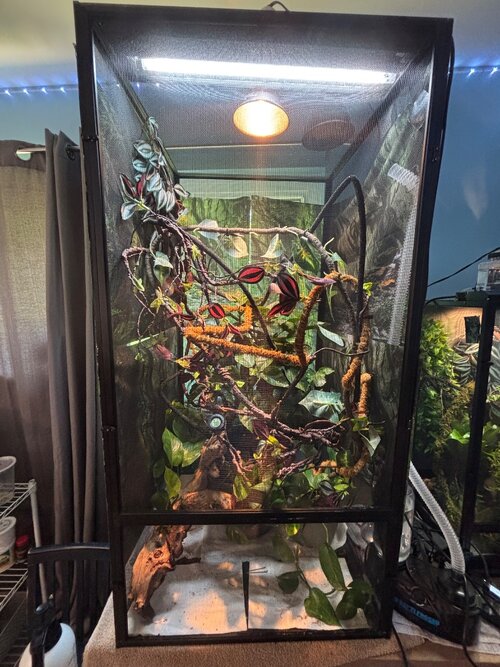
Post pics of the entire chameleon and the entire enclosure including the lighting on top. Then copy and paste the form below into your reply and answer all the questions with detail. Once I can see all husbandry I can try to narrow down the eye issue as well.

Chameleon Info:

  • Your Chameleon - The species, sex, and age of your chameleon. How long has it been in your care?
  • Handling - How often do you handle your chameleon?
  • Feeding - What are you feeding your cham? What amount? What is the schedule? How are you gut-loading your feeders?
  • Supplements - What brand and type of calcium and vitamin products are you dusting your feeders with and what is the schedule?
  • Watering - What kind of watering technique do you use? How often and how long to you mist? Do you see your chameleon drinking?
  • Fecal Description - Briefly note colors and consistency from recent droppings. Has this chameleon ever been tested for parasites?
  • History - Any previous information about your cham that might be useful to others when trying to help you.

Cage Info:

  • Cage Type - Describe your cage (Glass, Screen, Combo?) What are the dimensions?
  • Lighting - What brand, model, and types of lighting are you using? What is your daily lighting schedule?
  • Temperature - What temp range have you created (cage floor to basking spot)? Lowest overnight temp? How do you measure these temps?
  • Humidity - What are your humidity levels? How are you creating and maintaining these levels? What do you use to measure humidity?
  • Plants - Are you using live plants? If so, what kind?
  • Placement - Where is your cage located? Is it near any fans, air vents, or high traffic areas? At what height is the top of the cage relative to your room floor?
  • Location - Where are you geographically located?

Current Problem - The current problem you are concerned about.

--------------

Please Note:

  1. The more details you provide the better and more accurate help you will receive.
  2. Photos can be very helpful.
 
My chameleon is a Panther chameleon. Sex is male, about little over a year. I only take him out when he wants to and most of the time he does want to. He eats crickets, Dubia roaches, rarely superworms and hornworms. He only eats about 4 or 5 insects because he’s an adult. I feed him twice a day. Once in the morning and once in the evening. I use dandelion greens, apples (rarely), butternut squash, carrots, sweet potatoes, bananas (rarely), mustard greens, and kale. I use Repashy’s Super LoD (has the Jackson’s chameleon on the front) and I use calcium without D3. I dust lightly every feeding (I need to space out more). I maintain misting by hand but I am about to get an automatic misting system. I use a fogger at night to maintain humidity and I spray. I mist for about 2 minutes and I do see him drink. Recent colors have been white and stools have been moist. I have tested him for parasites and I have seen no parasites in the last few times I have tested him. I take a very thin wipe of his stool and put it on a slide and then examine it under a microscope. He has a tongue issue which is a birth defect he has. He cannot get the insects first try. So I help him make it easier on eating. I use a ZooMed 2’ x 2’ x 4’ and it is mesh screen. I use ZooMed UVB 24” lighting hood along with a 22” UVB bulb that is also ZooMed Reptisun. I use a 75w daytime basking light. Temperatures get up to about 90. Lowest night temp has been around 68. I use a laser thermometer to check basking, ambient, etc. Humidity is between 50% - 60% (which is where it needs to be for a Panther) and at night around 80%. I use a hydrometer in the cage. I have two pothos and a hibiscus as the main plant he climbs on. His cage sits on a table and there is a vent near his cage. He sits near a window. I am located in Ohio.

 
Ok I took your info and put it back into the form I provided. This makes it easier for us to spot issues and missing info. I do need pics of the entire set up please and more full body of the chameleon. See my feedback and additional questions in Red Bold.

Chameleon Info:

  • Your Chameleon - The species, sex, and age of your chameleon. How long has it been in your care? My chameleon is a Panther chameleon. Sex is male, about little over a year. How old his he right now?
  • Handling - How often do you handle your chameleon? I only take him out when he wants to and most of the time he does want to. He eats crickets, Dubia roaches, rarely superworms and hornworms.
  • Feeding - What are you feeding your cham? What amount? What is the schedule? How are you gut-loading your feeders? He only eats about 4 or 5 insects because he’s an adult. I feed him twice a day. Once in the morning and once in the evening. I use dandelion greens, apples (rarely), butternut squash, carrots, sweet potatoes, bananas (rarely), mustard greens, and kale. When you say you feed him twice a day do you mean 4-5 total or at each feeding? You should feed in mornings only so he has the day to bask and digest. Remove the bananas from the gutload these are high in phosphorus and can effect calcium absorption. Do you put anything else into your gutload?
  • Supplements - What brand and type of calcium and vitamin products are you dusting your feeders with and what is the schedule? I use Repashy’s Super LoD (has the Jackson’s chameleon on the front) and I use calcium without D3. I dust lightly every feeding (I need to space out more). So both of these are right. The rotation you want to be using them in is Calcium without D3 at every feeding lightly dusted on the insects and then every two weeks replace the calcium with D3 with the Repashy LoD so that it is being given 2 times a month. How often have you been giving the repashy LOD? This is important because I need to figure out if he is being overdosed on D3 and vitamin A.
  • Watering - What kind of watering technique do you use? How often and how long to you mist? Do you see your chameleon drinking? I maintain misting by hand but I am about to get an automatic misting system. I use a fogger at night to maintain humidity and I spray. I mist for about 2 minutes and I do see him drink. So the auto mister will help you a lot. Chams that openly drink in front of people tend to be very thirsty. Automisters let them drink morning and evening as needed. Adding a dripper during the day is helpful as well. The bigger thing about the auto misting sessions is that you can run a longer one in the evening so that they can actually fully clean out their eyes. If a chameleon is actively rotating the turret then something is aggravating it. We see this a lot with hand misting.
  • Fecal Description - Briefly note colors and consistency from recent droppings. Has this chameleon ever been tested for parasites? Recent colors have been white and stools have been moist. I have tested him for parasites and I have seen no parasites in the last few times I have tested him. I take a very thin wipe of his stool and put it on a slide and then examine it under a microscope. When you say recent colors what do you mean? Where they orange prior? As long as you are skilled in what parasites to look for then there is no issue with you doing it yourself.
  • History - Any previous information about your cham that might be useful to others when trying to help you. He has a tongue issue which is a birth defect he has. He cannot get the insects first try. So I help him make it easier on eating

Cage Info:

  • Cage Type - Describe your cage (Glass, Screen, Combo?) What are the dimensions? I use a ZooMed 2’ x 2’ x 4’ and it is mesh screen. good.
  • Lighting - What brand, model, and types of lighting are you using? What is your daily lighting schedule? I use ZooMed UVB 24” lighting hood along with a 22” UVB bulb that is also ZooMed Reptisun. I use a 75w daytime basking light. What bulb strength is your reptisun? a 5.0 or 10.0? When last did you replace you bulb? What is the distance from where it sits on your screen top to the highest basking branch below it? 75 watt may be a bit too strong based on the temps your getting. I would reduce it. If it is a flat bottomed focused heat bulb it will produce temps much hotter than he should have.
  • Temperature - What temp range have you created (cage floor to basking spot)? Lowest overnight temp? How do you measure these temps? Temperatures get up to about 90. Lowest night temp has been around 68. I use a laser thermometer to check basking, ambient, etc. With fogging at night you have to have your temps down below 68. The colder the better. hot moist air can create the perfect environment for respiratory infections. But with hydration via fogging it has to be cold for it to work the way you need it to. If you can not get temps down farther I would not risk fogging. RI's are not fun to deal with or medicate for. Basking is too hot... 90 with a laser means temps are probably hotter than that as the temp gun only measures surface temp. I would get a temp gauge with a probe and hook it in at the branch directly below the heat fixture to determine where your levels are at the branch. then add a few degrees as it gets hotter the closer you get to the light coming off the branch.
  • Humidity - What are your humidity levels? How are you creating and maintaining these levels? What do you use to measure humidity? Humidity is between 50% - 60% (which is where it needs to be for a Panther) and at night around 80%. I use a hydrometer in the cage. 50% -60 daytime is fine. 80% at night is fine but only if you can get it colder. Fogging is actually supplemental hydration they do not have to have it if you can not get your temps low enough.
  • Plants - Are you using live plants? If so, what kind? I have two pothos and a hibiscus as the main plant he climbs on.
Placement - Where is your cage located? Is it near any fans, air vents, or high traffic areas? At what height is the top of the cage relative to your room floor? His cage sits on a table and there is a vent near his cage. He sits near a window.


  • Location - Where are you geographically located? I am located in Ohio.
 
He is only 1.5yrs. I appreciate all this info. As some of this I didn’t know. I am taking him to the vet today. His urate has been white. 5.0 UVB. I do know what parasites I am looking for and have done extensive research on each parasite that chameleons can be prone to getting. I use the LoD every feeding… that’s why I said I might need to space it out more because it almost is too much. I stopped using bananas a long time ago actually. I need to change his bulb soon.
IMG_3062.jpeg
 

Attachments

  • IMG_3066.jpeg
    IMG_3066.jpeg
    416.3 KB · Views: 1
Back
Top Bottom