
Navigation
Install the app
How to install the app on iOS
Follow along with the video below to see how to install our site as a web app on your home screen.
Note: This feature may not be available in some browsers.
More options
You are using an out of date browser. It may not display this or other websites correctly.
You should upgrade or use an alternative browser.
You should upgrade or use an alternative browser.
What is this???
- Thread starter BocaJan
- Start date

NewOwner
New Member
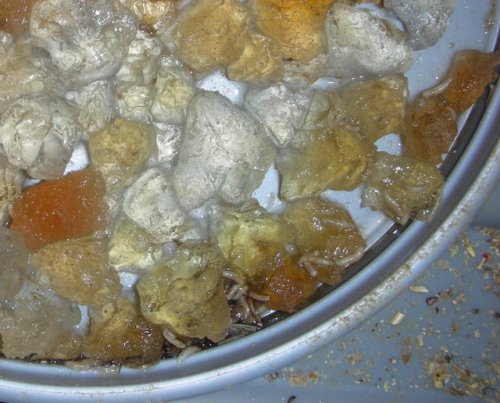
I found these larvae/grubs in my cricket's water dish after only 3 days of getting a new batch of crickets. What are they???? Will these be baby crickets? The crickets I purchased were 3/4" and not full grown. It is a mystery. Should I throw this away?
???
 pics will help haha
Eric Adrignola
Avid Member


dark, hairy larvae?
a type of dermestid beetle commonly infests cricket breeders, feeding on the dead crickets. Not really a bad thing, but they're nasty.
a type of dermestid beetle commonly infests cricket breeders, feeding on the dead crickets. Not really a bad thing, but they're nasty.


ColorCham427
Avid Member
LOL i found a few of em when I used to get mine from pet co... funny little things, I tried keeping them, seeing if they'll morph into a beetle or something, they wouldnt eat anything I offered... should of offered dead crickets!

summoner12
Avid Member

They look like maggots of some kind..... prolly from FF or something.... maybe those little beetles that sometimes show up in your box o crickets?

Jason4045
New Member
Indeed, they look kinda like maggots. Mabey a fly got inside your keeper and laid in the moist water crystals? I get skinny brown beetles with my mail order crickets sometimes but not many and they just die after a few days or so. I am wondering if they find there way into the dry cricket food at the hatchery and they make it in with the crickets?!?!?
Eric Adrignola
Avid Member
dirty water crystals are wet and smell like rotten dead bugs. Maggot paradise. possibly phorids.

B
blackbetty
Guest
Ew. Im sorry Jann, that just looks gross, I couldnt imagine seeing that in my order.. Ick! Hope whatever it is, it isnt an infestation!

BocaJan
New Member
OK, I will throw away the water crystals and start over with some new ones. I just purchased the crickets 3 days ago and I use cricket crack so I can't imagine it is from mouldy food. Geesh, what next! Come on dubias.....hurry up and make babies! Can't stand crickets. They are so dirty.
Didn't I read yesterday that whatever we feed our chams they still need some crickets??? DARN
Didn't I read yesterday that whatever we feed our chams they still need some crickets??? DARN
B
blackbetty
Guest
Yea I saw that, but I know lots who use Dubias as a staple and no crickets as long as others are used occasionally, silkies, horns, supers, ect... I think there is always going to be a conflict of interest.. But Im with you on no more crickets!
So that came WITH your crickets? Like in the box or bag? I would think it must have been in there prior to shipping then..
Yuck, I have an issue with maggots.. im sure most do, but I really really cant stand them.. Like fruit flies dont bother me, but housefly maggots make me convulse...
So that came WITH your crickets? Like in the box or bag? I would think it must have been in there prior to shipping then..
Yuck, I have an issue with maggots.. im sure most do, but I really really cant stand them.. Like fruit flies dont bother me, but housefly maggots make me convulse...


royden
New Member


It might have been me who said that. The reason I said it is because I use dubia's as a staple, and hadn't fed my cham crickets in many months. I bought him some crickets on a whim and he ate them like candy. Like silkworms, he couldn't get enough. It just reminded me of the need for variety. Rocahes are still the staple but I'm going to order 2 dozen crickets every now and then like I order silkies.
Gone are the days of me ordering 500-1000 crickets a month, caring and feeding them. No way.
BocaJan, you might want to get a 'booster order' for your dubias to get them up to speed. Make sure their temps are in the high 80's.
Gone are the days of me ordering 500-1000 crickets a month, caring and feeding them. No way.
BocaJan, you might want to get a 'booster order' for your dubias to get them up to speed. Make sure their temps are in the high 80's.


Chameleon Company
Avid Member
Some "food" for thought ....
Upper Esophageal Infections in Chameleons
Upper E. infections are due to an excessive build-up of bacteria in the mouth and upper esophagus. It is not caused by temperature/humidity issues as most respiratory infections may be, although it is often diagnosed as such. It is usually caused by the introduction of large quantities of otherwise common bacteria into the chameleon’s mouth via its food, most commonly scavenger bugs like crickets.
Lets assume crickets. What happens is that the cricket is ingesting from a bacterial stew somewhere, which means access to moisture and crud. This may be wherever you house your crickets, or possibly, right in the chameleon's cage. If in your cricket bin, any water source that is not removed and disinfected every two days or less becomes a source. If not done at least every four days its a guarantee. This includes those cricket water pellets/bites, sponge-bottom waterers, etc. If using the water pellets (or whatever they are called, I avoid them like the plague), fully take out and wipe clean any corner/dish they are in, and use a different corner/clean dish every two days. In your chameleon's cage, many people have live plants with a plastic dish beneath it to catch/hold water runoff from the plant. Standing water there will be contaminated easily, then consumed by crickets, who can handle high bacteria consumption. All of the above turn crickets into what we call "poison pills".
Symptoms become more apparent as the infection advances. Visual build-up of gummy mucous, but no labored breathing (at first). As it worsens, this mucous will dry outside the lip, forming an ugly crust at times. It will likely not go away on its own, and will eventually overwhelm and kill the animal. This can usually take a month or more. It is also easily diagnosed and confirmed via a culture and sensitivity panel (about $75 at your vet's), and responds to common orally administered antibiotics. You must find and eliminate the source as well.
It is our experience that this type of infection is more common in the hobby than URI's (Upper Respiratory Infections). It is often semi-diagnosed as such, and with a culture, is then remedied in the animal as if it were a URI, which will work. Problem is, the bacteria source / causative husbandry deficiency goes un-remedied, and it can happen all over again. Hope this helps.
Upper Esophageal Infections in Chameleons
Upper E. infections are due to an excessive build-up of bacteria in the mouth and upper esophagus. It is not caused by temperature/humidity issues as most respiratory infections may be, although it is often diagnosed as such. It is usually caused by the introduction of large quantities of otherwise common bacteria into the chameleon’s mouth via its food, most commonly scavenger bugs like crickets.
Lets assume crickets. What happens is that the cricket is ingesting from a bacterial stew somewhere, which means access to moisture and crud. This may be wherever you house your crickets, or possibly, right in the chameleon's cage. If in your cricket bin, any water source that is not removed and disinfected every two days or less becomes a source. If not done at least every four days its a guarantee. This includes those cricket water pellets/bites, sponge-bottom waterers, etc. If using the water pellets (or whatever they are called, I avoid them like the plague), fully take out and wipe clean any corner/dish they are in, and use a different corner/clean dish every two days. In your chameleon's cage, many people have live plants with a plastic dish beneath it to catch/hold water runoff from the plant. Standing water there will be contaminated easily, then consumed by crickets, who can handle high bacteria consumption. All of the above turn crickets into what we call "poison pills".
Symptoms become more apparent as the infection advances. Visual build-up of gummy mucous, but no labored breathing (at first). As it worsens, this mucous will dry outside the lip, forming an ugly crust at times. It will likely not go away on its own, and will eventually overwhelm and kill the animal. This can usually take a month or more. It is also easily diagnosed and confirmed via a culture and sensitivity panel (about $75 at your vet's), and responds to common orally administered antibiotics. You must find and eliminate the source as well.
It is our experience that this type of infection is more common in the hobby than URI's (Upper Respiratory Infections). It is often semi-diagnosed as such, and with a culture, is then remedied in the animal as if it were a URI, which will work. Problem is, the bacteria source / causative husbandry deficiency goes un-remedied, and it can happen all over again. Hope this helps.


BocaJan
New Member
Do you have tiny flies the size of fruit flies or slightly bigger flying around? If so, when they walk do they walk with a jerky motion?
Yep. Never had tiny flies (gnats?) before but have had them for the last couple weeks. Are the two related?
Similar threads

- Replies
- 4
- Views
- 756


- Replies
- 2
- Views
- 410


- Replies
- 96
- Views
- 19K