Hi HyperC,
Chameleons are the easiest reptile to care for so long as you don't F*** a few things up.
1) Do not oversupplement: They are much more sensitive to supplements than most commonly available reptiles. You want to use a PLAIN CALCIUM every feeding. When you dust your bugs, you want there to be just a fine, light coating on each insect. Not CAKED on. Vitamin D3 is made naturally by the chameleon through it's skin (it is actually a hormone, and mis-classified as a vitamin)....hormones are produced in the body, vitamins are absorbed by the body through food. One unique thing about Vitamin D3 is that it can be both manufactured by your body (through exposure to UVB rays, it's the very same with you and me as it is our reptiles), or it can be taken orally (like people get it in milk, calcium supplements, etc). The problem with D3 is that the body regulates itself when it produces it itself.
That is to say, when the body makes enough D3, it stops filling up once it hits full. When you give it orally, it tries to fill PAST full and can cause oversupplementation, kidney problems, and other serious health problems.
UVB provides enough D3 naturally, but a lot of us use a Calcium + D3 supplement once to twice a month. If you dust VERY, VERY lightly, once a week is fine.
Popular opinion at the moment is to use Repashy Calcium PLUS because it is touted as a cure-all all-in-one supplement; this is true for most common reptiles like crested and leopard geckos, but not at all true for chameleons. Use 1) calcium 2) calcium +D3 3) multivitamin separately and the latter two sparingly.
2) Don't over or under water: overwatering causes moisture buildup in the cage, which causes bacteria buildup, which primarily causes lung infections and death. Underwatering causes dehydration and death. You want to use a clean water source (Reverse osmosis or Distilled, or Rain water if you have unpolluted rain water ((which is rare these days)) )....Many of us spray for 30 seconds to 1 minute, or until water droplets form on the screen, leaves, and furnishings in the cage. WAIT UNTIL THIS WATER DRIES COMPLETELY before spraying again. Depending where you live and your humidity levels, this could be 20 minutes (desert, dry, winter time area I live in right now), or 2 hours (Florida).
Chameleons drink rain water which is naturally distilled water in the wild. Rain water, Distilled water, and Reverse osmosis water are all of similar quality. Tap, well, bottled, spring and otherwise don't cut it as they are full of chemicals, heavy metals & minerals......IMO people shouldn't even be drinking them.
3) Variety of diet & gutload is key: Chameleons get bored of the same food just like you and me. Most reptiles will happily eat crickets for 25 years straight. Chameleons are on a higher intellectual field and develop a 'woe is me' complex when they are fed the same thing all day ever day. The healthiest foods for them is crickets, silk worms, phoenix worms, roaches (green banana roaches if you can), superworms, waxworms...........in that order. No one insect should make up more than 20% of their monthly diet is the generally accepted rule of thumb. You can use wild moths and insects but make sure you do some research on what is safe and what is not.
4) HANDLING IS OKAY. Popular opinion is that chams are hands-off & look-only. I strongly believe that the sooner you tame (or force) a chameleon to get used to you, the less stress they will have to endure throughout their lifespan. 2 months of stress getting used to you pales in comparison to 8 years of stress every time they see you. The best way to go about taming your chameleon is slow, progressive, gentle, understanding, sweet slow loving.
5) Your female WILL lay eggs, research it and be prepared for it.
6) DO NOT OVERFEED YOUR FEMALE OR SHE WILL DIE PREMATURELY. Females should eat 5-6 insects a day at the most. However, yours is young and growing, so 8-10 is acceptable now. 10-18 like you are feeding will cause her to become obese, produce too many eggs, and die of egg complications.
As long as you understand a few key principles, chameleons are the easiest pet to care for. Goodluck and POST PICS!
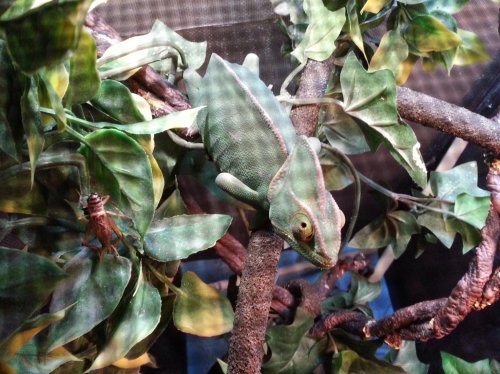
PS don't worry about the larger sized crickets. A lot of people are afraid of choking but aside from never, ever hearing of a cham die from choking, chams will eat one large bug and let it sit in their mouth for 10-20 minutes while the saliva digests the insect, making it easier to swallow and digest. The problem I see is putting too many insects in your cage at once. If a cham zaps one large cricket and sees another one it can go after, instead of letting it 'stew' in the mouth and break down with the enzymes in the saliva, it will POWERCRUNCH it, swallow it too fast, and move on to the next one. As long as you are aware of that, you can maybe feed 4 crickets on two or three separate occasions per day instead of throwing them all in at once.

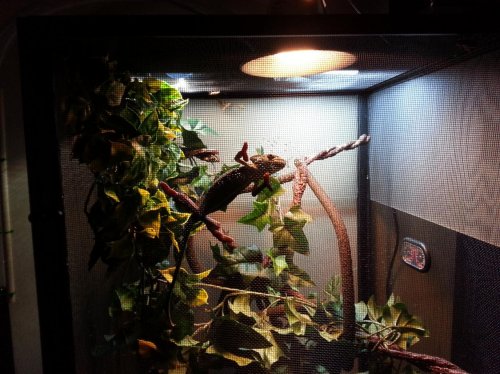
 I have her in a screened cage 18x18x36 her health seems to be good, her stool is the right colors...Now i have some questions ATM i have been dusting her crickets with zoo meds reptivite with D3 so what other vitamins do you all recommend...