
Navigation
Install the app
How to install the app on iOS
Follow along with the video below to see how to install our site as a web app on your home screen.
Note: This feature may not be available in some browsers.
More options
You are using an out of date browser. It may not display this or other websites correctly.
You should upgrade or use an alternative browser.
You should upgrade or use an alternative browser.
Pretty quadricornis boy
- Thread starter Dooley1
- Start date


DGray
Avid Member
Hey Perry,
Do you know what percent of the imported Quads were nominate vs gracilior
back when they were coming in regularly? I included another pic that looks
more like Kevin's but still has a lot of yellow (sorry about the focus).
I am pretty sure the vast majority were q. quadricornis; the locales for gracilior are more remote.

pamnsam94
Established Member


I am pretty sure the vast majority were q. quadricornis; the locales for gracilior are more remote.
I remember Nick of First Choice Reptiles regularly had both for a time but that was some time ago. If I remember correctly, there were a few times where he ran out of the standard quads (the type I was looking for because of their higher dorsal crests compared to gracilior) but he still had the gracilior. I don't know though what numbers were exported or the percentages of each compared to one another. However, over the total number of years they were exported, I definitely think it is safe to say that a greater number of the standard quads came in.
pamnsam94
Established Member
Sorry, had to adjust the size of the photo
That's a nice T. q. quadricornis. I'll try to post some pics of gracilior later today.


Dooley1
Avid Member
Kevin,
Would you mind trying to get a total length on him? I'd like to compare him to his brother. Thanks
Perry-he's roughly 5" STV and 12" TL.


bobcochran
Chameleon Enthusiast

So, I'm still wondering how to differentiate between the two subspecies.
Size, color, number of horns, size of dorsal crest???
Size, color, number of horns, size of dorsal crest???
bobcochran
Chameleon Enthusiast
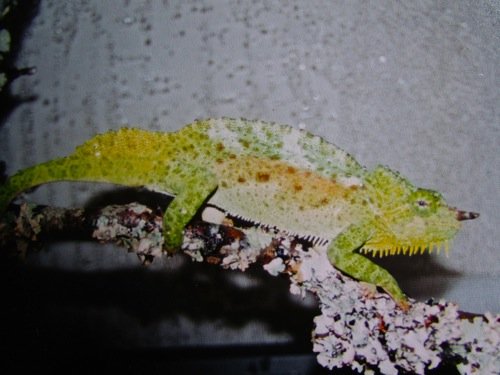
DGray
Avid Member
So, I'm still wondering how to differentiate between the two subspecies.
Size, color, number of horns, size of dorsal crest???
It's not obvious; lung shape is one of the primary differences, with hemipenal morphology, and the shape and extent of sail fins. Horn number is not diagnostic. The original gracilior article is in German - I will look in Tillbury when I get home for his take on it.
bobcochran
Chameleon Enthusiast
Some articles in foreign languages can be translated on the computer. I don't remember how but I bet my kid could help me do it. I appreciate your efforts
to help me with this. At the time I had these animals I wasn't aware there were different subspecies. Such were the times
to help me with this. At the time I had these animals I wasn't aware there were different subspecies. Such were the times


pamnsam94
Established Member
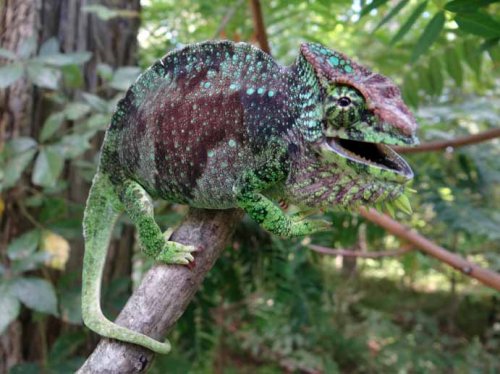
Here are some pics of T. q. gracilior:
https://www.chameleonforums.com/lauries-t-q-gracilior-90320/.
I think some gracilior are easy to distinguish from the nominate subspecies (possibly those individuals at the far ends of each side of the species spectrum if you will). For example, all female quads with red nails that I've seen have been gracilior and all male quads with yellow heads have also been gracilior. However, not all gracilior females have red nails and not all gracilior males have yellow heads. In general, males of the nominate subspecies are capable of having higher dorsal crests/fins, while males of gracilior sometimes have longer horns. Gracilior are more known to sometimes have more than 4 horns (6 to 8) but many of us know of individuals of the nomimate subspecies that had more than 4 horns. Also, I notice that gracilior males do not tend to have as much blue/turquoise coloration as the standard quad males can have. Most, if not of the gracilior females that I recall seeing have blue scales on the neck arranged in kind of a "striped" pattern. Here's another photo of a female gracilior. I tried to repost some of the photos in the above link, but apparently, you're not able to do that.
https://www.chameleonforums.com/lauries-t-q-gracilior-90320/.
I think some gracilior are easy to distinguish from the nominate subspecies (possibly those individuals at the far ends of each side of the species spectrum if you will). For example, all female quads with red nails that I've seen have been gracilior and all male quads with yellow heads have also been gracilior. However, not all gracilior females have red nails and not all gracilior males have yellow heads. In general, males of the nominate subspecies are capable of having higher dorsal crests/fins, while males of gracilior sometimes have longer horns. Gracilior are more known to sometimes have more than 4 horns (6 to 8) but many of us know of individuals of the nomimate subspecies that had more than 4 horns. Also, I notice that gracilior males do not tend to have as much blue/turquoise coloration as the standard quad males can have. Most, if not of the gracilior females that I recall seeing have blue scales on the neck arranged in kind of a "striped" pattern. Here's another photo of a female gracilior. I tried to repost some of the photos in the above link, but apparently, you're not able to do that.
Attachments

Chris Anderson
Dr. House of Chameleons


I posted photos from my trip to Cameroon that includes photographs of both Trioceros quadricornis quadricornis and Trioceros quadricornis gracilior (will include the links below). By far the easiest way to differentiate these subspecies is their locality, but since that is rarely, if ever, available in captive specimens, you have to go by other characteristics. In preserved specimens, you can look at internal morphology, which exhibit relatively distinct characters that differentiate the subspecies. With live specimens, however, the external morphology is not simple discrete characters but rather relative differences. As has already been indicated, T. q. quadricornis tends to have a taller sailfin and the horns in T. q. gracilior tend to be relatively longer and thinner, often with this species exhibiting more. There are some color and pattern differences, but not enough is known about the variation between localities of each subspecies to nail down exactly what color and pattern differences are reliable. Trioceros q. gracilior do tend to have red nails, however.
Regarding the pair of horns coming in above the typical row of horns, this is not completely unheard of, although not the norm. If you look at the photos in the threads before with adult T. q. quadricornis and T. q. gracilior photos in it, you can see that the 3rd pair of horns typically come in lateral and along the same row as the other horns. There is an example of this superior horn pair in T. q. gracilior, however, in Necas' book (2nd Edition) on page 201.
Photos of juvenile Trioceros quadricornis quadricornis in this thread: https://www.chameleonforums.com/exo-terra-cameroon-expedition-2-nyassosso-mount-kupe-56261/
Photos of an adult Trioceros quadricornis quadricornis in this thread: https://www.chameleonforums.com/exo-terra-cameroon-expedition-5-mount-manengouba-pt-2-a-58897/
Photos of Trioceros quadricornis gracilior in this thread: https://www.chameleonforums.com/exo-terra-cameroon-expedition-4-mount-oku-57382/
Chris
Regarding the pair of horns coming in above the typical row of horns, this is not completely unheard of, although not the norm. If you look at the photos in the threads before with adult T. q. quadricornis and T. q. gracilior photos in it, you can see that the 3rd pair of horns typically come in lateral and along the same row as the other horns. There is an example of this superior horn pair in T. q. gracilior, however, in Necas' book (2nd Edition) on page 201.
Photos of juvenile Trioceros quadricornis quadricornis in this thread: https://www.chameleonforums.com/exo-terra-cameroon-expedition-2-nyassosso-mount-kupe-56261/
Photos of an adult Trioceros quadricornis quadricornis in this thread: https://www.chameleonforums.com/exo-terra-cameroon-expedition-5-mount-manengouba-pt-2-a-58897/
Photos of Trioceros quadricornis gracilior in this thread: https://www.chameleonforums.com/exo-terra-cameroon-expedition-4-mount-oku-57382/
Chris
pamnsam94
Established Member
I haven't seen a very large sample, but I mentioned that I have seen a difference in the distribution of blue scales (particularly that most females of gracilior have blue in the neck region and that, in general, I've seen more overall blue coloration in the T. q. quadricornis males than in T. q. gracilior males).
Chris' photo shows a really nice gracilior male that has the same blue scales and pattern on the neck region, as does my photo of a female gracilior so that may be common with both sexes. I've never read about that characteristic as a general way to help distinguish the gracilior subspecies (and again, I haven't seen a large enough sample so I'm not drawing any conclusions) but it does make me wonder.
When I said that the nominate subspecies males seem to have more blue coloration overall, what I primarily meant was that many times, I see quite a lot of blue around the dorsal region, something I don't see as much with gracilior males (blues seem to be more on their heads and necks than on their bodies).
With gracilior, at least of those I've seen, it seems the blue scales are more concentrated around the neck. I'd like to know if my observations of blue distribution generally hold true in a larger sample of each subspecies.
One last comment is that you might have read that in addition to red nails, the tops of the gracilior females' heads are red. That's not always the case though as Chris' photo of a gracilior female shows. I don't know how common (what percentage) red nails and red heads are with gracilior females, but as with many of these characteristics, there are exceptions. Also, you may have heard that gracilior males have yellow heads, but both Chis's photos and mine of gracilior males show that some don't. We are talking about variation within a species, so I wouldn't be surprised to even see a quad that had a 50:50 mixture of traits typically thought of belonging to one subspecies or another.
Chris' photo shows a really nice gracilior male that has the same blue scales and pattern on the neck region, as does my photo of a female gracilior so that may be common with both sexes. I've never read about that characteristic as a general way to help distinguish the gracilior subspecies (and again, I haven't seen a large enough sample so I'm not drawing any conclusions) but it does make me wonder.
When I said that the nominate subspecies males seem to have more blue coloration overall, what I primarily meant was that many times, I see quite a lot of blue around the dorsal region, something I don't see as much with gracilior males (blues seem to be more on their heads and necks than on their bodies).
With gracilior, at least of those I've seen, it seems the blue scales are more concentrated around the neck. I'd like to know if my observations of blue distribution generally hold true in a larger sample of each subspecies.
One last comment is that you might have read that in addition to red nails, the tops of the gracilior females' heads are red. That's not always the case though as Chris' photo of a gracilior female shows. I don't know how common (what percentage) red nails and red heads are with gracilior females, but as with many of these characteristics, there are exceptions. Also, you may have heard that gracilior males have yellow heads, but both Chis's photos and mine of gracilior males show that some don't. We are talking about variation within a species, so I wouldn't be surprised to even see a quad that had a 50:50 mixture of traits typically thought of belonging to one subspecies or another.
Similar threads


- Replies
- 8
- Views
- 1K


