

comocham
Member
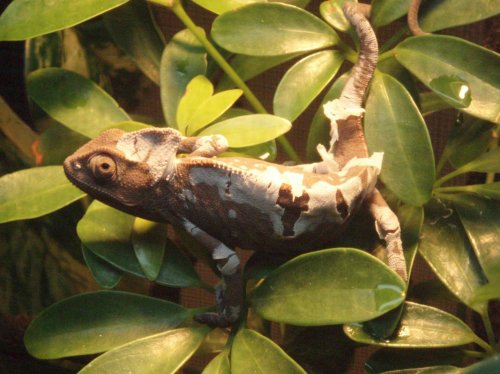
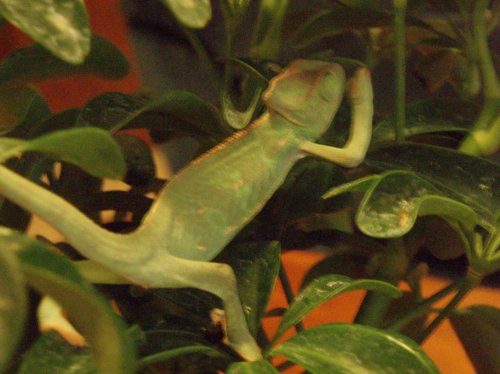
The problem is his casque is beginning to deform a little, and he never shows green coloration unless he is asleep or out of his enclosure.
here ya go.
Cage Info:
• Cage Type – 20” x 18” x 24” black screen enclosure with a plastic bottom with holes drilled in it.
• Lighting – I use a zoo med 50w basking lamp and a reptisun 5.0 uvb bulb
• Temperature – Basking spot 84- 91 degrees; ambient temp 75-80 degrees I have a flukers digital temp/hum. Gauge and a acurite digital gauge.
• Humidity – Low- 40% High- 80% he has a live plant and is misted multiple times a day to keep the humidity up. I have a flukers digital temp/hum. Gauge.
• Plants – He has a live schefflera and a couple fake pothos looking things and some biovines.
• Location – The cage is located in the corner of my bedroom by the closet door. There isn’t much traffic in this area and if there is I open the door in front of the cage so he can’t see it. The bottom of the cage is 3 ½ feet off the ground.
Chameleon Info:
• Your Chameleon – 3 month old male veiled, 1 month in my care, about 8 inches in length nose to tail, weight -20 g
• Handling – when cleaning his cage, I try not to handle him as much as possible
• Feeding – He eats 10-15 ½ inch crickets a day, he is fed around 8 in the morning I use ssimsswiss’s gutload and flukers calcium enriched gel.
• Supplements – I lightly dust 2 crickets a day with repcal calcium 0% d3, then 1 time a month with repcal herptivite and t-rex 2:0 calcium with d3
• Watering – I hand mist him with micro-waved jugged spring water 3 times a day for around 4 minutes at a time I usually see him drink around 2 times a day
• Fecal Description – it is blackish brown that looks well digested (no cricket parts) the urate is usually white to creamy or yellow. He hasn’t been tested for parasites.
• History – He was shipped from florida at 2 months old and he was in perfect condition when recieved
• Current Problem – his casque is beginning to deform it looks like, he only shows green when asleep or outside of his enclosure and he has had a bad attitude lately
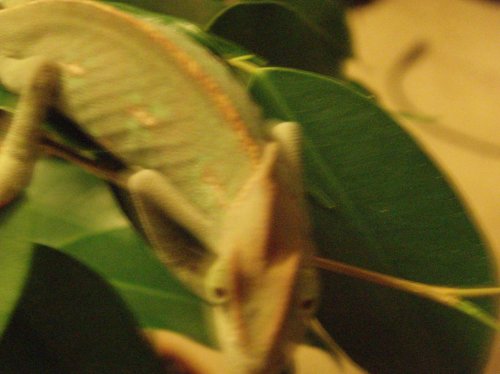
Here are a few pics as well. The one of him shedding pretty much represents his color all the time and the other one is a bit blurry... he does'nt like the camera.
here ya go.
Cage Info:
• Cage Type – 20” x 18” x 24” black screen enclosure with a plastic bottom with holes drilled in it.
• Lighting – I use a zoo med 50w basking lamp and a reptisun 5.0 uvb bulb
• Temperature – Basking spot 84- 91 degrees; ambient temp 75-80 degrees I have a flukers digital temp/hum. Gauge and a acurite digital gauge.
• Humidity – Low- 40% High- 80% he has a live plant and is misted multiple times a day to keep the humidity up. I have a flukers digital temp/hum. Gauge.
• Plants – He has a live schefflera and a couple fake pothos looking things and some biovines.
• Location – The cage is located in the corner of my bedroom by the closet door. There isn’t much traffic in this area and if there is I open the door in front of the cage so he can’t see it. The bottom of the cage is 3 ½ feet off the ground.
Chameleon Info:
• Your Chameleon – 3 month old male veiled, 1 month in my care, about 8 inches in length nose to tail, weight -20 g
• Handling – when cleaning his cage, I try not to handle him as much as possible
• Feeding – He eats 10-15 ½ inch crickets a day, he is fed around 8 in the morning I use ssimsswiss’s gutload and flukers calcium enriched gel.
• Supplements – I lightly dust 2 crickets a day with repcal calcium 0% d3, then 1 time a month with repcal herptivite and t-rex 2:0 calcium with d3
• Watering – I hand mist him with micro-waved jugged spring water 3 times a day for around 4 minutes at a time I usually see him drink around 2 times a day
• Fecal Description – it is blackish brown that looks well digested (no cricket parts) the urate is usually white to creamy or yellow. He hasn’t been tested for parasites.
• History – He was shipped from florida at 2 months old and he was in perfect condition when recieved
• Current Problem – his casque is beginning to deform it looks like, he only shows green when asleep or outside of his enclosure and he has had a bad attitude lately
Here are a few pics as well. The one of him shedding pretty much represents his color all the time and the other one is a bit blurry... he does'nt like the camera.


 I have not raised temps up yet on the remaining ones, and if he is eating well and poopng it sounds like you are doing everything right!


