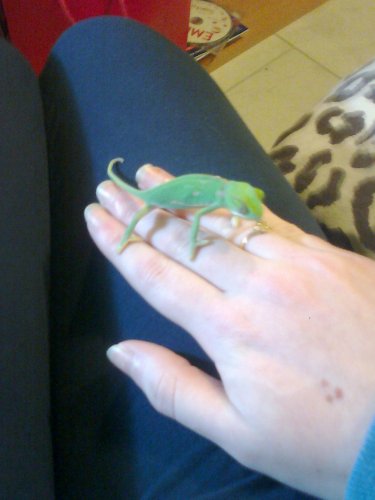
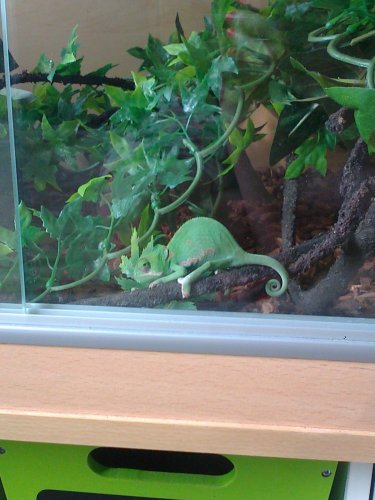
Well..the MBD is definitely showing in that photo.

When a chameleon had MBD you first need to bring his calcium back into balance and in the meantime you need to correct your husbandry to keep it there so things won't get worse.
To correct it the quickest, the chameleon should be given shots of calcium until its blood calcium levels are high enough that it can be given a shot of calcitonin to draw the calcium rapidly back into the bones.
The second best way IMHO is to give it some extra calcium for a while in the form of liquid calcium sandoz or liquid calcium gluconate...but without testing it you will have no idea what is enough.
Here's some information I hope will help you with things like supplements, gutloading, etc....so that you can keep things in balance...
Appropriate cage temperatures aid in digestion and thus play a part indirectly in nutrient absorption.
Exposure to UVB from either direct sunlight or a proper UVB light allows the chameleon to produce D3 so that it can use the calcium in its system to make/keep the bones strong and be used in other systems in the chameleon as well. The UVB should not pass through glass or plastic no matter whether its from the sun or the UVB light. The most often recommended UVB light is the long linear fluorescent Repti-sun 5.0 tube light. Some of the compacts, spirals and tube lights have caused health issues, but so far there have been no bad reports against this one.
A wide variety of insects that have been well fed and gutloaded should be fed to it. At that size you only need to feed it every two or three days. Feed it enough that it doesn't get fat (and, of course, doesn't get thin either).
Since many of the feeder insects we use in captivity have a poor ratio of calcium to phosphorus in them, its important to dust the insects just before you feed them to the chameleon at most feedings with a phos.-free calcium powder to help make up for it. (I use Rep-cal phosphorus-free calcium).
If you also dust twice a month with a phos.-free calcium/D3 powder it will ensure that your chameleon gets some D3 without overdoing it. It leaves the chameleon to produce the rest of what it needs through its exposure to the UVB light. D3 from supplements can build up in the system but D3 produced from exposure to UVB shouldn't as long as the chameleon can move in and out of it. (I use Rep-cal phos.-free calcium/D3).
Dusting twice a month as well with a vitamin powder that contains a beta carotene (prOformed) source of vitamin A will ensure that the chameleon gets some vitamins without the danger of overdosing the vitamin A. PrEformed sources of vitamin A can build up in the system and may prevent the D3 from doing its job and push the chameleon towards MBD. However, there is controversy as to whether all/any chameleons can convert the beta carotene and so some people give some prEformed vitamin A once in a while. (I use herptivite which has beta carotene.)
Gutloading/feeding the insects well helps to provide what the chameleon needs. I gutload crickets, roaches, locusts, superworms, etc. with an assortment of greens (dandelions, kale, collards, endive, escarole, mustard greens, etc.) and veggies (carrots, squash, sweet potato, sweet red pepper, zucchini, etc.)
Calcium, phos., D3 and vitamin A are important players in bone health and other systems in the chameleon (muscles, etc.) and they need to be in balance. When trying to balance them, you need to look at the supplements, what you feed the insects and what you feed the chameleon.
Here are some good sites for you to read too...
http://chameleonnews.com/07FebWheelock.html
http://web.archive.org/web/200605020...Vitamin.A.html
http://web.archive.org/web/200406080...d.Calcium.html
http://www.uvguide.co.uk/
http://web.archive.org/web/200601140...ww.adcham.com/
If you can't access the sites above that have the word "archive" in you can do it through the WayBackMachine.


 with everybodies beautiful chameleons.