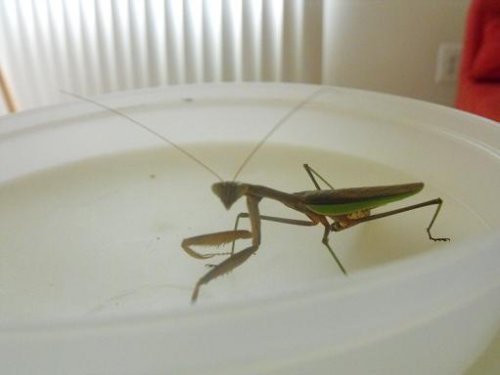
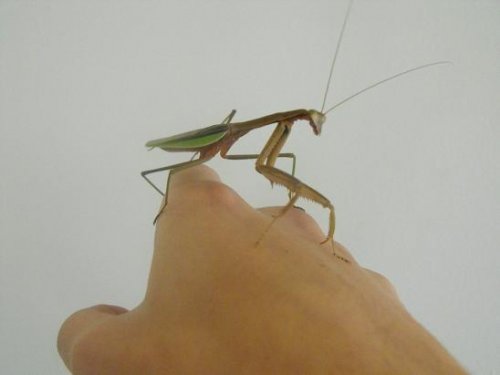
Looks like an adult chinese mantis. Probably doesnt have much longer to live, given that it is an adult and the time of year. Sex determination is the usual, 8 abdominal segments for a male, and 6 or 7 for a female.
They will live happily at room temperature (20-25c), though they can easily tolerate warmer temperatures (30c). Some humidity (40-70%) is important, especially when shedding. It is recommended that you lightly mist (hand sprayer, room temp water) once a day, or at the very least gently upon signs of shedding. Never use any spray bottle that has contained anything other than water.
No special lighting is required.
House in something that is about 3x the mantids length and 2x for width. A ten gallon fish tank (on its side) with screen lid will likely do nicely. Add a few sticks within the enclosure for perching and to hang from for molting and hunting insects.
Usually removing the lid is enough encouragement for a mantid to explore. They can climb quite quickly, will jump, and when full grown will fly (poorly). At first, some mantids try to bluff you by flaring their wings at you, or snap out with their forelegs. They consider you a predator or your fingernails as prey. Relax. Very few humans are eaten alive by mantids. You can handle your preying mantis once he or she gets used to you. You might start by allowing it to walk onto your hand or a stick to transport it to where you want it to be. Move slowly.
Once perched somewhere, a mantis will often stay there - on a houseplant or piece of furniture - for hours at a time, cleaning themselves ( they are fastidiously clean predators ), waiting for a meal to happen by.
The Chinese Mantis is a ferocious eater, not at all picky. Do not keep more than one adult Chinese Praying Mantis in the same enclosure, as these insects are solitary and may eat each other. Standard live food such as crickets, locusts, grasshoppers, roaches, wax worms, cabbage loppers, mealworms, moths, flies, silkworms, butterworms... It’s recommended that the size of the feeder insect does not exceed 1/3 the mantis’ length. Even though they are voracious and will attack most anything that moves, its best not to offer them poisonous insects, wasps, bees or spiders, as these could potentially harm the mantis. One insect a day is all they require for nourishment, and its no problem to give it two one day and then skip a couple days. You can either drop the food inside the tank and if the mantis is hungry, it’ll go after the prey…or you can feed them by hand: use fingers or a pair of tweezers to hold the cricket and wave it in front of the mantis, if it’s hungry, it will turn its head to stare directly at the insect and will snatch it from the tweezers. They get most of their hydration needs from their prey, but Mantids also drink by lapping up misted water dropplets from leaves, sticks, sides of the enclosure, etc.