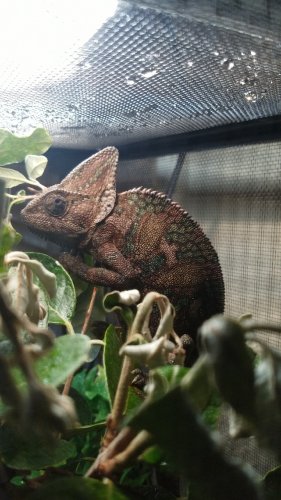
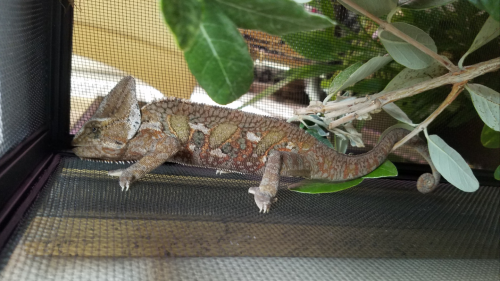
You need to provide appropriate temperatures so he can digest his food properly. For a male veiled the basking temperature should be in the mid to high 80's F.good digestion plays a part in nutrient absorption indirectly. The basking light can be a regular household incandescent light in a hood of a wattage that produces the right temperature.
You need to feed/gutload the crickets, superworms, roaches, etc with greens such as dandelion greens, kale, endive, escarole, collards, etc and veggies such as carrots, squash, zucchini, sweet potato, sweet red pepper, etc and a small amount of fruit such as berries, melon, apples, pears, etc.
Since many of the insects have a poor ratio of calcium to phosphorous it's recommended that you dust the insects just before feeding them to the chameleon with a phosphorous-free calcium powder to help make up for it.
It's recommended that you dust lightly twice a month with a phosphorous-free calcium/D3 powder to ensure the chameleon gets some D3 without overdosing it and leaving it to produce the rest of it from its exposure to the UVB light. D3 from supplements can build up in the system and lead to health issues but D3 produced from exposure to the UVB light won't as long as the chameleon can move in and out of the UVB at will.
It's also important to dust twice a month with a vitamin powder that contains a beta carotene prOformed source of vitamin A. PrOformed sources wont build up in the system like prEformed sources can so this makes it safe to use. This puts you in charge of deciding if/when the chameleon needs the prEformed vitamin A.
Of course you have to provide a suitable big enough habitat...which you already seem to have... and water through misting and a dripper.
Don't place the cage near a draft (vent, window, etc).
I've likely missed a few things...but there are care sheets on the forum you can read too. Hope this helps.