New Cham Owner

Nijnik

New Member
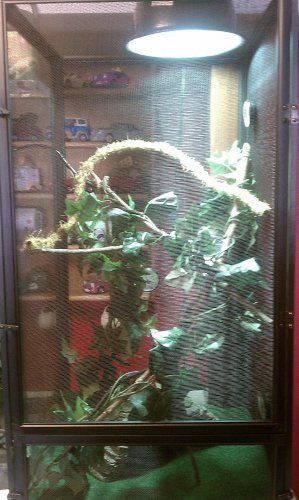
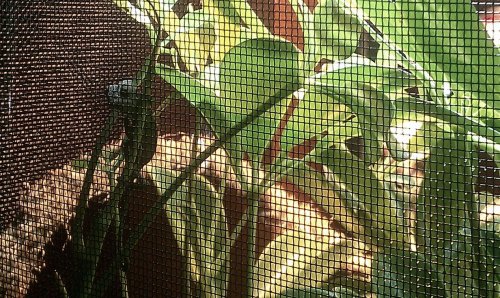
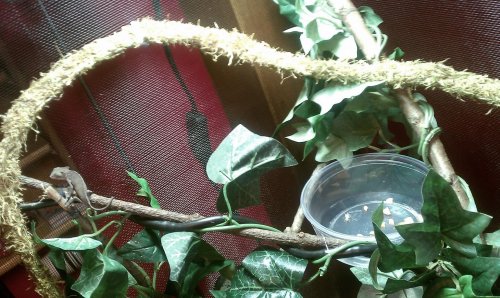
First post. Hi everyone, we have had our baby veiled for about a week now and I was just looking for some input on his setup. He came to us from Florida. Pictures included.

-Male Veiled ~ 1 month old? Little unsure of the age
-Handled about every other two days so far. Took him outside for natural sunlight once.
-Small gut loaded cricket diet. He has only been eating a small amount every other day. I would say hes eaten about 20-30 crickets so far. Lightly coated in Flukers Calcium, we have a Reptivite (multivitamin) w/ D3 that we will be giving him once a week.
-Drip system in the cage and misting at least 2-3 times daily.
-Fecal droppings were found on a leaf but had been coated in water from drip system, haven't seen any since.

-16x16x30 inch screen mesh cage.
-One zoo med power sun 160w bulb. Suppose to provide UVA/UVB and heat. Closest branch is about 10-12 inches from the bulb.
-Temp ranges from about 95 at the top to about 75 at the bottom.
-Humidity ranges from about 50 to 75
-We had a live hibiscus plant in the cage but it started to turn yellow so we've removed it for now. Looking for another suitable plant. Some plastic leaves around branches.
-Located on a high counter, top of the cage is slightly above my eye level.
-Pacific Northwest
 

Attachments

  • IMAG0111.jpg
    IMAG0111.jpg
    280.8 KB · Views: 118
  • IMAG0110.jpg
    IMAG0110.jpg
    274.3 KB · Views: 152
  • IMAG0109.jpg
    IMAG0109.jpg
    256.1 KB · Views: 154
The calcium does not have D3. It is the vitamin that contains D3. I was under the impression that the calcium supplement could/should be given at least every other feeding, especially since he is so young. The vitamin w/D3 should be given once a week or every two weeks. Could anyone else confirm?
I was definitely looking at the Pothos plant. Although I think I may have found the reason for my hibiscus turning yellow, I found its roots starting to poke out the bottom of its container, so a transplant is happening soon. Maybe that will help it.
 
First post. Hi everyone, we have had our baby veiled for about a week now and I was just looking for some input on his setup. He came to us from Florida. Pictures included.

-Male Veiled ~ 1 month old? Little unsure of the age
-Handled about every other two days so far. Took him outside for natural sunlight once. Don't handle him at this young age unless absolutely necessary, let him settle in.
-Small gut loaded cricket diet. He has only been eating a small amount every other day. I would say hes eaten about 20-30 crickets so far. Lightly coated in Flukers Calcium, we have a Reptivite (multivitamin) w/ D3 that we will be giving him once a week. Typically most feed 15-20 crickets daily, you need to use calcium with no D3 or phosphorous daily, Calcium with D3 twice a month, and a multivitamin 1-2 times a month depending on brand
-Drip system in the cage and misting at least 2-3 times daily.
-Fecal droppings were found on a leaf but had been coated in water from drip system, haven't seen any since. What were the colors?

-16x16x30 inch screen mesh cage.
-One zoo med power sun 160w bulb. Suppose to provide UVA/UVB and heat. Closest branch is about 10-12 inches from the bulb. Most likely that powersun is too strong for your cham. Most use a repti glo or repti sun tube 5.0 and 20-40 watt regular housebulb
-Temp ranges from about 95 at the top to about 75 at the bottom. Your temps are WAY too hot, unless you intend to cook your cham you'll want to get these down ASAP. At this age you should supply a basking temp at about 82, 85 at the highest and ambient temps in the 70s
-Humidity ranges from about 50 to 75
-We had a live hibiscus plant in the cage but it started to turn yellow so we've removed it for now. Looking for another suitable plant. Some plastic leaves around branches.
-Located on a high counter, top of the cage is slightly above my eye level. Make sure to add more greenery. Get a thick Schleffera, great for babies. Your cham has no where to really hide. You can also use quite a few others, ficus and pothos are also popular. You can buy them in Home Depot for $10.
-Pacific Northwest


Look at the highlighted above.

Take a look at this blog and it will give you better information.
https://www.chameleonforums.com/blo...-keepers-young-veiled-panther-chameleons.html

Welcome to the forums, it's a great place to learn about chams and become an addict!
 
Thank you for the link and advice mbondy. I'll make sure to change his lighting conditions today :( It would suck to see that powersun go to waste. Would it be safer to use when he is older? Fecal colors were a brown. Is it ok that we leave food in a bowl for him to find and can he eat small superworms at this young age? Be back later with an update on cage and maybe more pictures. :)
 
Thank you for the link and advice mbondy. I'll make sure to change his lighting conditions today :( It would suck to see that powersun go to waste. Would it be safer to use when he is older? Fecal colors were a brown. Is it ok that we leave food in a bowl for him to find and can he eat small superworms at this young age? Be back later with an update on cage and maybe more pictures. :)
Not a problem, we're here to help. Have you noticed him closing his eyes during the day or anything like that? Your temps are definitely too hot so get that going. I can ask around about the powersun, I know some people use them more so for adults and free ranges but they are lifted several inches off the cage. I wil look into that.

Was there any white on his dropping? The white is urate and means your cham is well hydrated, a tint of orange is ok but if you see more orange you know you've to up your mistings.

Cup feeding is your best bet, some chams cup feed and others do not. You can do both, sounds like your cham eats well anyways! You can feed supers but make sure they are.tiny, no bigger then the space between their eyes in width.

Ask away with any other questions, he's cute!
 
Update

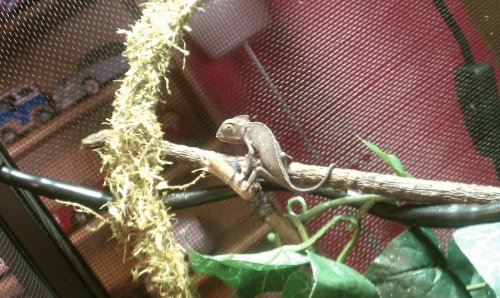
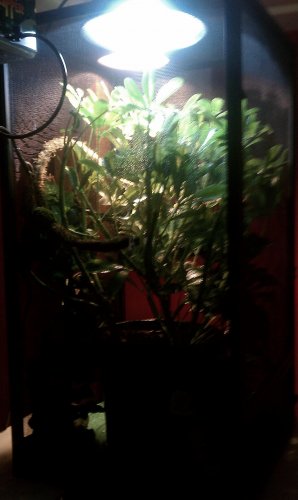
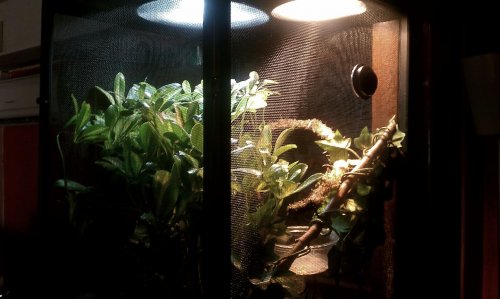
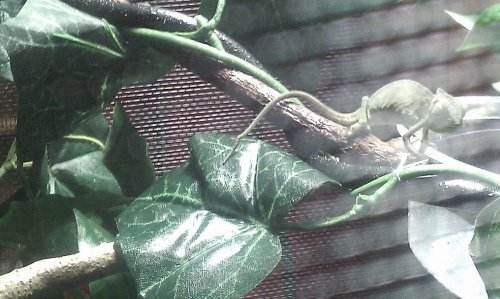
Went out and bought a compact reptisun 5.0 UVB bulb, I was going to get a tube version but the compact was able to fit in the deep dome I had already bought and the UVB bulb came with a 100w basking bulb. Temps seem to have topped out at 90 (that still seems high :()now up near the the basking bulb. Also went out and bought a thick Schleffera (which almost takes up the entire cage now). He has already taken well to the new plant. Is it a problem if a lot of the UVB seems to just be hitting the top of the plant instead of penetrating the whole cage? New pictures attached. Also, we noticed a small kink in his tail when we first got him. I took a picture of that as well. He has full use of his tail and still wraps it around branches, and curls it all the way up at night when sleeping.
 

Attachments

  • IMAG0112.jpg
    IMAG0112.jpg
    267.7 KB · Views: 179
  • IMAG0113.jpg
    IMAG0113.jpg
    247.3 KB · Views: 94
  • IMAG0114.jpg
    IMAG0114.jpg
    258.6 KB · Views: 92
  • IMAG0115.jpg
    IMAG0115.jpg
    314.9 KB · Views: 104
Went out and bought a compact reptisun 5.0 UVB bulb, I was going to get a tube version but the compact was able to fit in the deep dome I had already bought and the UVB bulb came with a 100w basking bulb. Temps seem to have topped out at 90 (that still seems high :()now up near the the basking bulb. Also went out and bought a thick Schleffera (which almost takes up the entire cage now). He has already taken well to the new plant. Is it a problem if a lot of the UVB seems to just be hitting the top of the plant instead of penetrating the whole cage? New pictures attached. Also, we noticed a small kink in his tail when we first got him. I took a picture of that as well. He has full use of his tail and still wraps it around branches, and curls it all the way up at night when sleeping.

Your temps are still very high. Most people like to keep their veiled temps around 80-85 at the hottest point. I would suggest using a regular house bulb, 50-60 watts. this will lower your temps to a suitable range.
As for the plant,,, yay! and yes its fine that the uvb is only hitting the top of ht eplant. if the rays will hit his basking spot, then when he goes to bask, he will get the rays. however, you can take your cham outside. natural sunlights does so much more for them than the fake uvb rays.
As for the tail, My veiled got the same kink in his tail... (thus his name is now Kink) After about 3 sheds, it went away. Just keep an eye on it, it can potentially fall off if the tail tip dies after the kink in it. But dont fret. My guys kink went away, nothing fell off. however, a bruise did form, so if you see the tail tip turn blackish, thats probably what it is. if this bruise forms, put him in the shower for 15-20 minutes a day.
Do youj know how to shower a cham?
if not, heres how
get a plant and place itin the shower.
turn on the shower and make the water warm, not hot. aim the shower head towards the wall so that the water bounces off the wall. put the plant and the chammy in the mist that comes off the wall. not directly in the showers spray.
 
We will definitely be taking him outside on warm sunny days in the future. We are trying to limit his handling for now, so tempting to hold him. I swapped out the 100w basking bulb with a 60w CFL. Temps have already fallen to about 80 from about 5 or 6 inches from the top of the screen. I will make sure to keep an eye out on the kink. Thanks for the shower suggestion/advice. :)
 
We will definitely be taking him outside on warm sunny days in the future. We are trying to limit his handling for now, so tempting to hold him. I swapped out the 100w basking bulb with a 60w CFL. Temps have already fallen to about 80 from about 5 or 6 inches from the top of the screen. I will make sure to keep an eye out on the kink. Thanks for the shower suggestion/advice. :)
You can take him outside in his cage. this avoids the handling, and it is safer this way. unless you are going to sit there and watch him like a hawk while he is outside free ranging, then a hawk can come and eat him. :eek:

Now, im glad your temps have lowered, youll find he will be happier this way.
it is very tempting to hold them, almost unmanagable!
Good luck and keep everyone posted!
 
Went out and bought a compact reptisun 5.0 UVB bulb, I was going to get a tube version but the compact was able to fit in the deep dome I had already bought and the UVB bulb came with a 100w basking bulb. Temps seem to have topped out at 90 (that still seems high :()now up near the the basking bulb. Also went out and bought a thick Schleffera (which almost takes up the entire cage now). He has already taken well to the new plant. Is it a problem if a lot of the UVB seems to just be hitting the top of the plant instead of penetrating the whole cage? New pictures attached. Also, we noticed a small kink in his tail when we first got him. I took a picture of that as well. He has full use of his tail and still wraps it around branches, and curls it all the way up at night when sleeping.

Aw man... You got the compact?:(
Take that back ASAP. Those are not very good. They cause eye problems. And I believe that they have to be straight across, not in a dome fixture.
 
Reptisun 5.0 Compact

After doing a little research on different forums, people have said that the majority of eye problems came from 10.0 bulb. Although some had been documented on the 5.0. I also read that a lot of the irritations were from older bulbs (as in a couple years ago) and it's possible that these problems have been worked out since then. Getting my information from: http://www.uvguide.co.uk/phototherapyphosphor-summary.htm.
Fast forward to my setup, right now the 5.0 compact is tucked inside a zoomed deep dome fixture sitting on top of the screen mesh cage. The closest leaf is approximately 7 or so inches away. Can anyone else confirm my analysis of the compacts? The report linked above was last updated around sept. of 2009 I think.
 
Here's some information I hope will help you with things like supplements, gutloading, etc....
Appropriate cage temperatures aid in digestion and thus play a part indirectly in nutrient absorption.

Exposure to UVB from either direct sunlight or a proper UVB light allows the chameleon to produce D3 so that it can use the calcium in its system to make/keep the bones strong and be used in other systems in the chameleon as well. The UVB should not pass through glass or plastic no matter whether its from the sun or the UVB light. The most often recommended UVB light is the long linear fluorescent Repti-sun 5.0 tube light. Some of the compacts, spirals and tube lights have caused health issues, but so far there have been no bad reports against this one.

A wide variety of insects that have been well fed and gutloaded should be fed to it.

Since many of the feeder insects we use in captivity have a poor ratio of calcium to phosphorus in them, its important to dust the insects just before you feed them to the chameleon at most feedings with a phos.-free calcium powder to help make up for it. (I use Rep-cal phosphorus-free calcium).

If you also dust twice a month with a phos.-free calcium/D3 powder it will ensure that your chameleon gets some D3 without overdoing it. It leaves the chameleon to produce the rest of what it needs through its exposure to the UVB light. D3 from supplements can build up in the system but D3 produced from exposure to UVB shouldn't as long as the chameleon can move in and out of it. (I use Rep-cal phos.-free calcium/D3).

Dusting twice a month as well with a vitamin powder that contains a beta carotene (prOformed) source of vitamin A will ensure that the chameleon gets some vitamins without the danger of overdosing the vitamin A. PrEformed sources of vitamin A can build up in the system and may prevent the D3 from doing its job and push the chameleon towards MBD. However, there is controversy as to whether all/any chameleons can convert the beta carotene and so some people give some prEformed vitamin A once in a while. (I use herptivite which has beta carotene.)

Gutloading/feeding the insects well helps to provide what the chameleon needs. I gutload crickets, roaches, locusts, superworms, etc. with an assortment of greens (dandelions, kale, collards, endive, escarole, mustard greens, etc.) and veggies (carrots, squash, sweet potato, sweet red pepper, zucchini, etc.)

Calcium, phos., D3 and vitamin A are important players in bone health and other systems in the chameleon (muscles, etc.) and they need to be in balance. When trying to balance them, you need to look at the supplements, what you feed the insects and what you feed the chameleon.

Here are some good sites for you to read too...
http://chameleonnews.com/07FebWheelock.html
http://web.archive.org/web/200605020...Vitamin.A.html
http://web.archive.org/web/200406080...d.Calcium.html
http://www.uvguide.co.uk/
http://web.archive.org/web/200601140...ww.adcham.com/
If you can't access the sites above that have the word "archive" in you can do it through the WayBackMachine.
 
Back
Top Bottom