Need entomologist advice

Brodybreaux25

Chameleon Enthusiast
Im struggling to find a entomoligist in the Louisiana area that can answer a few questions on parasites infecting wild caught southeast Louisiana locust/grasshoppers.

I'm not getting anywhere doing research online because every result returned to me is either for locusts or parasites, not parasites affecting Louisiana locusts.

I have contacted my local division of the Audubon Society but haven't received a response.

Some questions I have-
What parasites infect wild locusts in southeast Louisiana?

Which of them are transmitable to Veiled Chameleons?

How common is it?

Any way to tell, like warning signs, if a locust is infected with a parasite?

If I would breed a batch of locusts for feeding my chams would the babies also be infected if I moved the eggs straight into a new enclosure once laid?

Any suggestions would be greatly appreciated!
 
None of the babies would be infected first of all, and to breed locusts you would likely have to move the eggs anyway because all of them need an incubation like environment if not also a cooling period.

As far as ones that are most likely to infect your chameleons it's like all other feeders that get infected. Most likely issues are intestinal parasites to be passed. They likely won't show signs of it because most parasites don't infect insects to infect an actual insect, but use them as a vehicle for their very young larval stages or eggs etc to transfer to a different host.

Any intestinal parasites could likely be transmitted to a chameleon as soon as they eat them, but a healthy chameleon won't have issues with them unless their immune system is otherwise compromised.

Unless you are looking for a specific type of parasite and know the likely name you won't get tons of info that is very clear. I can give you the intestinal parasites you have to worry about. I don't think locusts would carry lung worms.. I think those are mostly carried by snails? Need to check to make Sure
 
Is this the one...if it is I wouldn't feed it to the chameleon..it is toxic...
http://entnemdept.ufl.edu/creatures/orn/lubber.htm

This might help...
http://www.insectidentification.org/insects-by-state.asp?thisState=Louisiana

How about contacting these people...
http://entomology.lsu.edu/public.html
Yes we have huge numbers of those here but I am aware they are toxic. They also get huge, no way an adult Cham could eat one of the full grown lubber. They stand about 3-4" tall when grown.

That's the same identification guide I've been using, very user friendly and would suggest it to others also! According to that guide I'm catching Carolina locusts and Katydids.

I haven't contacted the Ag Center yet but I will today. Thanks!
 
So I don't agree with everything that is stated in this post as far as feeding wild caught insects etc. But it has a lot of good info otherwise and a lot that is eye opening for those who think captive fed and CBB don't get parasites often at all.

http://www.drsfostersmith.com/pic/article.cfm?aid=2387
Thank you Andee, that was very helpful. You have been an invaluable resource when it comes to chams, especially with my feeder questions!

I'm defiantly going to do some research on the four subtypes of endoparasites, I don't think exoparasites will be an issue.

Mind mind if I ask what parts of that article you disagree with?
 
It just thinks the best way to avoid parasites is to feed only captive bred and from reputable sources. But as we've learned there are few reputable sources known out there. Plus they seem to think parasites are more dangerous even in small numbers than they really are. Sure if your reptile gets dangerously over run that is definitely something to worry about. But as long as they aren't showing signs of a major infestation I wouldn't worry too much
 
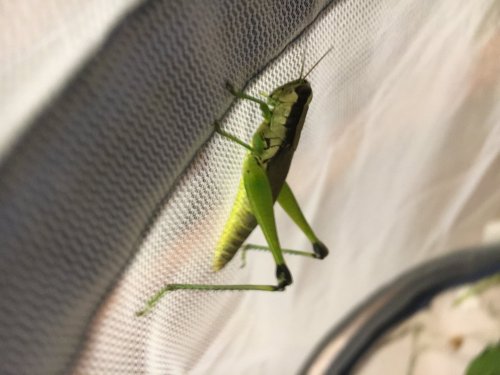
So in an hour I caught about 200 locust to feed to my chams but I'm surprised at how many varieties I came up with. I will also attempt to breed my own for my personal use. But before I can do either of those I need to see which of these are Cham safe.

Being new to chams and locusts, Can someone double check my identifications before I move forward?

BTW, I live in southeastern Louisiana. And numbers 1 & 3 are by far the most common species I came across. The Carolina locust out number every other type by at least 10:1.


1- Carolina Locust - (Dissosteira carolina)

2- katydid of some kind?

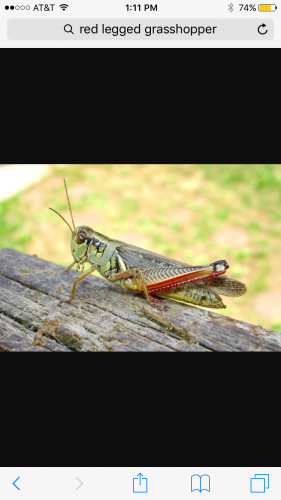
3- Red-Legged Grasshopper - (Melanoplus femurrubrum

4- no clue

5- Fork-Tailed Bush Katydid - (Scudderia furcata)
IMG_0444.JPG
IMG_0448.JPG
IMG_0445.JPG
IMG_0446.JPG
IMG_0447.JPG
 
ok 4 looks like a cone head grasshopper of some type, but there are a lot of types of cone heads and that's just me guessing without looking at all at anything.

2 looks like it maybe the female form of 5 or may be a nymph version, definitely has the body type of a katydid though

Your number 1 is wrong, I actually think that is a lubber, and wouldn't feed it, it has the correct body shape and wing shape and not all lubbers are super bright.

I actually think 3 is the Carolina Locust your looking for.
 
What you said about the lubbers makes sense, those are very doscile, barely fly, and are very slow compared to the rest.

I think I'll move forward with trying to breed just the number 3 for now since they are so easy to catch. Thanks Andee!
 
Of course! Enjoy your new project ^^ remember to do a lot of research and to try a lot of different things. They may not be like grasshoppers at all or other species of locusts. Idk, I know my local species of grasshopper that was most common didn't eat anything but fresh growing sprouts and grasses, which most people don't have issues convincing other types of grasshoppers to eat store bought greens.
 
Oh no sweetie you are fine, the one you recently caught is once again number 4.... I guess I need to look up the name for that one so you feel a bit safer? though if you confuse it because of the colorblindness it could just be somthing you want to check back with regularly.
 
Back
Top Bottom