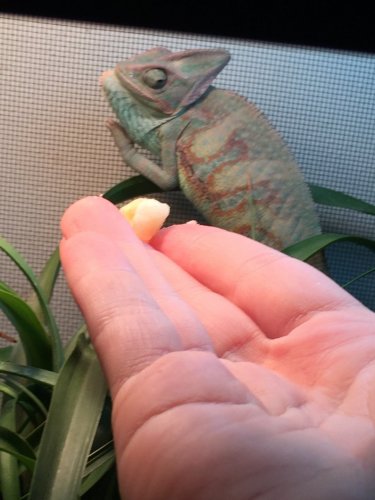
This is what I get.... That's a peice of banan btw, I usually try bugs but he's not into fruits and veggies yet so I'm trying to introduce some, I thought if he smelled it he may like it.
Thanks for the picture. That clears up a lot of questions I was going to ask. Apologies in advance for the clipped tone. I'm tired and late to go somewhere but wanted to write this. Understanding the nature of chameleons--what they are and what they aren't--is so important for the health and happiness of your pet chameleon. You will be happier with your pet when you understand what it can and cannot give you, too. Win win all around.
Okay, let's be clear: Chameleons don't ever have attitude problems. They are not mean. They are not nasty. They are simply chameleons exhibiting chameleon behavior.
Can they be difficult to handle? Yes. Can some always be terrified of their owners until the day they die. Yes. Will they bite and attack out of fear? Again, yes.
Let's just analyse your picture and let's not put any motives or try to figure out what the chameleon is thinking. Let's simply look at the behavior that is being presented.
I see a chameleon that is puffed up. It is looking not at the food item but at your hand about two inches behind the food, the area around the thumb and first finger. The chameleon's left arm is raised. Your hand and the screen seem to be blocking any escape routes. Your hand is within what appears to be one to two inches of it's body. The chameleon appears to be leaning away from your hand and the screen is preventing it from leaning further away or escaping. There do not appear to be any escape routes other than over the hand.
Based on experience, I've found that the raised-arm posture shows a chameleon that is afraid and stressed of something very close to it. Leaning away is also associated with fear. From experience, I've found fear triggers that puffed up behavior. So does territorial aggression between chameleons.
Just from the picture, it appears to me you have trapped a frightened animal between the screen and your hand and it has no escape. It is exhibiting classic fear behaviors--puffing up, arm raised, leaning away and if the screen weren't there, I would also expect escape behaviors.
Now, with all that going on, do you really expect it to take a food that it isn't particularly fond of and eat? Occasionally, extremely stressed animals will eat but the norm is for the stress hormones to suppress appetite.
Hand feeding chameleons is not like hand feeding a mammal. They have an incredibly long tongue and that is what they use to put the food in their mouths. They actually don't like to eat food close to their faces and they don't like to just use their mouths to pick up food although they can learn to eat without using their tongues, but it seems to not be something they prefer to do. They seem to have trouble using their tongue on prey that is close to their faces and will arch up to get distance between the prey item and their face.
To get your chameleon to hand feed, reduce the stress and fear levels in the animal--in other words, get out of its personal space. Chameleons are usually quite easy to read when they are stressed. They change colors or shapes. There is no missing a puffed up animal. Whenever you see your chameleon even start to puff up--they might do it by just starting to throw the throat spikes forward--back out of their space.
Hand feed from a distance. Hand feed food items that are highly desired like green bugs. Start with a hungry chameleon.
One other thing, I don't know if chameleons can smell anything. I have my doubts they use their nose for much other than breathing. I think their nostrils go straight down to front of their mouths, not leaving any room for whatever organ is in a nose that detects odors.
All the best.


 . Any advice? Weather is starting to get wArmer and id love for him to be ok with going out on the porch with me to get a little natural sun light. Another thing is he hates being misted. I even use hot water and test it on my hand first to make sure it's always nice and warm for him. Advice?



 It's just the way some are


