Thanks! When should I start to get worried about her being egg bound?
It isn't always obvious when an animal crosses the line between everything progressing normally to being in trouble. I know how stressful it is and feel for you.
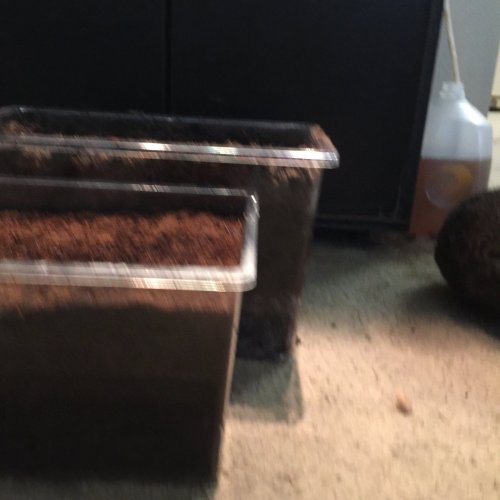
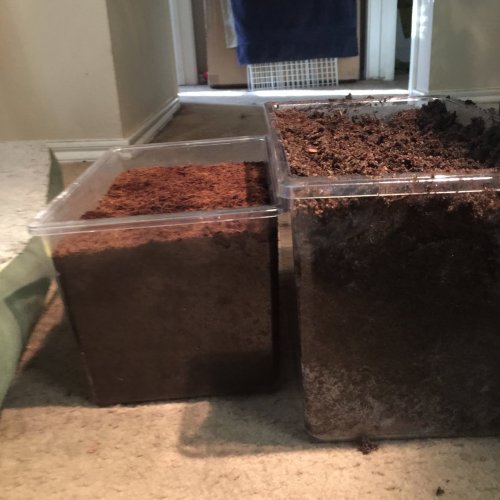
Furnish your laying bin with things like a little plant and sticks. Often they like to dig around the base of a plant, among the roots. I will plant something small in my laying bins, often a fern that gives them a plant coming out of the ground, roots in the ground and some cover from the fronds. I also stick groups of branches/twigs in the ground. I'll dig a small starter hole at the base of the plant and the branches that are stuck deeply into the substrate. Make sure she has sufficient cover to feel safe at all levels of the cage, especially near the bottom. I will cover the front of the cage with a white cloth.
I have only used a bucket to transport them back and forth between the vets'. I set up a tall painters' bucket the same way I set up their laying bin--deep enough substrate, plants, sticks, starter holes and perches. The species I work with is a fairly shallow layer, so you might want to use something taller than a painters' bucket. I'm not a fan of planning to use a garbage can for egg laying since I imagine that moving her out of her cage into another cage (a garbage can) will stress her and exacerbate any laying problems she might be having but other breeders have used it with success.
Back to your original question: When should you be worried.
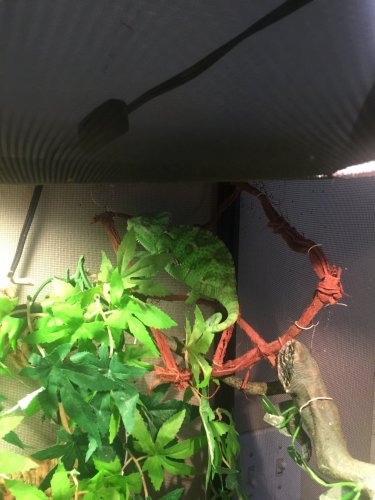
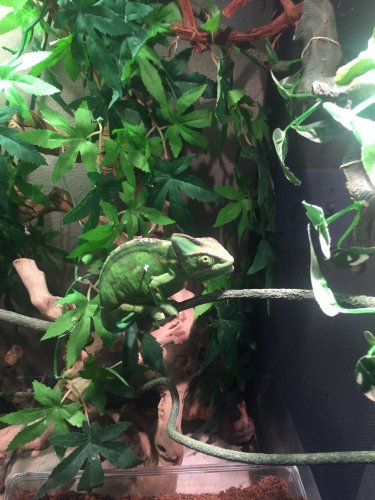
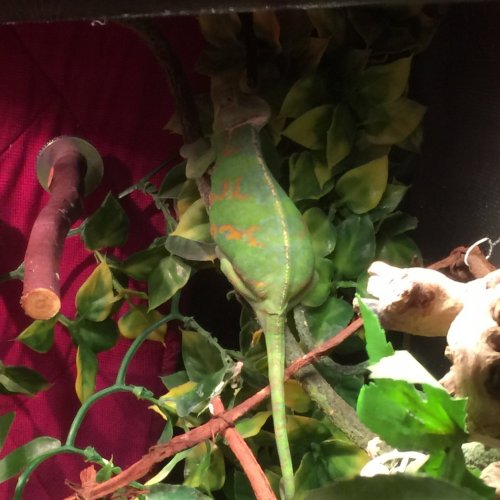
It's a judgment call and there is no black and white answer. Ideally, you want a chameleon to look all happy and content, maybe she doesn't eat much for a few days and then one day without any fanfare, she drops down to the bottom, lays her eggs and is up on her branch eating and drinking in a couple of hours. That's ideal and it doesn't always go like that. Often, they appear restless/distressed before laying, sometimes for days. They are up and down. Some will dig holes yet not lay over a period of days. Often those animals go on to lay without any problems once they get to the point of actually digging the hole and laying their eggs. (I don't know what veiled females look like when they are laying, but my species turns jet black and that blackness when laying is normal.) Sometimes a female that is up and down for a week deteriorates and needs intervention. It's a fine line between normal and a problem and isn't obvious. I am super stressed as my females approach egg laying so I understand your worry.
I check on them a couple of times a day without disturbing them--I just lift a tiny corner of the cloth and find out what they are doing. I use a white cloth that allows light to go through so when I lift the corner to look, I am not suddenly flooding the cage with a new light source. If I have a female that seems a little distressed as egg laying approaches, I will make a judgement call of when to take her to the vet for an xray and possibly other things like fluid, calcium and a shot of oxytocin. I look at her face--is she going downhill? If she is, she's at the vets. I have more experience than you of what distress looks like that turns out to be the female preparing for a normal egg laying and one where we give her some help.
There is a point where you might notice that her body/muscles seems to get lax. Everything softens as it prepares for delivery. You can see the muscles fall over her pelvis. You will see the egg outlines much more clearly. Her vent might be more relaxed. This is not to be confused with her becoming dehydrated or being in active labor. This is where your observation skills are really important, to be able to see she is not dehydrated because dehydration will also make her look like this. If she is laboring, you will see the egg outlines more obviously. If she is sitting up on her branch, happy and relaxed but you are starting to see her body become more slack, she's close. If she is looking like that but is restless, she might be in labor.
My gut feeling for a novice like yourself would be to take her to the vet sooner rather than later. If she is laboring and not producing eggs, the longer she is in that state, the more exhausted she becomes. She might need fluids and calcium. She might need oxytocin. In general, you don't give oxytocin to laboring animals since they might not be producing eggs because of a blockage but sometimes their contractions aren't strong enough. Xrays will help you and a vet decide how to proceed.
I would not do surgery on a chameleon because it has notoriously poor outcome and is very expensive. Often by the time you get to the point of deciding to do the surgery, the animal is in such poor shape they have almost no chance of surviving the surgery even in the hands of the best reptile surgeon. This kind of surgery is very difficult surgery and requires a particularly skilled surgeon. I would never just let an animal die from dystocia. She gets the best care, not matter what my ultimate decision is.
I know I didn't give you the answers you want but hope I gave you a better understanding of what to expect. Good luck.






 )
)


