@Tmckinnis I'm very sorry you are going through this. It's hard to lose a baby so unexpectedly.
Let me start with this--
no one on this forum can tell you what went happened.
An experienced vet/pathologist doing a necropsy probably couldn't give you a good answer.
Single photographs, especially of veiled chameleons, do not give the whole picture. I find babies, and veileds in particular both adults and babies, to be skilled shape shifters. One minute they look emaciated and the next are fat as butter and look to be in terrific condition. Baby veileds are even more extreme than adults in this shape shifting ability. I find healthy veiled babies to look very skinny to me when I am sure they are not.
Sunken eyes, while a symptom of extreme dehydration, are also symptoms of other things like pain or disease. Many chameleons, especially older males, seem to pull their eyes in when you try to take a picture of them. I have many pictures of beautiful males in pristine condition that I cannot post on the internet because they have pulled their eyes in and that makes them look unwell. From your one grainy picture I can't tell if those eyes are sunken in or not.
The ability to look at a chameleon and gauge it's condition is a skill that takes time to develop. It is not something you can develop from reading words. I almost think it is an art. You need to see a lot of animals over time to develop it. Dehydration is not just about white urates and sunken eyes.
That said I'll offer you a few of my thoughts and hopefully you can find some peace.
Babies are just plain hard for novices to keep alive and do well with. There is no room for error with babies. They are a very poor choice for a novice chameleon keeper. Learn on a well established juvenile from a reputable breeder. You would never have known that especially since your children have been successful with reptiles. The salesperson at the pet shop certainly wouldn't tell you and might not even know anything at all about keeping chameleons. How could a novice possibly know that? They can't. Many on the forum spend a tremendous amount of time trying to learn about keeping chameleons before they get one. It doesn't always help as they often make the same mistakes as the impulse buyer does.
Forgive yourself any errors you might have made in your husbandry. Chamleon keeping is a learning experience--not very many people get it right the first time, even zoos. I'm an experienced chameleon keeper yet I have a learning curve when I start keeping a new species. I learn all the time. Babies are just plain tough for novices.
Dehydration is a major problem with captive chameleons and babies in particular. Most breeders raise their babies in big solid plastic tubs in order to keep the humidity in the air up. My own babies have a fogger spilling a misty cloud into their tub 24 hours a day. Small babies dehydrate very easily. The fact you saw your baby drinking suggests the ambient humidity was much too low. I almost never see my chameleons--adults or babies--drink. If I do, I am on alert as to why because a drinking chameleon signals to me that something is wrong. Pet keepers underestimate just how humid the climate is where these animals evolved and do not keep the air anywhere near humid enough.
Kidney failure is the end result of chronic or acute dehydration. A single episode of severe dehydration can set an animal up for kidney failure. Things happen to animals before we buy them that affects their long term health.
Your baby might have been sick before you bought her from any number of diseases or conditions. Even the nutritional status of the mother plays a huge role in a baby's survival. You will never know.
I know it is very hard for you, a new comer to Chameleon Forum, to be able to weed out the experienced keepers from the novices but be careful of whose advice you take. I notice that one person who responded to your thread has had chameleons for less time than you had your little baby. That person should not be offering any advice.
I hope you don't give up on chameleon keeping. If you decide to keep chameleons, I suggest you start a new thread to help you decide what you really want and how to supply the animal you get with all it needs. Many novices start with veiled chameleons but I personally think they are a poor choice for a novice. They are so cheap, wholesaling for $8 apiece, that they are very unhealthy right at hatch. There are other species that are very easy to keep. Some panthers are in the same boat as veiled, being raised by people who are not giving them the care they need from before conception to sale. The species I breed are incredibly hardy and a great novice chameleon as long as the novice can set them up right so don't rule out some of the rarer species. Avoid a wild caught, which means avoiding Jacksons.
Again, I am sorry for your loss.

 I went in to turn on her light's one morning and she didn't perk up as quickly as normal. In fact she was on the ground of the habitat so I gave her a little nudge a few times and she still didn't wake up and even almost fell over to her side with my final nudge. She finally opened her eyes and moved around so I thought maybe it was from her being a little cold. Before I left for work she was on the wall looking good and even saw her dart her tongue out to catch a cricket but missed. I let her be and when I came to check on her at bed time she was on her back on the bottom of the habitat dead and turning black. My boys who have lizards and snakes are confused as to what I did wrong or if she was just sick when I bought her. Any ideas?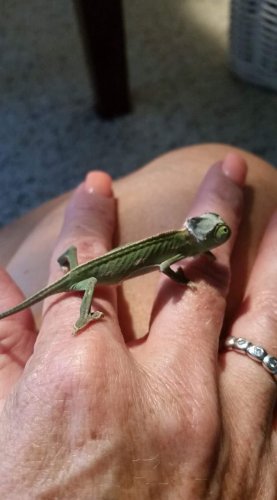

 I understand that heartbreak. How was she kept, fed, misted, etc.? We might be able to help you find out what happened, or at least narrow it down to a few issues. Members request you answer these questions to assist. Safe travels over the rainbow bridge, dear one.


