melleri help

damien1010

New Member
I am due to pick up a pair of melleri on friday.

One of them is completely white with yellow stripes and i read on LLL reptiles page this is an indication of imminent death?

How true is this?

Should i purchase this chameleon ?

Thanks
 
I am due to pick up a pair of melleri on friday.

One of them is completely white with yellow stripes and i read on LLL reptiles page this is an indication of imminent death?

How true is this?

Should i purchase this chameleon ?

Thanks

I'd suggest going to The Melleri Discovery website and reading about their color changes. Its about the best authority on melleri.

There is quite a bit of color variation in melleri including a pale greyish background, but the few times I've seen a melleri in serious trouble (such as severely injured, in shock, or so stressed it is shutting down) it showed a similar coloration. Does it show this coloration constantly? Is there also an over pattern of black spots? Is this cham posturing or trying to threaten another animal it can see? Are the two melleri housed together?

I think I'd plan to go back to look at this cham more than once before buying it. If it is in such serious trouble you may not see it again.
 
Some questions to answer before you buy these Melleri:

Are these Mellers' adults?

Who has determined they are a male and a female? This is hard to do on Melleri.

Are they wild-caught, if so, how long have they been in country, and what parasite treatments have they been given?

Do you have a huge space for them?

Are you ready for one of the harder species to keep alive?

They are a beautiful species, but need LOTS of water pouring down, higher humidity, more room than a 24x24x48, and will eat like a horse. They die more often than not when you buy an imported one, captive bred or captive hatched are safer choices.

CHEERS!

Nick:D
 
The coloration- not true. I didn't verify it (yet- I'm on break from melleri), but I suspect many males take on this coloration during breeding season.

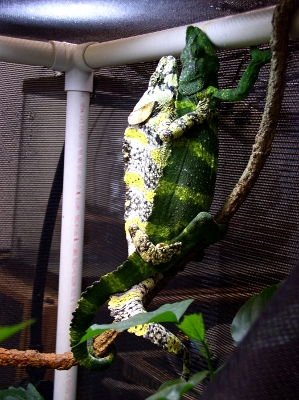
A pair of mine breeding:

mellers.jpg


You can see here the male's coloration and he was not about to die. I think this is the coloring you are referring to.

Sexing melleri is difficult. Take any claims of a sexual pair with a grain of salt. I came up with two methods to sex them.

The first method is to visually isolate the animals just like you would other chameleons. After 3 or 4 weeks, re-introduce one to another. Males and females respond with sterotypical chameleon sexual displays. Males will then nod and flare up, females will gape and rock side to side or remain passive and accept the male for breeding.

The second method is to have animals with healthy weight, then observe them from the top. Chameleons have sterotypical shapes from the top. Males are straight, females have kind of a pear shape, with wider bellies. If you have other chameleon species such as jacksons- the shape types for each sex will be the same from above as the melleri. Most melleri for sale will not yet have healthy weight.
 
Last edited:
I have pictures but can not upload them from my phone.

If i send them somone on here via facebook then maybe someone can upload them here for opinions.


They appear chunky.
have been in the country about 2 week.
are CF and eating well.
Space isn't my issue and housing is sirted via 2 custom built enclosures from my place of work.
 
The light grey colors would not stay on the chameleon without female presence, so if the color goes back to the colors of the female in flux lizard's picture, I wouldn't worry about the temporary colors displayed.

CHEERS!

Nick
 
The light grey colors would not stay on the chameleon without female presence, so if the color goes back to the colors of the female in flux lizard's picture, I wouldn't worry about the temporary colors displayed.

Actually- it does remain for a long while (weeks?) at least sometimes. *If* I remember rightly. My memory is not always the greatest. Prior to my fire I had about 2 dozen melleri, some that were bred from this pair and raised up, some wild caught.

If I remember rightly the grey comes in somewhat gradually and stays a while. *maybe* it is triggered when introductions are made with other melleri and then develops and remains when they are out of sight again. Could be just an indication of dominance or sexuality- sort of like how introducing male panthers visually to each other riles them up and then they have a higher sex drive when a female is introduced to one. They seem to have more interest in courting when the grey is there. At least that is the best I remember my impression at the time.

My study was cut short by tradgedy on these guys. So take what I just said about coloring and male sexuality as an impression and not a fact. It could be an incorrect conclusion limited by the number of individuals I had and observed it with.

At any rate- it is not necessarily a sign of a problem.

Someday I'll work with them again.
 
Last edited:
The coloration- not true. I didn't verify it (yet- I'm on break from melleri), but I suspect many males take on this coloration during breeding season.

A pair of mine breeding:

You can see here the male's coloration and he was not about to die. I think this is the coloring you are referring to.

Maybe, but the coloring I imagined from his description was not the same as your male is showing. The two I've seen it on included an adult I got from a stupid college kid that was close to death, and also had one that aspirated and was choking. Their color was a weird pale white background with orange-yellow bars, no black spotting at all. I hope you are right!
 
Their color was a weird pale white background with orange-yellow bars, no black spotting at all

The dark mottling on the male in the photo is because he is actually breeding and excited at that moment. Spotting on this species is always an indicator of stress or excitement in this species. Normally he would be the pale color you see mixed without the dark mottling but with the yellow bars.

Yeah- hard to say if it is the same from a description.

piccys would help.

To the OP- in case you aren't aware- these guys can be difficult to acclimate sometimes.
 
Yeah- hard to say if it is the same from a description.

piccys would help.

To the OP- in case you aren't aware- these guys can be difficult to acclimate sometimes.

Let's hope! I had never seen that coloration on a melleri before even after living with several for years. Don't want to see it again either.
 
Let's hope! I had never seen that coloration on a melleri before even after living with several for years. Don't want to see it again either.

Did you house them communally?

Did they ever breed?

Just curious to see what differences, similarities there might have been in our situations that might make a difference in that coloring.
 
Back
Top Bottom