Is there any way to get rid of the cricket stink?

Anyone who has used crickets as feeders probably knows exactly what I’m talking about. The dreaded dead crickets smell, it doesn’t just stay contained to inside the cricket tote/bin it stinks up the whole room. I was wondering if there are any safe ways I can remove the smell or cover it up. I’ve tried an air purifier, it didn’t work. I’ve tried keeping the crickets outside but they just die from the cold air and stink even more. Right now I’m keeping them in my garage but the whole room stinks of dead crickets. I’ve even tried an essential oil diffuser and it kind of worked until it ran out and the cricket stench took over again. Does anyone have any other suggestions on what I could do to get rid or at least suppress the cricket stink?
 
First, what kind of crickets do you have? Domestic crickets are the ones usually sold by pet stores and not only do they stink far worse, but they also die off quicker. Banded crickets are most definitely much much better and are available by most on line bug vendors.
It’s also important to keep them clean and with lots of ventilation. The fumes from their poos can kill them. I too use the two bin method, but probably move/clean them every 2-3 days as needed. Each of my buns has ventilation not just at the top, but along the sides too.
Changing the egg flats or whatever you use for them when they get foul makes a big odor difference. Remove uneaten food promptly.
I have heard that some keep their crickets on vermiculite, but that can get expensive. Some use small activated charcoal bags in their bins, like these. https://www.amazon.com/Activated-El...1777003031&sprefix=Activated+,aps,179&sr=8-19
Hope this has helped.
 
Mind me asking where you get grasshoppers from? Don’t think I’ve seen an online shop with them
I breed my own grasshoppers. You can purchase them from Dragonhoppers.com or Feedmychameleon.com from Dean. I have also purchased from Khai Phan. You can contact him on Facebook. Breeding is easy. 2 years ago, I purchased breeders from Dean. Started my own colony. Last spring, I caught my own to use as breeders. I don't feed the wild caught. I only feed the ones hatched under my care.

If you feed grasshoppers, don't feed the kicker legs. Cut that portion off (above the knee). IMO - the kicker leg portion is too bony and has small bards that could cause impaction. I have no data to support my opinion but that's just my practice. I snip the legs with scissors.

I don't like crickets because of the stench and care needed to keep them alive. Grasshoppers require very little effort. No water needed. I hang a head of romaine lettuce in the cage and change the paper towels at the bottom of the cage once every 2 weeks.
 
Last edited:
lt GIF
 
First, what kind of crickets do you have? Domestic crickets are the ones usually sold by pet stores and not only do they stink far worse, but they also die off quicker. Banded crickets are most definitely much much better and are available by most on line bug vendors.
It’s also important to keep them clean and with lots of ventilation. The fumes from their poos can kill them. I too use the two bin method, but probably move/clean them every 2-3 days as needed. Each of my buns has ventilation not just at the top, but along the sides too.
Changing the egg flats or whatever you use for them when they get foul makes a big odor difference. Remove uneaten food promptly.
I have heard that some keep their crickets on vermiculite, but that can get expensive. Some use small activated charcoal bags in their bins, like these. https://www.amazon.com/Activated-Elimination-Basement-Absorbers-Deodorizer/dp/B0FT33HQPD/ref=sr_1_19?crid=G3XMU5ZOOCUX&dib=eyJ2IjoiMSJ9.ieJH8mAAgklkVWQe7lbp6vmLrbrb7rxqfzZtxoPqAuVoVoK7acc7xwCQTwmCdlbriTfvJjDrFm2fUgzYi3RfOYTdJx14RRHT79o250tnVByYCnEXgknyMN7d8MBCK_pOX4x17dvnasMGR41Tlh27k_710UbmIIFwew2x9yv55bUxd1E2fdq9M-HDfnV_vVCGj1RVqIWu7j0_MZuxufMvhNviIzo-zyV7u8HlReBmN43qzrbIGsU0WcPwnlaG0mA80BjJRvulNYRBcVxMlzctTgmjm61YhJFs8zcWOIGOQaw.6gHwMoO0GLah8xCHHokMoLiwp48zz6gf8s4DXzlgLoc&dib_tag=se&keywords=activated+charcoal+odor+absorber&qid=1777003031&sprefix=Activated+,aps,179&sr=8-19
Hope this has helped.
I keep banded crickets in a plastic tote with holes drilled in the sides, I might try the 2 tote method. Thanks!
 
If you have a bad smell and lots of dead crickets something has gone terribly wrong. In my experience, crickets die off rapidly if kept in damp conditions. I keep mine dry, except for their water dish. When I give vegetables I use small amounts and I keep everything else dry. Clean and dry is the key once they are out of the first week or so. I would highly recommend lots of ventilation, too.
 

I keep banded crickets in a plastic tote with holes drilled in the sides, I might try the 2 tote method. Thanks!
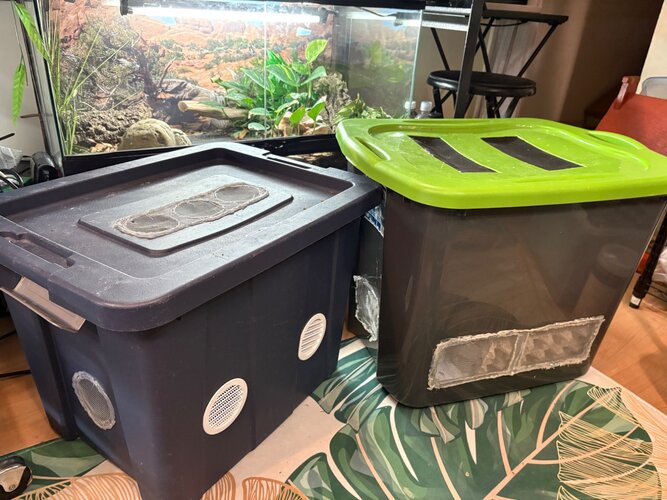
Make sure there’s plenty of air flow. Here’s my two totes. I reused the vents that Josh’s Frogs had on the shipping boxes for my crickets and hot glued screen too. In between ‘cleaning’ them, I will sometimes leave the lids half off.
IMG_8944.jpeg

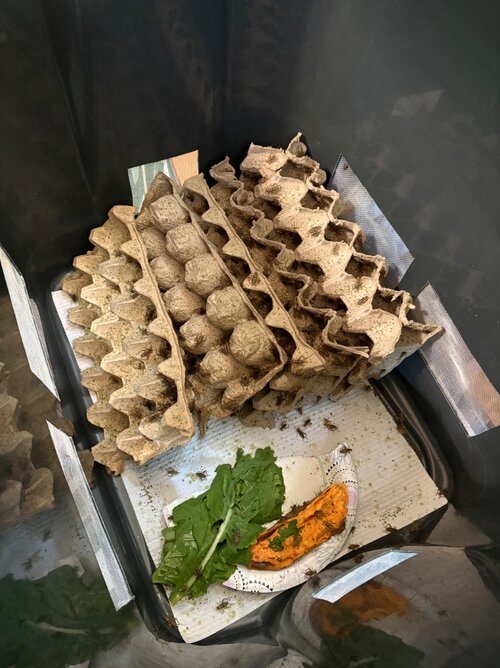
This is the inside - you’d never tell that this was perfectly clean just a few hours ago. This is how I keep 1K-2K crickets. I don’t give water as they get enough from their food. I will lightly spray their food before giving. The sweet potato today got extra misting as I microwaved it too long.
IMG_8941.jpeg
 
I'll try not to go on a cricket rant but I've been breeding crickets off and on since I was a teenager since it was the only way I could afford to feed my reptiles. The reasons I love crickets so much is 1. I can go from having a handful of adults to thousands of baby crickets within a couple of weeks if incubating the eggs at high temperatures. To do that with something like Dubia I'd have to start off with a lot of adults. Crickets are a boom/bust type of animal. When I need to prodice a huge volume fast, that's an advantage over something slow but steady. Crickets are kind of stupid and while they will hide, they will also come out and walk right infront of animals and because they move a lot, I find just about everything eats them and they don't get so large that most of my small to medium sizes species can't eat them (for tiny species though they could still become a problem if not removed when too large). Crickets come in a large variety of sizes , even microphagous species can eat pinheads. I always get a lot of hate for pumping crickets, but for someone like me that has a lot of small to medium lizards, salamanders, and frogs they tend to fill every niche. I've used dubia a lot too and they worked great for things like painted agamas and OK for things like cave geckos that will tend to eat them out of mealworm bowls but for other species they can hide too much and grow too large for my liking and as I've moved more and more to naturalistic caging, it can be challenging to remove hiding insects from behind sprayed in cork, etc, so I prefer something not larger at maximum size than my animals can eat.

 
Last edited:
I havent cooked mine but might starthttps://www.ars.usda.gov/oc/utm/getting-more-uses-out-of-the-vitamin-packed-sweetpotato/
" MA: Sweetpotatoes are a unique vegetable in that the starch degrading enzymes are greatly accelerated during the cooking processes. These enzymes convert some of the starch into maltose and sweetens the sweetpotato as it bakes. This is why there is typically a syrup that leaks out onto the baking sheet. Cooking may degrade some of the health promoting compounds, but the majority will remain. On the other hand, beta-carotene may become more bioavailable after cooking and bioavailability can be further increased when consumed with fat (e.g., sweetpotato fries)" I wonder I can imagine the cooking process makes it easier to eat and the sweetness might encourage them to eat more too
 
Back
Top Bottom