need immediate help. I am trying to set it up appropriately and have googled what seems to be minimal info on Senegals specifically. I also read chamelions are difficult in general with Senagals ranking at the top. So I definitely need help here. NO bashing just sincere assistance to try to give him the best start possible. Thanks so much. We have a boa, bearded dragon, 2 iguanas, a red ear and box turtle as far as reptiles. I even have a mealie farm so I know the bedding they are coming from. The care of those seem simple enough but from what I am reading of the Senegal I am concerned. I have him in a screen cage with the recommended lighting from the pet store. Though they didn't bother to mention the Senegal wasn't for beginners. He has branches and artificial vines. The pet store was out of the drip regulator so I have a temp set up with a plastic container dripping on the vines. I put a couple of mealies on a plastic lid. He hasn't eaten them. This is day 2 what do I do about feeding???

Navigation
Install the app
How to install the app on iOS
Follow along with the video below to see how to install our site as a web app on your home screen.
Note: This feature may not be available in some browsers.
More options
You are using an out of date browser. It may not display this or other websites correctly.
You should upgrade or use an alternative browser.
You should upgrade or use an alternative browser.
Impulsive hubby brought home a Senegal...
- Thread starter Mel
- Start date

Heika
New Member


We are a fairly "no bash" forum. 
To start with, you need to mist your chameleon. Mist it with hot water from a clean spray bottle until you see it start to drink. Then keep misting until it stops drinking. You may want to invest in a hand held pump sprayer from Home Depot or the likes.. they come in pretty handy, and you should be misting your chameleon a bare minimum of 2X daily for 10 minutes each time. Right now, it would be better to do it longer. Your chameleon has been through a pretty major ordeal by being imported. Many wild caught animals have a hard time with drippers. I hope you have been careful about cross contamination with your other animals, because you can be 99.9% positive that your animal has parasites. The only exception is if it is the fraction of a percent of senegals that are captive bred or hatched. The number is pretty low, and I wouldn't count on it.
Meal worms in a container for a wild caught chameleon really won't get him or her going. Try crickets or superworms.. something that moves a lot. Run them up the screen near where he or she is sitting to make sure it sees them. Then, back away so it doesn't feel watched. You will probably need to release the insects into the cage for a long while to come, but may eventually be able to cup feed after your chameleon is well acclimated and comfortable with you.
Your chameleon would probably feel more comfortable with live plants and lots of cover right now.
Here is some specific info on the senegal: http://www.adcham.com/html/taxonomy/species/chsenegalensis.html
You probably won't find much else outside of a book. Here is the care section on that species from Petr Necas' "Chameleons, Nature's Hidden Jewels."
"Biology, Captive Care: Despite the large numbers of Senegal Chameleons that have been imported into Europe and the United States, little is known about their care in captivity. It may be suitable to keep them in a large, simple, well lit enclosure. Daytime ambient temperatures should reach 30 degrees celcius with localized spot heating, and room temperatures are adequate at night."
A good general care site: http://www.chameleonsdish.com/
Another good site: http://www.chameleonnews.com/
And, just so we know what the pet store recommended.. how about you answer this stuff? This came from the health forum sticky..
Cage Info:
To start with, you need to mist your chameleon. Mist it with hot water from a clean spray bottle until you see it start to drink. Then keep misting until it stops drinking. You may want to invest in a hand held pump sprayer from Home Depot or the likes.. they come in pretty handy, and you should be misting your chameleon a bare minimum of 2X daily for 10 minutes each time. Right now, it would be better to do it longer. Your chameleon has been through a pretty major ordeal by being imported. Many wild caught animals have a hard time with drippers. I hope you have been careful about cross contamination with your other animals, because you can be 99.9% positive that your animal has parasites. The only exception is if it is the fraction of a percent of senegals that are captive bred or hatched. The number is pretty low, and I wouldn't count on it.
Meal worms in a container for a wild caught chameleon really won't get him or her going. Try crickets or superworms.. something that moves a lot. Run them up the screen near where he or she is sitting to make sure it sees them. Then, back away so it doesn't feel watched. You will probably need to release the insects into the cage for a long while to come, but may eventually be able to cup feed after your chameleon is well acclimated and comfortable with you.
Your chameleon would probably feel more comfortable with live plants and lots of cover right now.
Here is some specific info on the senegal: http://www.adcham.com/html/taxonomy/species/chsenegalensis.html
You probably won't find much else outside of a book. Here is the care section on that species from Petr Necas' "Chameleons, Nature's Hidden Jewels."
"Biology, Captive Care: Despite the large numbers of Senegal Chameleons that have been imported into Europe and the United States, little is known about their care in captivity. It may be suitable to keep them in a large, simple, well lit enclosure. Daytime ambient temperatures should reach 30 degrees celcius with localized spot heating, and room temperatures are adequate at night."
A good general care site: http://www.chameleonsdish.com/
Another good site: http://www.chameleonnews.com/
And, just so we know what the pet store recommended.. how about you answer this stuff? This came from the health forum sticky..
Cage Info:
- Cage Type - What kind of cage are you using? What is the size?
- Lighting - What kind of lighting are you using? How long do you keep the lights on during the day?
- Temperature - What temperature range have you created? Basking spot temp? What is the temperature at night?
- Humidity - What are your humidity levels? How are you creating and maintaining these levels?
- Plants - Are you using live plants? If so, what kind?
- Location - Where is your cage located? Is it near any fans, air vents, or high traffic areas?
- Your Chameleon - The species, sex, and age of your chameleon.
- Feeding - What are you feeding your cham? What amount? What kind of schedule? How are you gut-loading your feeders?
- Supplements - What are you dusting your feeders with and what kind of schedule do you use?
- Watering - What kind of watering technique do you use? Do you see your chameleon drinking?
- Fecal Description - Briefly note colors and consistency from recent droppings.
- History - Any previous information about your cham that might be useful to others when trying to help you.
- Current Problem - The current problem that you are concerned about.

Jordan
New Member
You can do this with mealworms too.
Mealworms to beetles
Mealworms to beetles

Scrappy
New Member
Hi Mel ... I can understand the impulsiveness as my first cham was an impulse buy of a Senegal. I was able to successfully maintain him for 2 1/2yrs. This is one of the most difficult breeds of chams to keep in captivity. They are also highly prone to the skin worms because 99% of them are WC. If you plan to keep him the first thing you will want to do is get him to a vet to be checked out. Mine was eating crickets and silkworms. They feed better by free ranging their food rather than cup feeding. They temp and humidity requirements are similar to a panther. Make sure he has lots of places to hide, a uvb light and a heat light. Heavy misting 2 - 3 times a day.
Hope that helps, if you have any more questions, please let me know and I'll try to help.
Hope that helps, if you have any more questions, please let me know and I'll try to help.
This is how I have my mealie farm set up for feeding my sugargliders. My son also uses them for his Bearded Dragon. http://www.sugarglider.com/glidergossip/topic.asp?TOPIC_ID=6643
My husband is familiar with the setup better than I as the reptiles are supposed to be thier dept. LOL! The cage is 26x26x31 I do believe he intends to build another. Any suggestions? There are 2 lights. I believe UV in the day and heat lamp at night.(?) We have 3 long artificial vines wrapped and hanging across a large pc. of branch. I have a plastic container that I am using for the moving water for now. I am wondering if it is safe to use a mini waterfall that I have. It has a 3 inch catch bottom. Can they drown? I am also misting him with the spray bottle. I put small crickets in with him but I let him alone so he didn't worry about me. I can't be sure if he is eating them. Would it be okay to put an orange slice or somnething in there for the crickets? I appreciate the responses I am getting. Thank you.
My husband is familiar with the setup better than I as the reptiles are supposed to be thier dept. LOL! The cage is 26x26x31 I do believe he intends to build another. Any suggestions? There are 2 lights. I believe UV in the day and heat lamp at night.(?) We have 3 long artificial vines wrapped and hanging across a large pc. of branch. I have a plastic container that I am using for the moving water for now. I am wondering if it is safe to use a mini waterfall that I have. It has a 3 inch catch bottom. Can they drown? I am also misting him with the spray bottle. I put small crickets in with him but I let him alone so he didn't worry about me. I can't be sure if he is eating them. Would it be okay to put an orange slice or somnething in there for the crickets? I appreciate the responses I am getting. Thank you.

Brad Ramsey
Retired Moderator
Mel,
Generally accepted lighting requirements for a chameleon include a uva/uvb light like the reptisun 5.0 for 12 hours a day and a daytime bsaking light where the animal can warm himself during the day. No nighttime heat lamp is required or for that matter recommended. Temp under the heat lamp (among other things I am repeating) is mentioned by Heika.
I find it much easier to cup feed. Containing the feeders provides you the opportunity to moniter how much he is eating and prevents crickets from bothering him at night while he is sleeping. You can certainly put a bit of cricket food in the cup to maintain the feeders.
Concerning waterfalls:
It seems like everyone wants to put one in their cham enclosure and it is just not a good idea. They are impossible to keep clean and no matter how good of a job you think you are doing maintaining the feature, it will always be a breeding ground for bacteria. It is a much better idea to have a drip system and either do frequent mistings or install an auto-mister. This simulates the natural environment and provides water collected on leaves or dripping from branches which is the way these animals obtain their moisture.
A waterfall really does nothing to benefit them and as I mentioned will just cause you trouble and become a labor intensive pain in the a**.
Good luck with your new project. Success with these animals is an extremely rewarding experience.
-Brad
Generally accepted lighting requirements for a chameleon include a uva/uvb light like the reptisun 5.0 for 12 hours a day and a daytime bsaking light where the animal can warm himself during the day. No nighttime heat lamp is required or for that matter recommended. Temp under the heat lamp (among other things I am repeating) is mentioned by Heika.
I find it much easier to cup feed. Containing the feeders provides you the opportunity to moniter how much he is eating and prevents crickets from bothering him at night while he is sleeping. You can certainly put a bit of cricket food in the cup to maintain the feeders.
Concerning waterfalls:
It seems like everyone wants to put one in their cham enclosure and it is just not a good idea. They are impossible to keep clean and no matter how good of a job you think you are doing maintaining the feature, it will always be a breeding ground for bacteria. It is a much better idea to have a drip system and either do frequent mistings or install an auto-mister. This simulates the natural environment and provides water collected on leaves or dripping from branches which is the way these animals obtain their moisture.
A waterfall really does nothing to benefit them and as I mentioned will just cause you trouble and become a labor intensive pain in the a**.
Good luck with your new project. Success with these animals is an extremely rewarding experience.
-Brad
Last edited:

I have kept quite a few Senegals over the years...and have not found them as hard to keep in captivity as their reputation seems to indicate....maybe I've just been lucky?
You didn't mention any temperature for your basking area....but Heika is right. I've always kept the Senegal's basking temperature in the mid to high 80'sF.
I've never had a problem with a Senegal not eating if it wasn't sick and was warm enough....but I have dealt only with WC's which usually arrive hungry.
I have found that Senegals need to be kept well hydrated...some are hard to get started to drink each day...but they drink a lot once they start. I always persevere until they drink each day.
You didn't mention any temperature for your basking area....but Heika is right. I've always kept the Senegal's basking temperature in the mid to high 80'sF.
I've never had a problem with a Senegal not eating if it wasn't sick and was warm enough....but I have dealt only with WC's which usually arrive hungry.
I have found that Senegals need to be kept well hydrated...some are hard to get started to drink each day...but they drink a lot once they start. I always persevere until they drink each day.
Thanks for the patience here...
I need to chechk with my hubby on the temp. I know he has a therm. I am misting 3 times a day. Keeping his water drip going also. I put small crickets in but as I said I'm not sure he's eating them. I know there were supposed to be 15 and I found 5 dead in the water catch bowl. Last night I put a few mealies in a bowl. I'm desperate for him to eat. There is no hand feeeding these guys right? We hand can feed our Beardie. What kind of live plants would be good? They eat some plants right? Does a feeder bowl need to be elevated? If this lil guy doesn't make it I told my hubby no more chamelions. I'm stressing with the chamelion! Thanks again, Mel Oh yeah, I called the exotic pet store to ask if the chamelions were imported or a local breeder. She said imported. She also said for $5.00 they could...can't think of the word...dah....to purge parasites. You think she would have mentioned it when we bought it.
I need to chechk with my hubby on the temp. I know he has a therm. I am misting 3 times a day. Keeping his water drip going also. I put small crickets in but as I said I'm not sure he's eating them. I know there were supposed to be 15 and I found 5 dead in the water catch bowl. Last night I put a few mealies in a bowl. I'm desperate for him to eat. There is no hand feeeding these guys right? We hand can feed our Beardie. What kind of live plants would be good? They eat some plants right? Does a feeder bowl need to be elevated? If this lil guy doesn't make it I told my hubby no more chamelions. I'm stressing with the chamelion! Thanks again, Mel Oh yeah, I called the exotic pet store to ask if the chamelions were imported or a local breeder. She said imported. She also said for $5.00 they could...can't think of the word...dah....to purge parasites. You think she would have mentioned it when we bought it.
You said..."I put small crickets in but as I said I'm not sure he's eating them"...I don't think you said how big the chameleon is...the crickets should be of an appropriate size...if they are too small for the chameleon it won't likely eat them. (If they are too big, the chameleon may not eat them either.)
You said..."There is no hand feeeding these guys right? We hand can feed our Beardie"...some Senegals are quite nervous and it would be quite stressful to handfeed those ones.
You asked..."What kind of live plants would be good? They eat some plants right?"...veileds eat plants...but I have never known a Senegal to do it on purpose. I still would use non-toxic plants that were well-washed, both sides of the leaves...such as pothos, or hibiscus.
You asked..." Does a feeder bowl need to be elevated?"...I don't use feeding bowls....but it would be better to be elevated. Your chameleon needs to be able to see the insects to attract him to them.
You said..." If this lil guy doesn't make it I told my hubby no more chamelions. I'm stressing with the chamelion!"...welcome to the world of chameleons! They can drive you crazy....but, watch out, they are addictive!
You said..."I called the exotic pet store to ask if the chamelions were imported or a local breeder. She said imported. She also said for $5.00 they could...can't think of the word...dah....to purge parasites. You think she would have mentioned it when we bought it"...I don't like it when they simply treat parasites without even knowing what they have or if they have any (which is what I'm assuming she's talking about). Different meds are used to kill different parasites and you need to have a fecal done to determine what parasites you are trying to kill. One clear fecal doesn't mean that you have a parasite-free chameleon either...it depends on whether the parasites are shedding or not. Also, the size of the dose is dependent on the chameleon's weight.
You said..."There is no hand feeeding these guys right? We hand can feed our Beardie"...some Senegals are quite nervous and it would be quite stressful to handfeed those ones.
You asked..."What kind of live plants would be good? They eat some plants right?"...veileds eat plants...but I have never known a Senegal to do it on purpose. I still would use non-toxic plants that were well-washed, both sides of the leaves...such as pothos, or hibiscus.
You asked..." Does a feeder bowl need to be elevated?"...I don't use feeding bowls....but it would be better to be elevated. Your chameleon needs to be able to see the insects to attract him to them.
You said..." If this lil guy doesn't make it I told my hubby no more chamelions. I'm stressing with the chamelion!"...welcome to the world of chameleons! They can drive you crazy....but, watch out, they are addictive!
You said..."I called the exotic pet store to ask if the chamelions were imported or a local breeder. She said imported. She also said for $5.00 they could...can't think of the word...dah....to purge parasites. You think she would have mentioned it when we bought it"...I don't like it when they simply treat parasites without even knowing what they have or if they have any (which is what I'm assuming she's talking about). Different meds are used to kill different parasites and you need to have a fecal done to determine what parasites you are trying to kill. One clear fecal doesn't mean that you have a parasite-free chameleon either...it depends on whether the parasites are shedding or not. Also, the size of the dose is dependent on the chameleon's weight.
Plants...possible ficus?
I have read the hibiscus were more difficult to keep indoors. I am not familiar with pothos. I will have to look it up. I think that's a type of ivy.? Is it alright to use the English ivy or hibiscus? Thanks! As far as being addictive I'm sure they can be but this impulse of my hubby's has me worked up. I just get nervous with thyese exotics. He bought home 2 5yr old Macaws about 18 mos ago. I could have divorced him over that!!! No joke either!!! Look who winds up researching and fretting over the proper care!!! UGH!!! Today is valentines. Guess what HE'S getting! Plants, LOL!!!
I have read the hibiscus were more difficult to keep indoors. I am not familiar with pothos. I will have to look it up. I think that's a type of ivy.? Is it alright to use the English ivy or hibiscus? Thanks! As far as being addictive I'm sure they can be but this impulse of my hubby's has me worked up. I just get nervous with thyese exotics. He bought home 2 5yr old Macaws about 18 mos ago. I could have divorced him over that!!! No joke either!!! Look who winds up researching and fretting over the proper care!!! UGH!!!
Today is valentines. Guess what HE'S getting! Plants, LOL!!!Here's what pothos looks like....if you get one with a cedar branch in it as a support like the one in the picture, I would remove it. Cedar has oils in it that can be toxic....
http://www.aboutflowers.com/gandb/pothos.html
Some of the ivies are poison....so check the list.
http://www.aboutflowers.com/gandb/pothos.html
Some of the ivies are poison....so check the list.
I found this list for plants. Some of which I can easily get seeds for. I would know for sure there weren't pesticides used on them. They probably would grow better with the artificial light and all the misting. LOL!http://www.bluebeastreptile.com/plantlist.
I have seen him lick at the water a couple of times. I hope he's drinking more when I'm not looking. I tried small crickets but found most in the water basin. I put mealies in a small green dish on a tree branch but those aren't gone either. I just bought some larger crickets in case he prefer them larger. Do chamelions run toward the crickets like a Beardie will or do they wait for one to pass close enough? If we could get him acclimated I'm ready to spoil him but I don't feel hopeful. The therm is reading 70 right now and it is rather cool out. I need to ask my hubby how to get the temp up. Thanks for keeping tabs on me. I appreciate any help.
I have seen him lick at the water a couple of times. I hope he's drinking more when I'm not looking. I tried small crickets but found most in the water basin. I put mealies in a small green dish on a tree branch but those aren't gone either. I just bought some larger crickets in case he prefer them larger. Do chamelions run toward the crickets like a Beardie will or do they wait for one to pass close enough? If we could get him acclimated I'm ready to spoil him but I don't feel hopeful. The therm is reading 70 right now and it is rather cool out. I need to ask my hubby how to get the temp up. Thanks for keeping tabs on me. I appreciate any help.

Dave Weldon
Avid Member

Howdy,
I think its time to post photos of your setup and your critter to better help sort out things. What was the basking temp? If crickets are drowning in something then that something has to go
I think its time to post photos of your setup and your critter to better help sort out things. What was the basking temp? If crickets are drowning in something then that something has to go
Well let's see my husband is out of town and I can't post pics. Go figure here I am at fretting over this lil guy. The temp is at 71. I believe 80's are what you are recommending so will this temp hurt him until my hubby gets home? Ugh! Okay no water catch so I got live plants. I guess that will absorb the excess drip.??? I'm still misting too. I just don't know about the eating still. I'm trying to leave him be to eat so I don't add stress. ??? Do chamelions run toward the crickets like a Beardie or do they wait for one to pass close enough? Today I think I'll try the silkworms.??? Oh yeah. the spoecialized exotic pet store did tell my husband this Senegal was easy to raise. Ugh! I guess we're too nieve!!!
Last edited:
Jordan
New Member
Kind of depends on the personallity on how they hunt. Something like a veiled, which is aggressive will charge their prey and then shoot. Others will sit still or walk very slowly to get in range and then shoot. I would say you probably have a sit and wait type hunter. An aggressive one will clear the cage within minutes of all feeders.
To catch excess water from a dripper you can take a jug of milk and cut off the top. Taping some screen around the top will keep the feeders and chameleon out of the water. You really just do not want an abundance of excess water standing at the bottom of the cage. If you have really good drainage you would not really need the catch container at the bottom but most of use do not so it is usually recommended.
To catch excess water from a dripper you can take a jug of milk and cut off the top. Taping some screen around the top will keep the feeders and chameleon out of the water. You really just do not want an abundance of excess water standing at the bottom of the cage. If you have really good drainage you would not really need the catch container at the bottom but most of use do not so it is usually recommended.
My husband even has a nice large outdoor cage for the iguanas with pond and I usually grow some veggies for them. I really am a nice person but I sure feel like I'm killing this guy. I really would like to tell this exotic pet store something about this. We have done business several times with them. I'm soooo disapointed.

Julirs
New Member
Mel--I am a new Chameleon owner also. I have a veiled that I got from a great breeder who is wonderful and has talked me through many of my fears. To say this little Chameleon has stressed me a bit could be an understatement. I don't see mine eating or drinking very often but since he is active, pooping, hydrated, and not sleeping during the day he should be fine. I am going to try my best to try not to worry and do everything that I know I should. He has the right cage, plants, lights, mistings and food variety. Everyone says it can be very bad to fuss too much over these shy solitary creatures. They have good Chameleon instincs to get them through.
Jordan
New Member
I sure wish I had an aggressive guy. I bet you senior members place bets on us nieve newbies as to how long before we loose the battle! I really am depressed.
I did not mean it like that. My veileds are aggressive. They are also extremely active. This means they have to have the food to sustain their active lifestyles. My jackson on the other hand is no where near as active. He roams the cage but not really comparable to the way my veileds do. He is a sit and wait kind of guy. He eats well but I almost never see it.
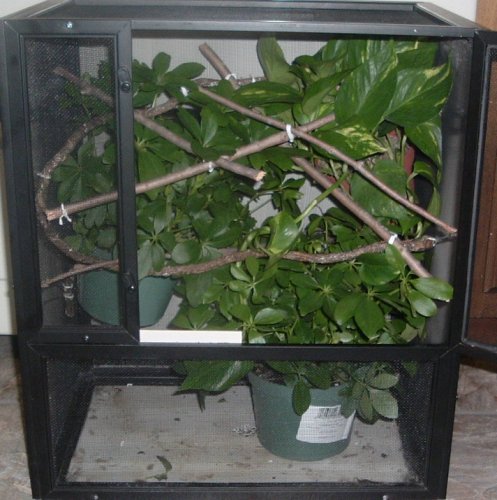
Perhaps this can help you with your set-up. This is for my juvenille jackson. The basking light was placed over the left corner. It is open more or less all the way to the bottom. He requires alot of water and it helps to dry the bottom quicker because the light actually hits it. Now you can see he has multiple branches in this area so he can bask at different temperatures. The plant in the back left corner is close enough that he can hide in it and still get some heat as he is kind of shy. I do often find him there soaking up some heat. This help him to feel comfortable. I also choose to put the basking lamp on the front corner to create a gradient. The side of the cage that the light is on is warmer and the other side is cooler. He can choose his comfort level and offers variations in humdity through out the cage. Alot of branches are important too. He can climb on any of the plants in the cage but some stable paths are necessary. When a feeder gets in range he usually can take one step in whatever dircetion they are and shoot his tongue. The middle part of the cage is his hide out. When I mist he usually goes there if he does not want to get wet. He can stay fairly dry and drinks the water as it drips off the leaves from above. I also drilled some holes in the middle part of the cage. I did put some screen on the bottom side so feeders could not escape out of the cage. For drainage I simply placed the whole cage on a tupperwear container. Does not look great but it is not a permanent cage so who cares it is, however, very functional for the time being. I should mention that I silicone around all the edges at the base so water could not escape out the sides. I hope this helps. Sometimes all they need is a good thought out home to get them going good.
IMHO you really need to get the temperature up above 70F ASAP...can you not add another incandescent (household light) light to the cage or a bigger wattage than you are already using? I don't think you are going to have much success getting him to eat unless he is warm enough. Please don't wait to add heat.
Chameleons will chase after insects most of the time.
Chameleons will chase after insects most of the time.
Similar threads

- Replies
- 89
- Views
- 11K


