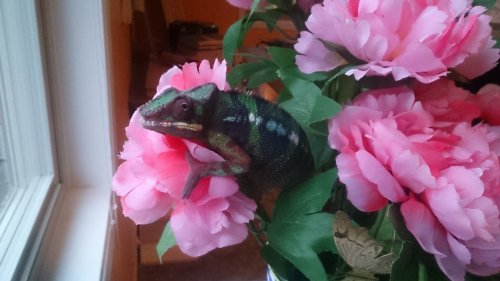
You said..."Currently I don't gut-load the feeders very often, which I know is not ideal"...you want to gutload/feed the insects a healthy diet and supplement them well so your chameleon will have all the nutrients it needs to be healthy too. You can feed/gutload superworms, crickets, roaches, locusts, etc with dandelion. greens, kale, endive, escarole, collards, squash, zucchini, sweet red pepper, sweet potato, carrots, and a bit of fruit such as berries, melon, apples, pears, etc.
It's recommended that you dust the insects at almost every feeding with a phosphorus-free calcium powder to make up for the insects usually poor ratio of calcium to phosphorus. It's recommended that you dust twice a month with a phosphorus-free calcium/D3 powder to ensure that the chameleon gets some D3 without overdosing it and letting it produce the rest of the D3 from it's exposure to the UVB light. D3 from supplements can build up in the system and lead to health issues but D3 produced from exposure to the UVB light won't as long as the chameleon can move in and out if the UVB at will. It's recommended.that you dust twice a month with a vitamin powder with no D3 that contains a beta carotene prOformed source of vitamin A. PrOformed sources of vitamin A won't build up in the system like prEformed vitamin A can so it's safe but it leaves it up to you to decide if the chameleon needs some prEformed or not. D3 from supplements and prEformed vitamin A are somewhat antagonistic to each other so they need to be in balance and both need to be in balance with the calcium and phosphorus too.
Appropriate temperatures allow for proper digestion and thus play a part in nutrient absorption. Hydration is important too of course.
@jajeanpierre has explained how the nutrients can be involved with the tongue and make you think your chameleon is having vision issues.
Hope you can get him back on track.
I also wouldn't let him hang out by a window in the winter...it might cause health issues too.