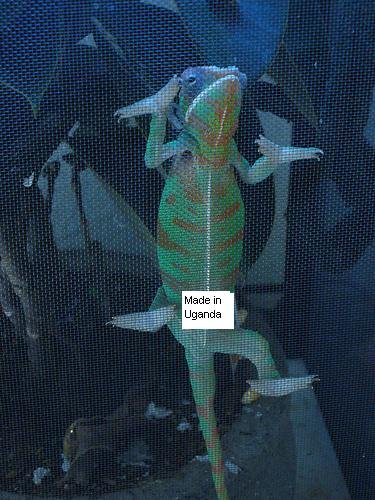
hoenhelii family

@anilr16 i post for you another pic of T Hoenhelii
garvid female whith anorher male and another female
i hope that you ll see the difference between your trioceros and tri hoenhelii :)

Celine,

Thanks for the additional photos! These look like the Kenyan hoehnelii that were exported in large numbers last time from the western Aberdares. Highly heterogeneous scalation (almost conical), a bit stalkier than the lowland populations, and with yellow heads. Gorgeous specimens, but from what I hear (and experienced in the past), tough to keep if night-time temperatures aren't low enough.

Cheers!

Fabián
 
Why could everybody house hoehneliis in pairs exepting me :eek:

I spoke with Rob Pilley a while back, who has kept several locales, from alpine to lowland, Kenyan and Ugandan alike, and he stressed the difficulty in keeping animals from different locales together. Since we often don't know the specific origin of these animals, and since they appear to live in small, isolated pockets within their range, he suggested keeping them separately, which I did. I had a really really tough time keeping them cool enough where I am, and was only able to keep the two lowland males I had alive successfully-- they were much more tolerant of higher nigh-time temperatures.

2858278451_dfbe23cb77_o.jpg


Cheers,

Fabián
 
Amazing pic Fabián ! One pair I've kept was form the yellow head locale, the others I don't remember well

Thanks! The yellow-head variety is really nice-- the males have this almost silvery, bluish, tint. They're just so tough to keep in warm climates, even with air conditioning. I look forward to living in a cool climate so I can keep them once again.

Cheers,

Fabián
 
You chams look great eisentrauti! Hoehneliis have always interested me but I have too many other projects going on to try and keep them. Keep up the good work!
 
Just for fun... some Ugandan hoehnelii from back in the day. Showing, yet more, variation within the species.

Male:
142-4300.jpg


Female:
143-4304.jpg
 
Just for fun... some Ugandan hoehnelii from back in the day. Showing, yet more, variation within the species.

Ahhhh.... Trace! You had those well hidden! The male I just posted above is also Ugandan-- you can clearly see the difference between a lowland animal and the more scaly alpine populations in Kenya. Amazing animals.

Thanks for posting!

Fabián
 
Sorry it's from Fabián ! ;)
I'm complete unable to make such nice pictures wheather I have a new camera now or not :rolleyes:

I know who Fabian and Chris are, and yes they have amazing photos, but I was talking about your chams from earlier in this thread. Your pics look better than a lot that i have seen. Also, I like to see people showing interest in often overlooked chameleon species.
 
I have some pics of a friend here, also from hoehneliis and believe me that they are in the sam color categorie than pumilum or damaranum :)
 
Greats shots showing variation guys! I had no idea there were so many different ones out there. I have witnessed a lot of variation in bitaeniatus, but hadn't seen it in these guys yet.
 
If you really want to know what local your chameleon is from, all you need to do is flip them over and look at their belly. :p
 

Attachments

  • 3048656834_a622c10a34.jpg
    3048656834_a622c10a34.jpg
    45.8 KB · Views: 152
the rudis arent in the hoehnelii family, but that clearly is a rudis. I have a gravid female rudis that displays the same colors and ive dealt with the species for a year so far, so i know quite alot on them.
Im positive everyone can agree with me that the middle pic is a rudis with the black diamonds.

absolutely not rudis!!!
 
For me i care my hoenhelli in the garden from mars to juillet
in summerthe temp can get up 32 degrees celcius the day and the night in low at 20 degrees .
in winter day 26 D night 14D The record for me the night 5 degrees( no problem for us:D)
If think this species love the sun not as other species of trioceros(QUAD CRISTATUS...)the can live with hot temperatures some months
whith high humidity theu need absoluty difference of 10 degrees night and day
 
Back
Top Bottom