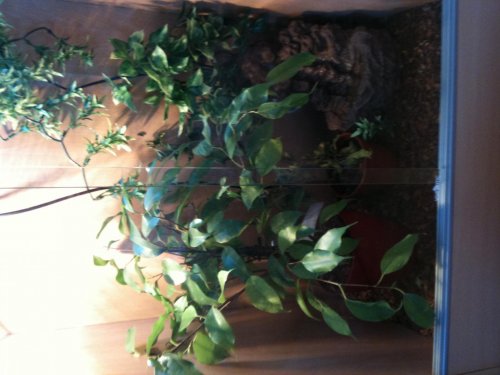
You said..."he said i also need a heat mat and repti bark for the floor and a waterfall for moisture"...I wouldn't use any of these. They are arboreal so they don't need a heat mat. If your house goes down below the low 60's F at night then you can buy a ceramic "bulb" Substrates might lead to impaction and some woods contain oils that are toxic to chameleons. The fountain is too difficult to keep clean.
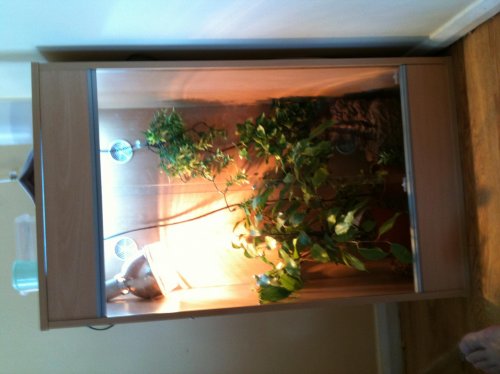
Is the cage completely solid...no screen anywhere?? If so this is not good IMHO. Where is the UVB light going to go?
How big is the cage?
Just want to mention this now, but when your female becomes sexually mature she could lay infertile eggs, so its important at that point to provide her with a place to dig to show you that she is ready to lay them. Its also important not to overfeed her once she is sexually mature...it may make the clutches larger and can lead to other issues too.
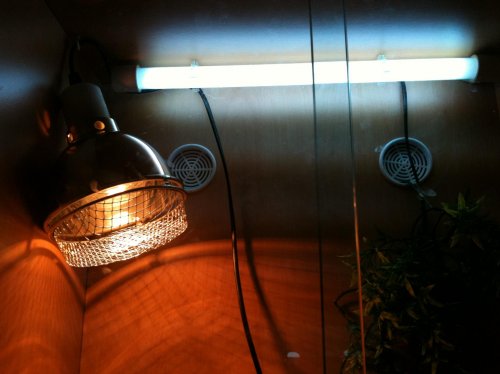
Its important that you provide UVB for your chameleon. The most often recommended UVB light is the long linear fluorescent Repti-sun 5.0 tube light. The UVB should not pass through glass or plastic. Exposure to UVB allows the chameleon to produce D3 which allows it to use the calcium in its system.
Since many/most of the insects used as feeders have a poor ratio of calcium to phosphorus, its important to dust them (before feeding them to the chameleon) with a phos.-free calcium powder.
To ensure that the chameleon gets some D3 without overdoing it I dust twice a month with a phos.-free calcium/D3 powder. D3 from supplements can build up in the system and cause problems but D3 produced from exposure to the UVB shouldn't as long as the chameleon can move away from the UVB if it wants to.
I also dust twice a month with a vitamin powder that contains a beta carotene (prOformed) source of vitamin A. Beta carotene can't build up in the system...however, its controversial as to whether all/any chameleons can convert the beta carotene...so some people give their chameleons a little prEformed vitamin A once in a while. The reason I use the vitamin powder with the beta carotene is that then the chameleon gets all the vitamins without overdosing the vitamin A and leaving it up to the chameleon's owner to control the prEformed vitamin A.
I gutload/feed the crickets, locusts, roaches, superworms, etc. a wide variety of greens (dandelions, kale, collards, endive, escarole, parsley, etc.) and veggies (carrots, squash, zucchini, sweet potato, sweet red pepper, etc.). BTW...these same greens and veggies along with a small amount of fruit (pears, apple, melon, berries, etc.).
Calcium, phos., D3 and vitamin A are all important players in bone health and need to be in balance. When trying to balance them you need to look at the supplements, what is fed to the chameleon and what is fed to the insects.
Appropriate temperatures also play a part in that they aid in good digestion so indirectly in nutrient absorption.
Here are some good sites...
http://web.archive.org/web/20060421.../index.php?show=6.Vitamin.D3.and.Calcium.html
http://web.archive.org/web/20060421.../index.php?show=6.Vitamin.D3.and.Calcium.html
http://www.uvguide.co.uk/
http://raisingkittytheveiledchameleon.blogspot.com/2007/12/keeping-female-veiled.html
http://chameleonnews.com/Home.html
Hope this helps!