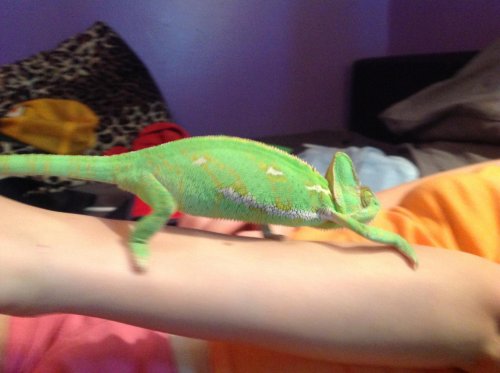
First of all...welcome to the forum! This is a great forum for chameleon owners!
Glad to hear she is a little better. Hopefully you can bring her back to good health.
Since you are new to this I will try to give youbadded much information as I can. Hope it won't be overwhelming.
I usually keep the basking temperature.perature in the low to mid 80's F for baby veileds. I use a regular incandescent household bulb in a domed fixture as a basking light. It should only be on during the day time. There is no need for heat at night unless the temperature drops below 65F...and no need for light at night.
The chameleon does need exposure to UVB light so that it can produce D3 so that it can use the calcium in its system. The most often recommended bulb for this is the long linear Repti-sun 5.0.
A wide variety of insects is recommended but crickets are a good staple since they are easy to obtain, keep and to gut load/feed. Insects should be of an appropriate size for the chameleon.
You can feed/gutload crickets, roaches, superworms, locusts with a wide assortment of greens such as dandelions, collards, endive, escarole, mustard greens, kale, etc and veggies such as carrots, sweet potato, sweet red pepper, squash, zucchini, etc.
Since most of the feeder insects we use have a poor ratio of calcium to phos its important to dust them at most feedings before feeding them to the chameleon with a phos - free calcium powder to help make up for it.
I also dust twice a month with phos - free calcium/D3 powder to ensure that the chameleon gets some D3 without overdosing it and leaving it to produce the rest from its exposure to the UVB light. D3 from supplements can build up in the system and lead to health issues.
I also dust twice a month with a vitamin powder that contains beta carotene (prOformed) source of vitamin A. PrOformed sources are converted as needed by the body but prEformed sources can build up in the system. However...here is controversy as to whether or not all/any chameleons can convert it....so it's up to the owner to decide whether to use any prEformed in addition to the regular vitamins. I have never had to use prEformed vitamin A for veiled chameleons....but its only my experience I'm speaking from.
Calcium, D3, phos and vitamin A are all important players in bone health and other systems in the chameleon and need to be in balance. Appropriate temperatures also play a part since they aid in digestion...thus indirectly in nutrient absorption.
Also...it's important to know that female veileds can produce eggs without having mated so it's important once they reach sexually maturity to provide them with an appropriate place to lay them so they won't become eggbound.
Hope this helps and that your little one will recover.