Chameleons have different likes & dislikes just like people. Mine
loves the mister during the day, and will come out into the mist and raise each leg in turn like he's taking a shower. On days he's allowed out to explore the Missus' plant table, he won't come out until
after he's been misted.

With all due respect, Bill Strand lives and raises his chameleons in California—not the Great Lakes or Northeast where winter heating systems can make the air drier than a popcorn fart.
He also uses drippers, which in my case is redundant.
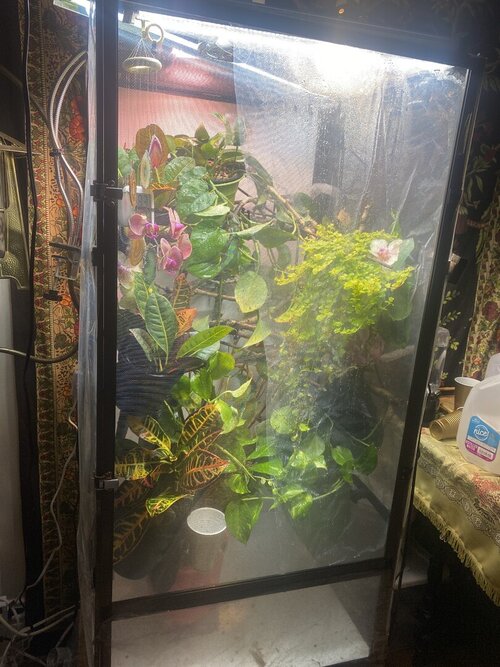
Sorry, but no, I don't see. 'Densely foliated' is subjective; you have lots of plants, and that's good, but the foliage isn't dense enough (IMO) to produce the microclimate I was talking about.
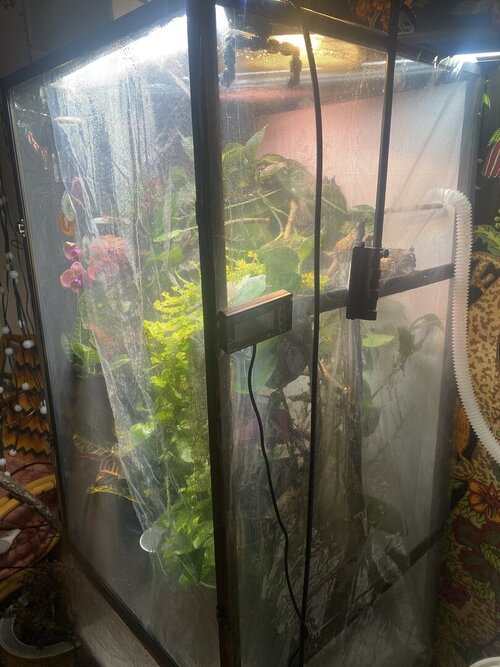
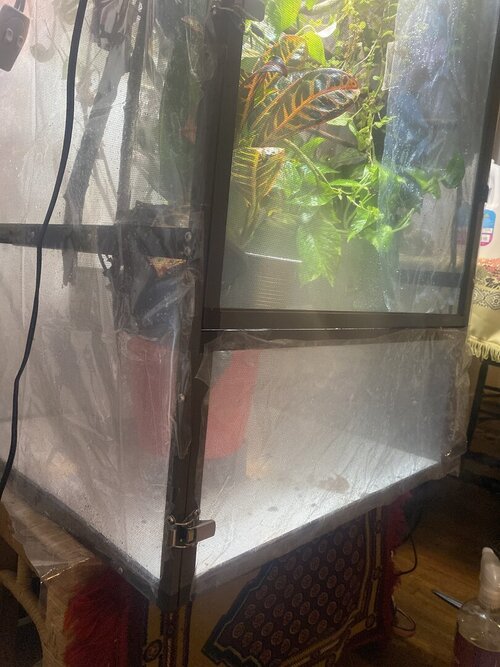
But lets talk about what I see in your pics above.
I can see you've got a lot of water going in by the amount of condensation (or mist) on the plastic. The question is, where is it going, and why? Thermodynamics say the moisture in the air will seek out drier air. This is (partly) what we have to control.
That's a
LOT of water all at once. Where's it all going? I'd guess (from experience & common sense) anything more than what's necessary to wet down the plants is likely going down the drain(age system), no?
You have the enclosure wrapped, and
that's good, but I see significant gaps in the wrapping. This is like trying to heat a log cabin with 1-2" gaps between all of the logs. It can be done, but you're going to have to pump a
lot more heat into it (or in this case moisture) than if the gaps were plugged/sealed. It also interferes with the natural
stack effect.
Window insulation—applied
correctly—would do a much better—
and less noticeable—job, and it's cheap. A hybrid enclosure would work even better—especially in areas like ours where seasonal conditions vary so greatly (also unlike California)—as the solid sides are also a better insulator than sheet plastic.
I can't see/tell if you have a fan to augment ventilation, but that should be a measure of last resort; stack effect—properly implemented—should be sufficient in most cases.
I'm seeing a double mist head. Two heads are generally recommend for that size enclosure, but the recommendation I got from B.S. (and MistKing) was to put them in the front corners—not right next to each other, where they likely have some overlap, yet may miss other areas. This can limit the effectiveness of your misting.
Something I
can't see are any instrumentation probe wires (or instrumentation for that matter), so IDK how (in)accurate your RH readings may/may not be.
I recognize we both live in areas with exceptionally dry (for chameleons) winters, and I'm relating what works—
for us—from my own husbandry and a lifetime of experience. Like everyone else here, I'm trying to help, but you're free to ignore.





 I mist many times throughout the night as well.
 . But if it isn’t that big of a deal to have the humidity so low during the day then I won’t worry so much. I’m just trying to see which should be the higher priority.


