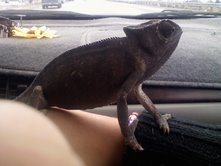
The following is information about the care of chameleons and maintaining their health....(it doesn't apply 100% to all chameleons.)...
Exposure to UVB either from direct sunlight or an appropriate UVB bulb (most highly/often recommended being the Repti-sun 5.0 long linear tube) will allow the chameleon to produce D3 which in turn will allow it to use the calcium in its system. The UVB from the sun or the light should not pass through glass or plastic. Some of the compact/spiral lights have been known to cause photo kerato conjuctivitus and this may cause the chameleon to try to get away from the light to avoid damage to its eyes. Also, by allowing the chameleon to be outside of its cage for long periods of time its not likely going to be exposed to the UVB long enough to produce enough D3. Lack of D3 can lead to MBD because the calcium can't be used.
Appropriate basking temperatures will aid in digestion and thus play a part in nutrient absorption. If the chameleon is allowed to be in an area where the temperatures are too cool, its digestion will slow down and it follows that it would absorb less nutrients.
Since most feeder insects have a poor ratio of calcium to phosphorous, the insects should be dusted before feeding them to the chameleon with a phos.-free calcium powder to help make up for it. This is not interchangeable with dusting with the calcium/D3 powder...its meant to balance the ratio of calcium to phosphorous and to work with the D3 acquired from exposure to UVB.
Dusting twice a month with a vitamin powder that contains a beta carotene (prOformed) source of vitamin A will ensure that it gets enough vitamins without overdosing the vitamin A. Beta carotene is converted into vitamin A as needed and won't build up in the system. Excess prEformed vitamin A (from animal sources and supplements usually) can build up in the system and prevent the D3 from doing its job and push the chameleon towards MBD. Using the powder with a beta carotene leaves the control of how much prEformed vitamin A it gets to the chameleon's owner...so its less likely to get an overdose (I hope).
Dusting twice a month with a phos.-free calcium/D3 powder (not necessary if the chameleon gets exposure to direct sunlight) will ensure that it gets enough D3 without overdoing it. D3 FROM SUPPLEMENTS can build up in the system and cause problems too....so just dusting lightly is enough.
Gutloading and feeding the insects a nutritious diet also plays a part in the nutrients available to the chameleon. I gutload/feed crickets, superworms, roaches a wide assortment of greens (dandelions, kale, collards, endive, escarole, mustard greens, etc.) and veggies (carrots, sweet potatoes, squash, zucchini, sweet red pepper, celery leaves, etc.). I don't usually like commercial products because I can't always be sure of what's in them so IMHO its harder to balance things.
Calcium, phos., D3 and vitamin A are the main players in bone health (and serve other important purposes in the system too) and the need to be in balance. When trying to balance them, you need to look at the supplements, what you feed to the chameleon and what you feed to the insects.
Water is important too...as for all creatures.
Here are some good sites that you might like to read...
http://adcham.com/
http://web.archive.org/web/20060502...als.com/vet/index.php?show=8.Gout.Basics.html
http://chameleonnews.com/
http://www.uvguide.co.uk/
Hope this helps.