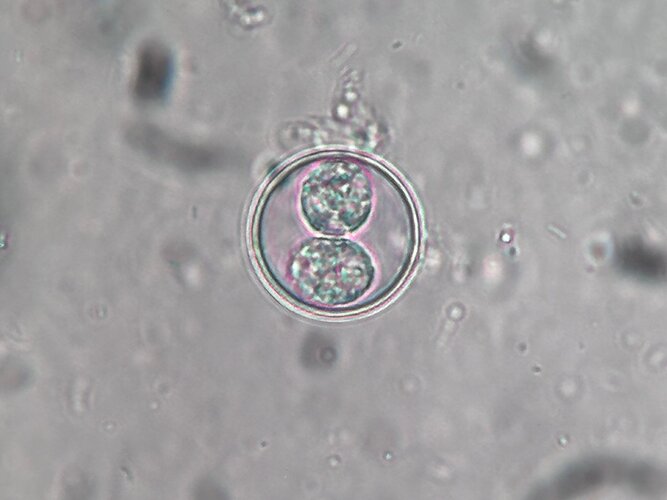
Feces check - Isospora Jajacimmani

How do I prevent Isospora after I've eradicated it? How are they getting it initially? Is it on their feeder crickets etc?
Coccidia makes it rounds in the captive community and number of ways. It has spent millenia learning how to get around. In our community breeders can be reservoirs of coccidia if they don't check. Pet stores can pass on coccidia if they bag up your crickets after cleaning cages. Coccidia probably won't come with the crickets but they could come on the bag that the crickets some in. And then their are reptile shows. You don't have to touch infected animals, you just have to touch the door knob someone who did hold an infected animal touched before you. I would suggest it is easier for coccidia to find their preferred host in captivity than it is in Madagascar.

Since your home probably has environmentally resistant oocysts spread around before you knew he was shedding there is no way to ensure there will not be a re-infection. I, of course, encourage every one to get a microscope and test their chameleons on a regular basis, but, outside of that, an annual fecal test is a great way to do checks.
Is a home microscope test accurate? I think that’s a great way to get kids doing some legit science work.
 
Is a home microscope test accurate? I think that’s a great way to get kids doing some legit science work.
Home testing is very accurate. In fact, finding the major endoparasites that infect our chameleons is actually very basic! Of course, it is a skill and there are plenty of things floating around in the slide so you have to know what you are looking for. Coccidia is actually one of the most straight forward of the parasites to identify and monitor. Home testing is limited and it can't find everything so getting a microscope is not a replacement for a vet, but it is a way to be a better partner to your vet. If you are doing home testing throughout the year you know exactly when to go to the vet and knock out an infection while it is starting rather than to wait until there is a physical symptom (the population has already gotten out of control) or else you just happen to have shedding going on when you do an annual wellness visit. Most people don't go tot he vet unless their animal is sick and so low levels of coccidia can be shed year after year without anyone knowing. This is how good breeders end up sending out healthy chameleons that just happen to also have coccidia.

I do have a course that teaches how to select a microscope, identify parasites, understand the medicines, and work with your vet if you re interested in diving into the microscopic world.
Hunting Microscopic Chameleon Parasites Course

Here is an example of the Isospora coccidia you are dealing with. This is an oocyst. These are the equivalent to eggs for parasites and these are very hard to kill. These come out in the poop and look to get into the mouth of the new host. It is mind blowing that a microscopic egg that cannot move on it's own can be pooped onto the ground in the vast forests of Madagascar and somehow find itself back into the mouth of the right host in the trees above. But they have gotten very good at it which is why they can do it in our captive community.

IMG_7512.jpeg
 
I’m afraid I’ll leave this question to those who have experience with this parasite.
I will offer though that many medications are very hard on delicate chameleon organs and keeping him well hydrated is essential. Perhaps you can get some silkworms to offer, which are very nutritious and hydrating, plus there is something irresistible about the wormy feeders. Hornworms are perfect for hydration if they are available where you are.
 
Thank you all again for the support and all this super useful tips.

We kept him hydrated (I hope) as much as possible, and every poop so far had the white stuff, nothing orange. We managed to cool down the living room to 18°C in the night so we could run the fogger and we were manual misting the plants 4-5 times during the day.

Meanwhile he also ignored any food again (so two days in a row) but today ate two crickets (yay). Today was also the 2nd appointment. Fridolyn was not amused to be put in the dark box again. We explained to the VET Fridolyns eating behaviour so the VET weighted him again. Surprisingly he had the same weight as one week before: 101g. The VET suggested, after we told him about our quarantine terrarium, to make a cloacal flush so he can test from fresh poop and see what's the status. And to our delight, he had no parasite at all. So it seems the treatment worked very well (it was the full one). This means, no 2nd treatment and we monitor his poop. (Finger crossed).

On the other hand I guess we have to earn his trust again. He still did not eat when we were back home and got directly black points when he saws us from far. So we stayed away as much as possible and now he went to sleep (at least we turned off the lights).
Thanks again all for the positive support. Let's hope he comes back to his eating habits asap.
With any parasitic infection, especially coccidia, you need to retest at least one more time, preferably two for coccidia, before celebrating. The parasite isn’t always shedding their eggs or whatever it is, so you can very well have false negatives. Sorry to rain on your parade.
 
Back
Top Bottom