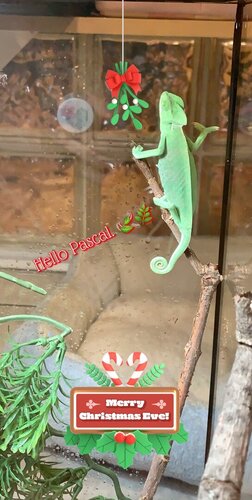
Chameleon Info:
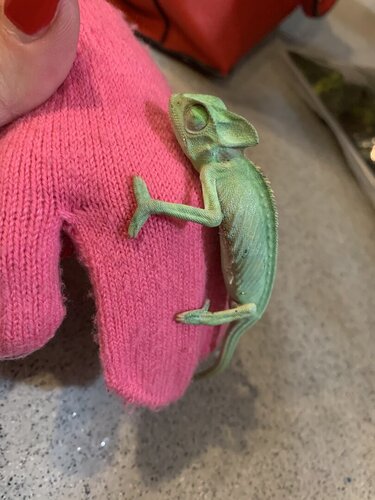
- Your Chameleon - The species, sex, and age of your chameleon. How long has it been in your care? Veiled chameleon, male 3-4 months, been in my care for 2 weeks.
- Handling - How often do you handle your chameleon? Every other day
- Feeding - What are you feeding your cham? What amount? What is the schedule? How are you gut-loading your feeders? Crickets offering 5-10 a day, in the morning and evening. Used an orange slice as told by pet store but have now switched to calcium dust
- Supplements - What brand and type of calcium and vitamin products are you dusting your feeders with and what is the schedule?
- Watering - What kind of watering technique do you use? How often and how long to you mist? Do you see your chameleon drinking? Misting by hand 2-4 times a day for about 1 min, also have the repti fogger humidifier
- Fecal Description - Briefly note colors and consistency from recent droppings. Has this chameleon ever been tested for parasites? Whitish yellow droppings, has not been tested.
- History - Any previous information about your cham that might be useful to others when trying to help you.
Cage Info:
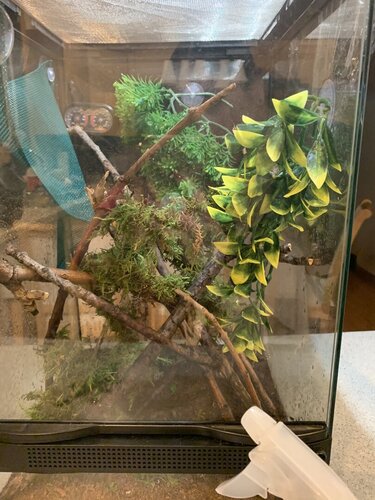
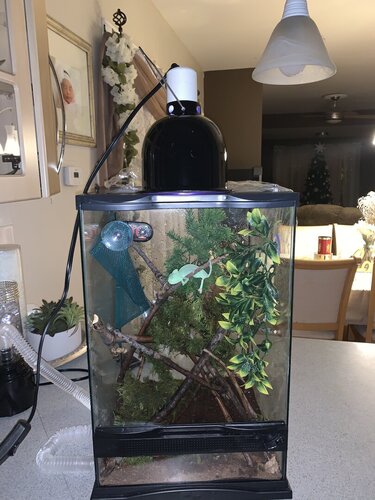
- Cage Type - Describe your cage (Glass, Screen, Combo?) What are the dimensions? Screen top and glass around 12” wide x 18” tall x12” deep
- Lighting - What brand, model, and types of lighting are you using? What is your daily lighting schedule? zoo med daylight blue 60w with uva on for 12-14 hours a daily. Was using a red nighttime heat bulb as well but stopped after reading he does not need at night.
- Temperature - What temp range have you created (cage floor to basking spot)? Lowest overnight temp? How do you measure these temps? Range between 60-80 degrees keeping track with thermometer at top
- Humidity - What are your humidity levels? How are you creating and maintaining these levels? What do you use to measure humidity? Between 60-80 currently have coconut fiber on the floor, misting and using the thermometer which includes measuring humidity. Have placed plastic wrap over the screen to help keep humidity. Also have mossy vine
- Plants - Are you using live plants? If so, what kind? No, plastic plants but real branches, currently changing.
- Placement - Where is your cage located? Is it near any fans, air vents, or high traffic areas? At what height is the top of the cage relative to your room floor? Currently on my kitchen counter top not near heat ventilation. Yes for high traffic in the kitchen (still have to find a good spot for him) about 4 ft from floor to top of cage
- Location - Where are you geographically located? Located in Chicago
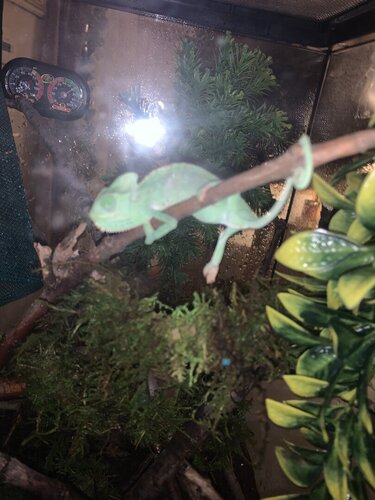
Current Problem - The current problem you are concerned about. Concerned that he is not eating enough and staying in one particular spot. Color is still green.
Your chameleon is in a dire situation, I'm sorry to say. It looks like skin and bones and they closed eyes are a very large concern. There are a lot of husbandry changes you need to make (almost everything unfortunately, to be honest), but a vet should be your first priority. Below I'll comment on specific husbandry changes that are important to make as soon as you can. But focus on making a vet appt first - at this point it is not optional.
Handling: Chameleons are not a good animal for handling, especially when you first get them. They are stress prone and frequent handling will make them distrust you. They need time to settle in first. Several weeks at least.
Feeding: Your gutload has almost no nutritional value to it. In order for crickets to provide your chameleon with the nutrients it requires, you need to offer the crickets healthy food like fresh produce (leafy greens like collards, mustard greens, turnip greens, escarole, sweet potato, papaya, etc) or a quality pre-made gutload (like Cricket Crack, NOT anything made by Fluker's). If you are feeding your crickets calcium, you can stop. That will not work for your chameleon.
Supplements: It appears you aren't supplementing at all, which is a critical aspect of chameleon care without which your chameleon will quickly fall ill. I recommend dusting feeders daily with Repashy Calcium Plus LoD. You do not feed the insects this, but cover the insect with it and then feed them to the chameleon.
Caging: Your enclosure is significantly too small for your chameleon. Even for a young one, you should use no less than 16x16x30. Adults need 24x24x48" enclosures and I would recommend just switching to one of these if your chameleon makes it.
Lighting: This category needs a total overhaul as well. First off, ditch the blue daylight bulb and replace it with a regular white household incandescent bulb instead. Colored lights are not recommended for chameleons.
More importantly, you don't list any UVB light at all?? Your chameleon needs a T5 HO linear UVB light right away if you do not have any. Without it, there is no chance of survival.
I implore you to read through the resources on this website in addition to making the above changes (but still vet above everything else) because there are many mistakes made in your current setup.