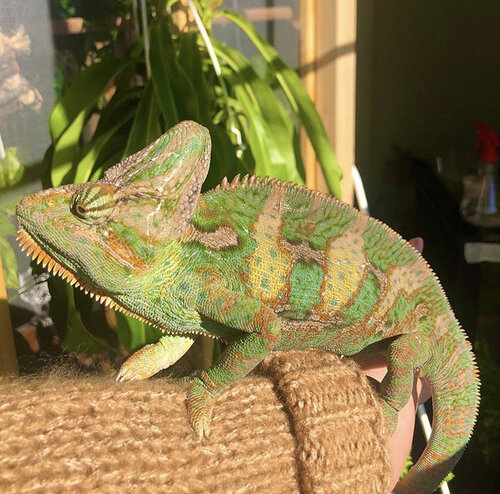
Chameleons can actually bite with a fair bit of force. Bite force has been measured in a number of species, but I'm only aware of it being published for various Bradypodion species. For instance, female Natal Midlands Dwarf Chameleons (Bradypodion thamnobates), which average only 6.642 cm SVL, will produce an average bite force of 24.74 N (da Silva et al., 2014 - PLoS ONE 9 (1)). Obviously though this is going to be quite a bit lower than say a Panther Chameleon (Furcifer pardalis), which are known to reach over 52 cm in total length. We can actually make a mathematical approximation, however, of what we could expect a larger species to produce.
If we assume a more typical sized panther chameleon (say 40 cm TL) and an approximately 50% tail length (thus a 20cm SVL), F. pardalis can be expected to be just over 3x the length of female B. thamnobates (20 cm / 6.642 cm). We then need to know, however, how a change in length relates to a change in bite force. The force a muscle can produce scales with muscle cross sectional area rather than length. Dimensional analysis tells us that area is proportionate to length squared (area is calculated as the product of two lengths), so area (and thus force) would scale in relation to length squared based on a pattern of geometric similarity (Hill, 1950 - Sci. Prog. 38). Thus, since F. pardalis is expected to be approximately 3x the length of female B. thamnobates, you would expect their bite force to on average be 9 times (3 squared) that of female B. thamnobates under geometric similarity. So, it would not be unreasonable to expect that an adult male F. pardalis could produce a bite force of over 222 N or a pound force of almost 50 lb!
Now, there are cases where an animal's proportions do not scale with geometric similarity. Veiled chameleons (Chamaeleo calyptratus) are a good example of this. The casque of C. calyptratus is not geometrically similar to that of B. thamnobates or F. pardalis. The structure of the casque is made up of bone and the space between the bones is filled primarily with jaw adductor muscles (the muscles responsible for closing the mouth and bite force). The casque thus creates an increased surface for jaw adductor muscles to attach and an increased space to store the bodies of these muscles. As a result, the enlarged casque serves not only a sexual selection and species recognition function, but also serves to increase the force they are able to bite with. Chamaeleo calyptratus thus have a disproportionately high bite force for their body size when compared to other chameleons.
Chris