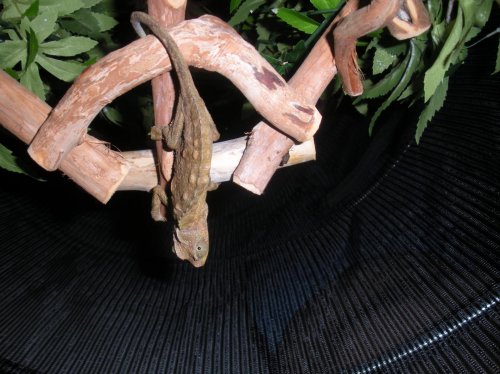
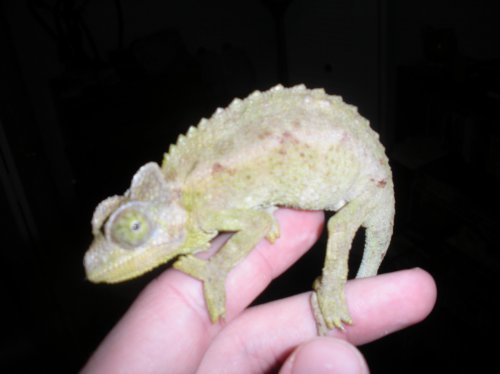
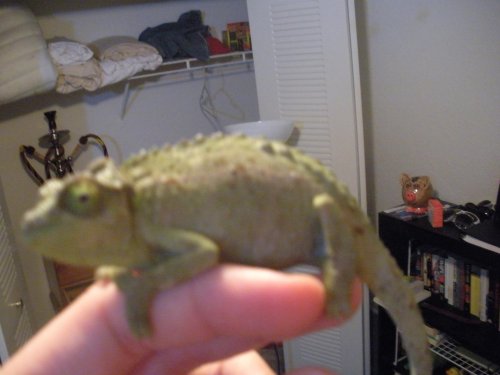
How much Calcuim with d3 have you been giving her? I have noticed this befor when a guy I knew said that jackson can handel d3 better then panthers. All his jackson chams ended looking just like yours. but I would still go to a vet.
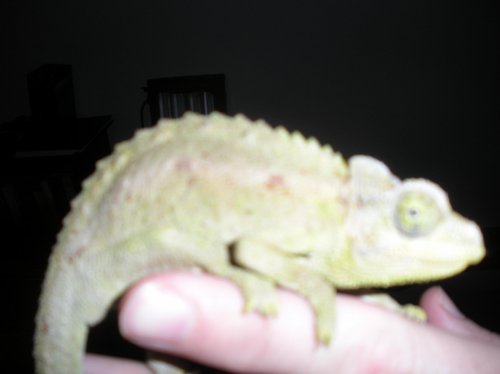
I can't really make out much from your pictures just to burry. It doesn't really look like parasites to me but too hard to see.
Can you fill out the how to ask for help form?
Here is some recommended information to include when asking for help in the health clinic forum. By providing this information, you will receive more accurate and beneficial responses. It might not be necessary to answer all these questions, but the more you provide the better. Please remember that even the most knowledgeable person can only guess at what your problem may be. Only an experienced reptile veterinarian who can directly examine your animal can give a true diagnosis of your chameleon's health.
Chameleon Info:
Your Chameleon - The species, sex, and age of your chameleon. How long has it been in your care?
Handling - How often do you handle your chameleon?
Feeding - What are you feeding your cham? What amount? What is the schedule? How are you gut-loading your feeders?
Supplements - What brand and type of calcium and vitamin products are you dusting your feeders with and what is the schedule?
Watering - What kind of watering technique do you use? How often and how long to you mist? Do you see your chameleon drinking?
Fecal Description - Briefly note colors and consistency from recent droppings. Has this chameleon ever been tested for parasites?
History - Any previous information about your cham that might be useful to others when trying to help you.
Cage Info:
Cage Type - Describe your cage (Glass, Screen, Combo?) What are the dimensions?
Lighting - What brand, model, and types of lighting are you using? What is your daily lighting schedule?
Temperature - What temp range have you created (cage floor to basking spot)? Lowest overnight temp? How do you measure these temps?
Humidity - What are your humidity levels? How are you creating and maintaining these levels? What do you use to measure humidity?
Plants - Are you using live plants? If so, what kind?
Placement - Where is your cage located? Is it near any fans, air vents, or high traffic areas? At what height is the top of the cage relative to your room floor?
Location - Where are you geographically located?
Current Problem - The current problem you are concerned about.
Chameleon Info:
Your Chameleon - xantholophus female about 14 months old I have had her for 2 months.
Handling - rarely
Feeding - 4-6 crickets a day gut-loaded with total bites cricket gutload.
Supplements - zoomed multivitamin, fluker calcium with and without d3. Calcium every other feeding, calcium with d3 every ten days, multivitamin twice a month.
Watering - I have an automatic mister that goes off 3 times a day.
Fecal Description - has dark and white parts
History - I got it from the breeder. She is possibly gravid having ben housed with a male before i got her.
Cage Info: 18 by 18 by 36 screen plenty of fake plants and branches.
Lighting - zoomed 26w compact flourescent uv bulb. zoomed 100w ceramic heat emiter. light on for 9 to 10 hours a day.
Temperature - 72 ambient to 80-84 basking. Lowest overnight temp is upper fifties on the coldest nights.
Plants - silk and plastic plants.
Placement - The cage is in a side bedroom hanging from the ceiling fan in the room is normaly off air vent does not point at it.
Location - orlando, florida
Current Problem - Bumps on the sides. They are hard and positioned over vertebra.