She should be in a bigger cage IMHO.
You said you use a repti-sun uvb compact fluoresent light...some of the compacts can cause eye issues...so the most often recommended UVB light is the long linear Repti-sun 5.0 fluorescent light.
You said the top towards the light is about 95 degrees...I keep my veiled females in the mid to low 80's to help keep their appetites down and feed them less than they would like to eat to keep them from producing large clutches.
IMHO real plants are better because some veileds have been known to try to eat fake ones.
If the chameleon can see the snake, I would try to change that. Some chameleons view snakes as predators.
I would take the substrate out...some substrates can cause impactions.
You said you feed her crickets [gut loaded with flukers' cricket gut loader] about a dozen a day. (dusted with rep-cal with d3)...
I gutload crickets, superworms, etc. with a wide variety of greens (dandelions, collards, kale, endive, escarole, mustard greens, etc.) and veggies (carrots, sweet potato, sweet red pepper, squash, zucchini, celery leaves, etc.)
Since many of the feeder insects we use have a poor ratio of calcium to phosphorus, I dust at most feedings with a phos.-free calcium powder to help make up for it.
I dust twice a month with a phos.-free calcim/D3 powder to ensure that the chameleon gets some D3 without overdoing it. I leave it to produce the rest of the D3 from its exposure to the UVB light. D3 from supplements can build up in the system and cause problems. D3 from exposure to UVB light should not build up as long as the chameleon can move in and out of it.
I dust twice a month with a vitamin powder with a beta carotene (prOformed) source of vitamin A. Beta carotene won't build up in the system but its controversial as to whether all/any chameleons can convert beta carotene...so some people give a little prEformed vitamin A once in a while. Excess prEformed may prevent the D3 from doing its job and push the chameleon towards MBD...so you need to be careful with it.
Calcium, D3, vitamin A and phos. are all important players in bone health and other systems in the chameleon and they need to be in balance. When trying to balance them, you need to look at the supplements, what you feed to the chameleon and what you feed to he insects.
Hope this helps!


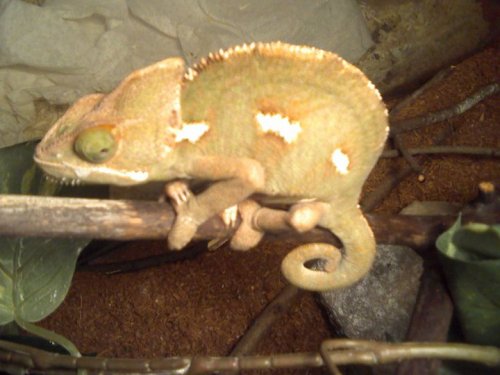
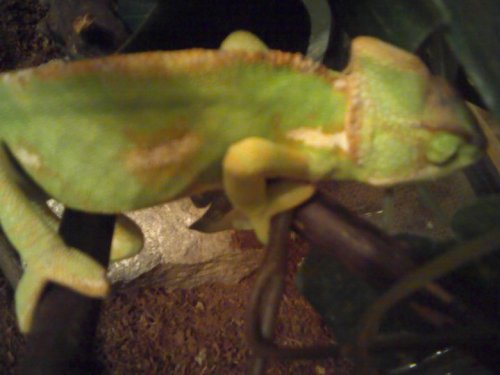
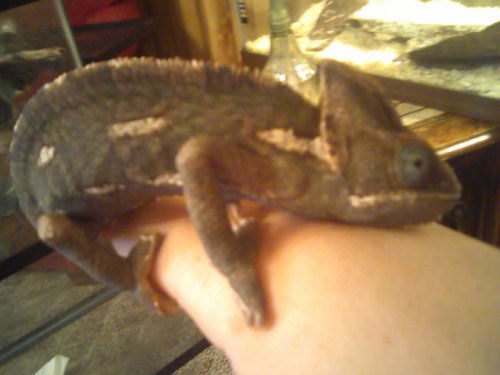


 the only time i get to see her pretty green is when shes sleeping and just wakes up in the morning! anybody else have some other suggestions?


