
Navigation
Install the app
How to install the app on iOS
Follow along with the video below to see how to install our site as a web app on your home screen.
Note: This feature may not be available in some browsers.
More options
You are using an out of date browser. It may not display this or other websites correctly.
You should upgrade or use an alternative browser.
You should upgrade or use an alternative browser.
Blood in Urine??????
- Thread starter jimr
- Start date


Olimpia
Biologist & Ecologist
Ok, he might require more water (It might not hurt to add one or two more mistings to his day juuuust in case, at any rate it might help him with kidney function if the blood is coming from there) but it might also be a kidney issue. It sounds like it might require a vet visit to make sure that things are functioning as they should. A blood test should (I think) determine if the kidneys are filtering everything as they should or if there is something going on.
That's my best guess though. Blood in the urine is usually urogenital in nature, so a vet would be in order. If you still have the poop a photo might help us give you more opinions.
That's my best guess though. Blood in the urine is usually urogenital in nature, so a vet would be in order. If you still have the poop a photo might help us give you more opinions.

Pilotman800
New Member
You should have a bit more variety for feeders. You should try silkworms, crickets, phoenix worms, dubia roaches, butterworms, and superworms. Mealworms should be used mainly as a treat.
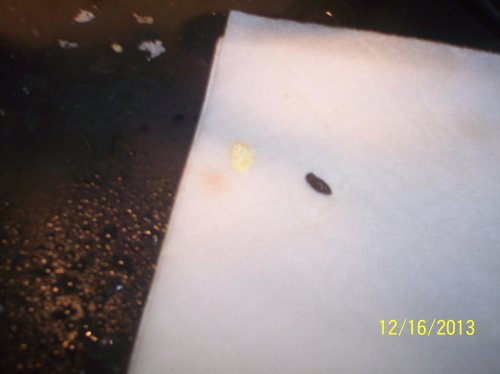
As for the blood, it would be helpful to have a photo.
As for the blood, it would be helpful to have a photo.
Pilotman800
New Member
I don't know if i'm just not experienced enough yet to see something out of the ordinary, but it looks normal to me. 

danibug23
New Member
I don't know if i'm just not experienced enough yet to see something out of the ordinary, but it looks normal to me.
If you look just below the white there is reddish pinkish something absorbed into the paper towel lol
Olimpia
Biologist & Ecologist
I see it. I imagine it is blood, but it is hard to tell. Normal poop wouldn't stain paper pinkish.
I would suggest making a vet appointment and taking a fecal sample (the fresher the better) with you so they can see if it isn't parasites or a renal issue. With some things, if it's my guys, I'll wait a few days to see if it wasn't a one time thing or if it is something to be worried about, but I personally wouldn't mess around with blood in the stool. Do you need help finding a good vet near you? We have dozens of members in your area who would help you.
I would suggest making a vet appointment and taking a fecal sample (the fresher the better) with you so they can see if it isn't parasites or a renal issue. With some things, if it's my guys, I'll wait a few days to see if it wasn't a one time thing or if it is something to be worried about, but I personally wouldn't mess around with blood in the stool. Do you need help finding a good vet near you? We have dozens of members in your area who would help you.

xanthoman
Avid Member
blood in urine aka gross hematuria
sorry, but to be honest your pic doesnt help much, in order for your pic to be of any real value it needs to be from 3" away not 3'. i did magnify it to 2x but it lost all resolution.
visible blood in the urine is known as gross hematuria, blood can also be in the urine, but not visible, this would be known as microscopic hematuria.
the only way to identify either with any certainty, would be through microscopy. so i would prep the floor of your cage asap for microscopy samples of urates, urine and feces. and submit fecal sample for a fecal float, submit the urates for a microscopy smear and submit a clean sq of the bed sheet (from underneath the urates as well if your vet is willing to deal with that).
first, you want to get the floor of your cage spotlessly clean. then, paper towels can cause issues, so i would use a piece of white (freshly washed) bedsheet cut to size, i would go 2 layers thick so the actual top layer isnt contaminated by the floor of the cage and just weight it down on the edges with some cleaned and washed/dried stones.
cup feed only what is necessary, so as not to contaminate the new cage floor. anything crawling on the floor of the cage might invalidate the sample. might also be a good idea to reduce, reposition or maybe even eliminate your dripper for the time being and hold your mistings to a minimum, as any moisture or anything else landing on your cage floor might contaminate the sample, (possibly watering by hand out of an eye dropper or better still a 12" long pipette)) i would submit everything asap.
in cham terms, gross hematuria would imo, most likely be pathogenic ie; parasites of one form or another. however there are also metabolic things that could cause hematuria, such as a kidney or bladder stone, or even kidney disease/renal failure. if the cham appears to be in otherwise good health then imo a stone is more likely. imo, the most likely cause for this would be too much calcium in relation to the water intake.
imo, another cause for this could be feeding too many cricks for too long. if you look at crick legs under a microscope, they are covered with sharp, not so little barbs, just like on a fish hook, plus the legs are all nearly bent at a right angle, when you get a bunch of them together they like to stick to each other like velcro, in microscopic terms, this is like trying to digest a ball of barbed wire. if the cricks themselves are dehydrated, then they are even harder to digest. so imo, in addition to the undesirable nutritional aspects of cricks, is just one more reason they dont make a good staple feeder. if you have to feed cricks, undersize is better than oversize, and the cricks should be well hydrated as well, for easier digestion by your cham. jmo
the first step is to determine if there actually is blood in the urine/urates by the above methods, which would also reveal if the cause was pathogenic or metabolic. if it turns out to be metabolic, then xray/ultrasound or a complete blood panel might be required to determine the actual cause.
i wouldnt wait on this as it could be serious, good thing you were observant enough to notice it. a problem like this could go south in a real hurry, so i would proceed asap. imo, since calcium could be a player in this, it might also be a good idea to slow down, or even eliminate, any supplementation until the cause is determined. just for the record, this isnt likely to resolve itself on its own. now is your chance to fix it,(assuming it is fixable) if you wait, imo, it may not be fixable. i subscribe to all threads i post in, but dont always make it back, so please feel free to keep me updated via vm or pm thanks. jmo
sorry, but to be honest your pic doesnt help much, in order for your pic to be of any real value it needs to be from 3" away not 3'. i did magnify it to 2x but it lost all resolution.
visible blood in the urine is known as gross hematuria, blood can also be in the urine, but not visible, this would be known as microscopic hematuria.
the only way to identify either with any certainty, would be through microscopy. so i would prep the floor of your cage asap for microscopy samples of urates, urine and feces. and submit fecal sample for a fecal float, submit the urates for a microscopy smear and submit a clean sq of the bed sheet (from underneath the urates as well if your vet is willing to deal with that).
first, you want to get the floor of your cage spotlessly clean. then, paper towels can cause issues, so i would use a piece of white (freshly washed) bedsheet cut to size, i would go 2 layers thick so the actual top layer isnt contaminated by the floor of the cage and just weight it down on the edges with some cleaned and washed/dried stones.
cup feed only what is necessary, so as not to contaminate the new cage floor. anything crawling on the floor of the cage might invalidate the sample. might also be a good idea to reduce, reposition or maybe even eliminate your dripper for the time being and hold your mistings to a minimum, as any moisture or anything else landing on your cage floor might contaminate the sample, (possibly watering by hand out of an eye dropper or better still a 12" long pipette)) i would submit everything asap.
in cham terms, gross hematuria would imo, most likely be pathogenic ie; parasites of one form or another. however there are also metabolic things that could cause hematuria, such as a kidney or bladder stone, or even kidney disease/renal failure. if the cham appears to be in otherwise good health then imo a stone is more likely. imo, the most likely cause for this would be too much calcium in relation to the water intake.
imo, another cause for this could be feeding too many cricks for too long. if you look at crick legs under a microscope, they are covered with sharp, not so little barbs, just like on a fish hook, plus the legs are all nearly bent at a right angle, when you get a bunch of them together they like to stick to each other like velcro, in microscopic terms, this is like trying to digest a ball of barbed wire. if the cricks themselves are dehydrated, then they are even harder to digest. so imo, in addition to the undesirable nutritional aspects of cricks, is just one more reason they dont make a good staple feeder. if you have to feed cricks, undersize is better than oversize, and the cricks should be well hydrated as well, for easier digestion by your cham. jmo
the first step is to determine if there actually is blood in the urine/urates by the above methods, which would also reveal if the cause was pathogenic or metabolic. if it turns out to be metabolic, then xray/ultrasound or a complete blood panel might be required to determine the actual cause.
i wouldnt wait on this as it could be serious, good thing you were observant enough to notice it. a problem like this could go south in a real hurry, so i would proceed asap. imo, since calcium could be a player in this, it might also be a good idea to slow down, or even eliminate, any supplementation until the cause is determined. just for the record, this isnt likely to resolve itself on its own. now is your chance to fix it,(assuming it is fixable) if you wait, imo, it may not be fixable. i subscribe to all threads i post in, but dont always make it back, so please feel free to keep me updated via vm or pm thanks. jmo
Last edited:
Similar threads

- Replies
- 10
- Views
- 1K


- Replies
- 6
- Views
- 615

- Replies
- 20
- Views
- 5K


