Comstocks2013
New Member
Chameleon Info:
Cage Info:
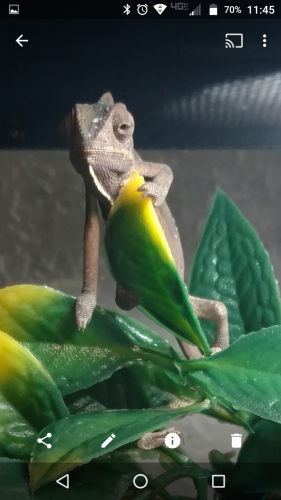
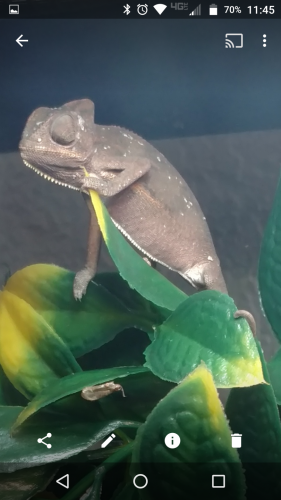
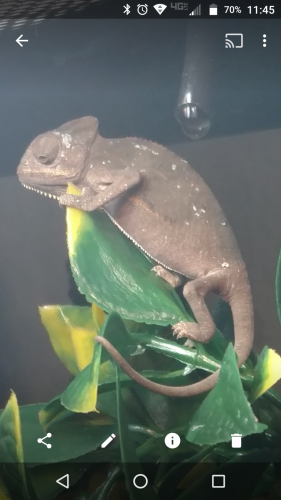
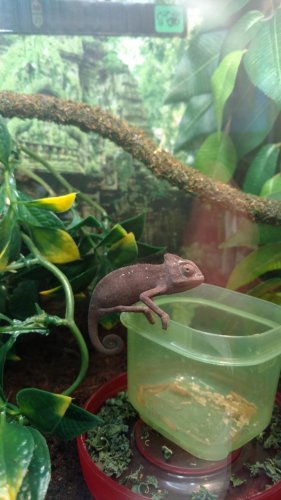
Current Problem - Yoshi is almost always a brown or dark brown color. The only time he turns green is when we hold him or when he's sleeping, at which point he turns a very healthy looking green. Is this ok? Should he always be brown when he's in his cage? From what I've read he could just be basking, however, sometimes he hides under leaves away from the light and he still stays brown. I've included a couple pictures. Any suggestions would be helpful as this is our first chameleon and we want to make sure we are providing the best care we can. Thanks!

- Your Chameleon - Yoshi is a veiled chamelon that we have had 1 week. I suspect it's a male.
- Handling - Every 2-3 days
- Feeding - Yoshi eats small gut loaded crickets, small meal worms, and small super worms. We put his food in a small bowl and he is able to reach it from a branch and vine. He seems to eat several times a day.
- Supplements - We have dusted the crickets with a calcium supplement one time in the past week.
- Watering - We have a little dripper on top of the cage that drips down on a plant. We also spray down the cage once or twice a day with a spray bottle.
- Fecal Description - Starts off white and then brown.
Cage Info:
- Cage Type - Glass 10 gallon aquarium. We plan on moving to a screen enclosure once he gets a little bigger.
- Lighting - Zoomed dual lamp with a daylight blue bulb and a reptisun bulb. We turn the light on in the morning and then turn it off at night.
- Temperature - Day time high temps seem to be 80-82. Night temps around 70. Sometimes I feel it gets too hot in there so I turn off the daylight blue bulb which then drops the temp to about 72-75.
- Humidity - I have not measured the humidity inside the cage although we mist it a couple times a day and have a dripper. The humidity in the house is ~30%.
- Plants - We have 2 artificial plans and a vine inside the cage.
- Placement - The cage is in the living room. There is a celing fan that is always running in the room.
- Location - Midwest USA.
Current Problem - Yoshi is almost always a brown or dark brown color. The only time he turns green is when we hold him or when he's sleeping, at which point he turns a very healthy looking green. Is this ok? Should he always be brown when he's in his cage? From what I've read he could just be basking, however, sometimes he hides under leaves away from the light and he still stays brown. I've included a couple pictures. Any suggestions would be helpful as this is our first chameleon and we want to make sure we are providing the best care we can. Thanks!