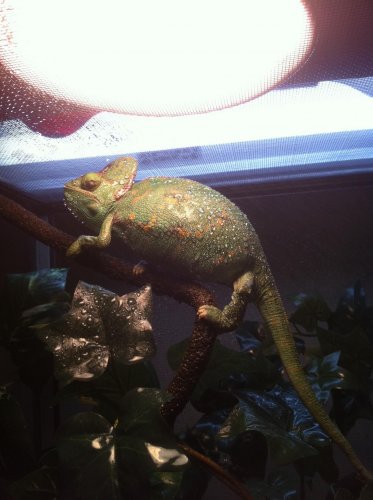
3 Y/O Female Veiled Dying...

jsharai

New Member
Chameleon Info:
  • Your Chameleon - Female, Veiled, Approx 3 Y/O - Purchased from pet store (by well meaning person who killed my Bearded Dragon) How long has it been in your care? Since Baby.
  • Handling - How often do you handle your chameleon? NEVER - She started biting me right after I got her, so I let her alone according to a book that said she's never tame.
  • Feeding - What are you feeding your cham? Crickets, Superworms, Mealworms What amount? 7-10 Crickets; 5-6 wormsWhat is the schedule? Every other day. How are you gut-loading your feeders? Flukers Orange and Cricket Crack; Lettuce
  • Supplements - What brand and type of calcium and vitamin products are you dusting your feeders with and what is the schedule? Flukers Calcium with Vitamin D
  • Watering - What kind of watering technique do you use? Misting How often and how long to you mist? 3-4 times daily with a full quart of warm water. Do you see your chameleon drinking? Yes
  • Fecal Description - Briefly note colors and consistency from recent droppings. Has this chameleon ever been tested for parasites? Was black-ish and white-gray. Not tested for parasites
  • History - Any previous information about your cham that might be useful to others when trying to help you. Besides being foul tempered (I say that endearingly) shes been a delight to have.
Cage Info:
  • Cage Type - Describe your cage (Glass, Screen, Combo?) What are the dimensions? DIY Screen 36
  • Lighting - What brand, model, and types of lighting are you using? What is your daily lighting schedule? Repti-sun 5.0, Heat lamp, Florescent "fill" lamp; clamp on heat lamp as needed
  • Temperature - What temp range have you created (cage floor to basking spot)? 70-85 Lowest overnight temp? 70 How do you measure these temps? In cage electric thermometer
  • Humidity - What are your humidity levels? 65-70 How are you creating and maintaining these levels? Misting What do you use to measure humidity? Flukers electric combo
  • Plants - Are you using live plants? If so, what kind? No, she dug them out
  • Placement - Where is your cage located? In corner of kitchen next to exterior windows Is it near any fans, air vents, or high traffic areas? No. At what height is the top of the cage relative to your room floor? 8 ft
  • Location - Where are you geographically located? New Orleans, LA
Current Problem - She started several weeks ago with pockets at the front of her orbits. They started going up and down. I misted her to try and irrigate possible shedding material caught there. She started having trouble seeing her crickets to eat. She managed to get them for a while, as well as the worms. Then she stopped eating and went to the bottom of the cage. She can open her eyes, but not much. When I walk up to the cage, she cracks an eye as if to say, "I'm still here". This has been going on for a week and honestly, I thought she would have passed by now. So I've been gently misting her and putting a few drops of water at the front of her mouth. She refuses to eat. She DOES move around the bottom of the cage, but not when anyone is looking. I"m going to try and get a photo up. It almost looks like the bone disease.

I can't afford a vet, so I have to rely on my own resources. If anyone has any ideas, we'd appreciate it. (Her baby picture is my avatar). I never thought I'd get attached to a little cham. But her personality got us. Thanks.

Jes
 
IMHO your chameleon is dying ...there could be a number of reasons why.
Her only chance at this point would be to see a vet IMHO.

You said..."How are you gut-loading your feeders? Flukers Orange and Cricket Crack; Lettuce"...IMHO your got loading is not very good. see below for more information.

You said you use Flukers Calcium with Vitamin D...usually its recommended to only use one with D3 twice a month and to use a phos.-free calcium powder at almost every feeding. How often do you use the powder?


Here's some information I hope will help you with supplementing, etc.....
Appropriate cage temperatures aid in digestion and thus play a part indirectly in nutrient absorption.

Exposure to UVB from either direct sunlight or a proper UVB light allows the chameleon to produce D3 so that it can use the calcium in its system to make/keep the bones strong and be used in other systems in the chameleon as well. The UVB should not pass through glass or plastic no matter whether its from the sun or the UVB light. The most often recommended UVB light is the long linear fluorescent Repti-sun 5.0 tube light. Some of the compacts, spirals and tube lights have caused health issues, but so far there have been no bad reports against this one.

A wide variety of insects that have been well fed and gutloaded should be fed to it.

Since many of the feeder insects we use in captivity have a poor ratio of calcium to phosphorus in them, its important to dust the insects just before you feed them to the chameleon at most feedings with a phos.-free calcium powder to help make up for it. (I use Rep-cal phosphorus-free calcium).

If you also dust twice a month with a phos.-free calcium/D3 powder it will ensure that your chameleon gets some D3 without overdoing it. It leaves the chameleon to produce the rest of what it needs through its exposure to the UVB light. D3 from supplements can build up in the system but D3 produced from exposure to UVB shouldn't as long as the chameleon can move in and out of it. (I use Rep-cal phos.-free calcium/D3).

Dusting twice a month as well with a vitamin powder that contains a beta carotene (prOformed) source of vitamin A will ensure that the chameleon gets some vitamins without the danger of overdosing the vitamin A. PrEformed sources of vitamin A can build up in the system and may prevent the D3 from doing its job and push the chameleon towards MBD. However, there is controversy as to whether all/any chameleons can convert the beta carotene and so some people give some prEformed vitamin A once in a while. (I use herptivite which has beta carotene.)

Gutloading/feeding the insects well helps to provide what the chameleon needs. I gutload crickets, roaches, locusts, superworms, etc. with an assortment of greens (dandelions, kale, collards, endive, escarole, mustard greens, etc.) and veggies (carrots, squash, sweet potato, sweet red pepper, zucchini, etc.)

Calcium, phos., D3 and vitamin A are important players in bone health and other systems in the chameleon (muscles, etc.) and they need to be in balance. When trying to balance them, you need to look at the supplements, what you feed the insects and what you feed the chameleon.
Please note that various supplements have various amounts of D3 and vitamin A and so some can be given more often than others. The idea still is not to overdo the fat soluble vitamins like D3 and prEformed vitamin A.

Here are some good sites for you to read too...
http://chameleonnews.com/07FebWheelock.html
http://web.archive.org/web/200605020...Vitamin.A.html
http://web.archive.org/web/200406080...d.Calcium.html
http://www.uvguide.co.uk/
http://web.archive.org/web/200601140...ww.adcham.com/
If you can't access the sites above that have the word "archive" in you can do it through the WayBackMachine.
 
Thanks for the great info! A vet might have been an option if she'd let anyone touch her. I've already been told that to move her at this point would definitely kill her from stress. Looks like I was short in the Calcium and gut loading material departments. Since I've been a member here, I've gotten great info. Unfortunately, I didn't know that I was doing the wrong thing. Now I've got some much better info...

And "Hi" japarker82! Nice to meet you. I'm on the North Shore in Covington...
 
Well, Gurl didn't make it. Thank you to those who helped out. I'm getting another soon, so I won't be far.

Jes

RIP Gurl
 

Attachments

  • GoodByeGurl.jpg
    GoodByeGurl.jpg
    247.4 KB · Views: 223
I'm so sorry. But you've learned a whole lot so the next experience will be better.

My aunt lives in Covington, I'm not quite sure....
 
Back
Top Bottom