Search results
-

Kinyongia boehmei
my boehmeis drink normally. I just spray and they drink as every other species. I keep them at 16°C-22°C now in Winter. -
2011 Best Photo
me too. This is something special. Maybe not perfect from the technical point of view, but I like the exceptionnel motive- MrCus
- Post #16
- Forum: Contest Archive
-
Kinyongia boehmei
Hi all of my female Kinyongias (boehmei, tavetana, multituberculata and vosseleri) had gestation duration of around 50-65 days. I think this is usual for this specias. This should be the same article from John Measey. He put some logger-probes next to the eggs where he found them and measured... -
Some Kinyongia Breeding Q and A
all of my multi-girls layed around 60 days after mating. So dont be nervious if she doesn't lay after 30 days... -
Kinyongia vosseleri hatchlings
Yes, the "father" is the guy on this picture I can upload a picture of the mother this evening. M. -
Kinyongia vosseleri hatchlings
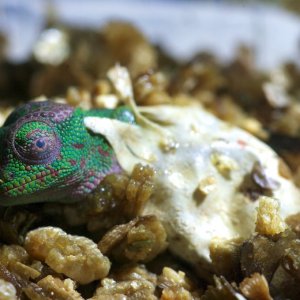
Hi everyone, two days ago I found one K. vosseleri egg scarified. When I came home from work yesterday evening, this Baby has already hatched. :) This means 342 days of incubation (~11month). I am waiting for a few more eggs to hatch, hopefully they are all healthy. Just have a picture... -
-
-
new slow-motion tongueshot videos
this is not my highspeedcamera. A friend of mine, a biologist, does films for TV-Stations etc. - He owns it. This camera costs more than 10'000$. The high-speed-memory (about 4GB/sec) to save the data and the stabilized spotlights with 800W each is extremely expensive, too. It was not easy for...- MrCus
- Post #3
- Forum: General Discussion
-
Species identification?
Hi, just found this thread. Yes, this is one of my chameleons. It is a K. vosseleri. You can see it in a few scenes in this youtube-movie: http://youtu.be/P3RInmg5SA4 -
new slow-motion tongueshot videos
Hi everyone just uploaded a new slow-motion video from my chameleons (some different Kinyongia - species) to youtube. Most of the shots were done at 2000-2800 fps have fun watching it (about 8 minutes) http://www.youtube.com/watch?v=P3RInmg5SA4- MrCus
- Thread
- Replies: 10
- Forum: General Discussion
-
K. Matschiei Copulation
hm can anyone confirm that notice? Until now I can not see any coherency on the length of the nails and the fertility of my chameleon-females. - Only patience helps. But my male has got quite long nails the last month.. hm. Does that mean anything? :) -
is Jacksonii a recognized sub-species?
Hi eisentrauti the status "species" or "subspecies" does not necessar ily say anithing about possible offsprings and their fertility. E.g. look at the Kinyongia fischeri complex: Until 2008 there were some subspecies K fischeri multituberculata, f. vosseleri, f. fischeri. - Since 2008 they are...- MrCus
- Post #9
- Forum: Science And Conservation
-
Eyes and distance
I know these postings talking about zoom. I guess this is a result of jumbling or misunderstanding the two things tele and zoom. Tele is a fixed focal length that makes far waway things seeming closer/bigger. Zoom is the ability of some object lenses to change the focal length from tele to wide...- MrCus
- Post #10
- Forum: Science And Conservation
-
Usambara Mountains - Climate Info
Hi Thanks for this link! (just one small thing: Haven't read the book already, but due to the book's title: Kinyongia multituberculata is from the huge West-Usambara area, chameleons from the smaller East Usambara Mts are vosseleri and matschiei ;) ) -
Eyes and distance
Well, i dont know exactly, but if e.g. a female sits on an exposed place and the male is not distraced by something, it recognize the female at about 15meters. This is what I wathed. I am sure they see each other at bigger distances.- MrCus
- Post #7
- Forum: Science And Conservation
-
Eyes and distance
well, I guess, first you need to understand, that there is no maximum distance you (or animals with similar eyes) can see. If the object is just big enough, you can see it even if it is Millions of kilometers away. The moon, for example. Or the milkyway. Of course, chameleons can see the moon...- MrCus
- Post #5
- Forum: Science And Conservation
-
Significance of keeping lines clean?
For the same reason why you keep chameleons instead of "our" German tauts or salamanders ;) Its legal to get wildcaught Chameleons but illigal to catch wildliving reptiles or amphibians from our own country. (And even if you could get a legal Bufo bufo, you would prefer a Chameleon I guess...) -
Kinyongia matschiei hatchling!
Congrats, keep us updated on this. Peter, maybe you can get in contact with Esther and finally get a female for your matschiei male? :) M.- MrCus
- Post #15
- Forum: Chameleon Breeding