The egglaying chamber is easily constructed by filling a 5 gallon bucket 6-12 inches full of moist sand or sand/peat moss mixture. What is wanted is a substrate that will facilitate tunneling. When the female is close to oviposition, she will often appear "restless" and wander around the cage looking for her preferred nesting spot. The female almost always choose the provided egg laying chamber, but occasionally, if a large plant is included, she will dig a nest below the root ball of a large potted plant. When she is serious about laying, she will begin to dig a tunnel, when the tunnel is sufficient for her needs (this usually take several hours) she will turn around and lay her eggs. After oviposition, the female will bury the eggs completely. Take care when digging up the eggs, as the females tend to lay them somewhere at the bottom of the container, and in a very tightly packed ball. Also, when looking for eggs, do not become disenheartened when you cannot find them right away, it often takes some serious, and delicate prospecting to find the egg mass (especially if the egg laying container is large!). Veiled chameleon clutches vary considerably, from 12 to as many as 80 eggs. Even without a second breeding, many females will go on to lay a second clutch from retained sperm 80-100 days after the first breeding.Eggs can be incubated in slightly moist vermiculite at 75-80 degrees. Fertile eggs are bright white, and when illuminated from behind in a dark room, are suffused with blood vessels. Infertile eggs are usually yellow and do not have blood vessels. During incubation, the eggs must be spaced a least one inch apart (to prevent premature hatching) and should be kept in the dark. After 150-200 days, the eggs should hatch. Right before hatching, the eggs will "sweat"-form little beads of water on their surface, and will begin to cave in. A day or so after this, the eggs should hatch.
Hatchling veiled chameleons are relatively hardy and can be housed in 10 gallon vivaria with a screen top, or (even better) and all screen enclosure. The temperature on the warm end should be 88-95 degrees and 75-80 on the cool end. Small live plants, such as pothos, are good to include in the enclosure. The babies will eat them and they will provide some hiding spots. As hatchlings, 6-7 babies can be kept in one enclosure, as long as food is liberally provided. Baby veileds should be fed pinhead crickets supplemented with calcium powder every day. They should be sprayed to provide drinking water and to raise the relative humidity every other day. Once the babies are two months old, the sexes should be separated both physically and visually. At this time, most babies are well established and ready to go to new homes.


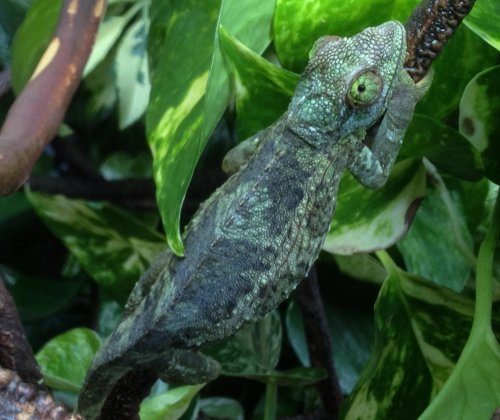
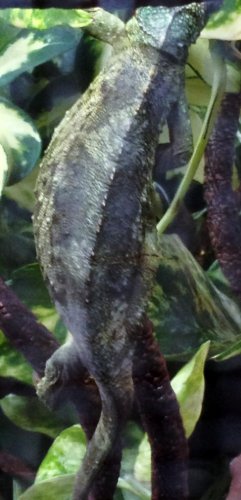
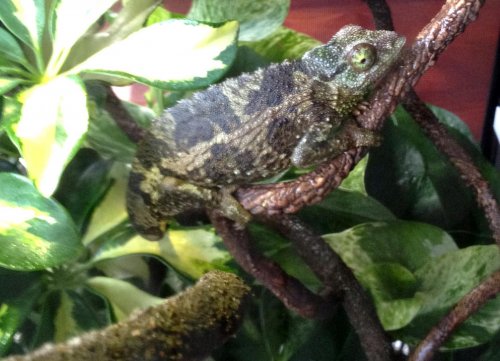
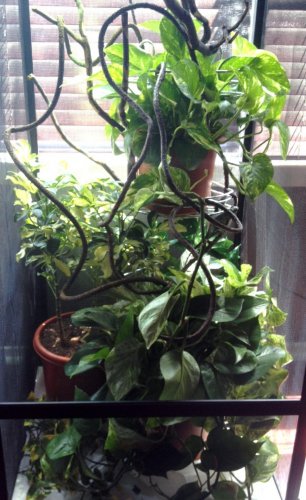


 .....I just wanted to know if anyone with experience with this specific species knows signs of pregnancy. I don't know her history or age so I wanted to know peoples thoughts based off of the pictures.


