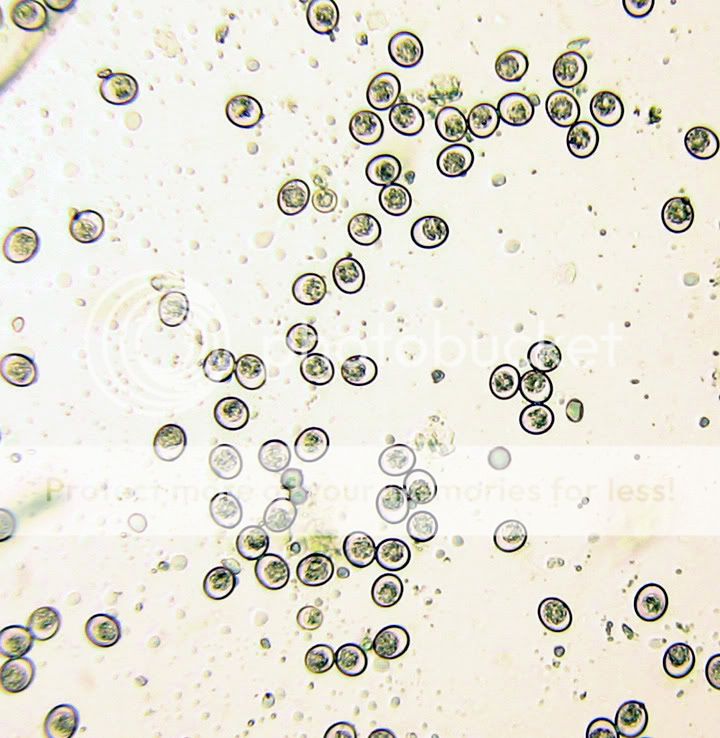
Parasite id pls :)

gpmo

New Member
Hi all,
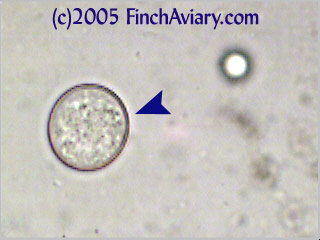
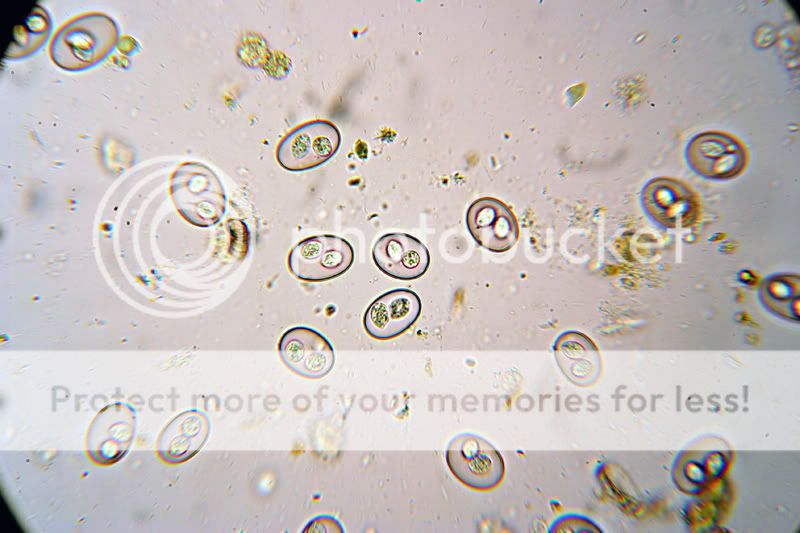
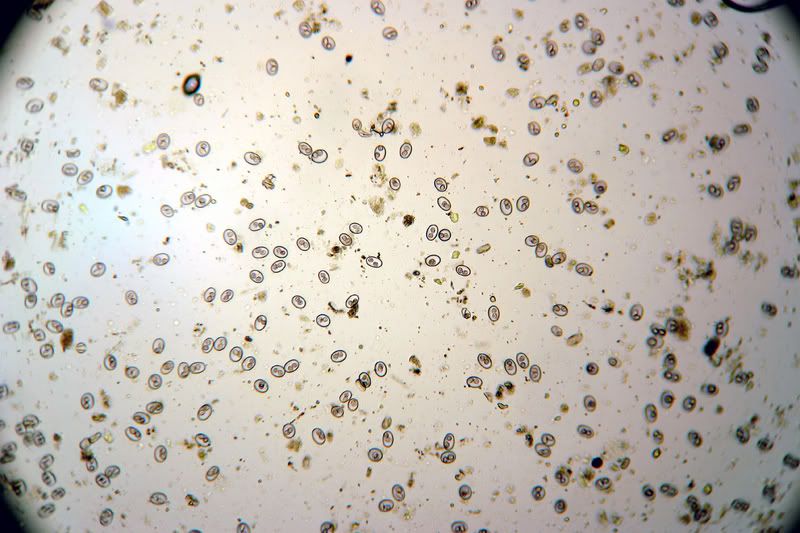
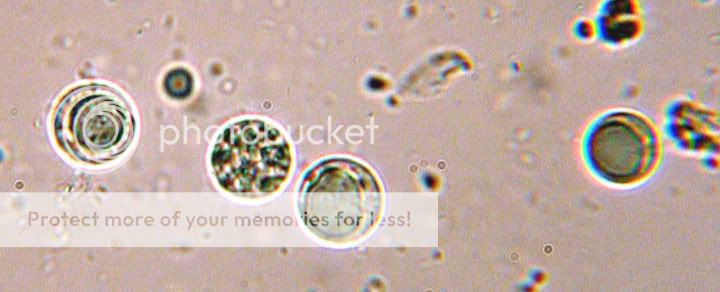
Ran a fecal on our Yemen on Sunday (first day I could find one that wasn't dried up :) ) and found these all over (on direct and float) any help with ID would be greatly appreciated!

gpmo (her)

Float
web.jpg


Float
web.jpg


Float
web.jpg


Direct
web.jpg


Direct
web.jpg


Sorry about pic quality, I didn't have a good setup :(
 
It looks like an oocyst of sorts. I'll skim through my book "Diseases of Reptiles" and see if I can't find something.
 
I don't know the type of parasite that is but if I were you I'd get your cham to get him treated for the parasites soon.
 
Thanks for the quick replies!
I promise his medical needs will be seen too promptly! I've emailed the pics to some veterinary parasitologists and no one has been able to ID. Just wondering if any cham owners have seen anything like this and if it is truly a parasite oocyst or a commensal. He is feeling fine/eating/drinking etc.

gpmo (her)
 
Syn,
I was leaning that way too but with the amount I saw I guess I would have expected him to be feeling bad...*shrug*

gpmo (her)
 
Well I've only read this book once or twice (and not fully).. so I can't give you a 100% answer. Just thought I'd try.
 
Did you use a stain at all? I notice a greenish hue. Pictures 1 and 2 are they of they same one or two different sites?

Im no expert but Ive done my share of fecals. Ive dealt with coccidia before. I think you have something else here. The outer shield on the coccidia is usually a uniform thickness all the way around usually. And eveyone you see will have that sheath, its their protection outside the body. I have noted that during treatment with ponazuril they seem to start to shed without their sheaths, presumably they have died already. I notice the other pictures in series the objects lack the outer shield and are of varying size as well. Which I havent noticed to be the case with coccidia. Im looking for a site I have bookmarked Ill post it in a few, hundreds of parasite photos.
 
Hiya Scott,

Pic 1 and 2 are of the same field. I didn't use stain on the direct or the float the odd color is just my crappy camera without a good mount on scope :( I would be very interested in the site you mentioned! I can't find anything similar in Mader's Reptile Medicine or online.

gpmo (her)
 
Just curious what do you use for gutload?

This site has alot of random photos, not specific to reptiles. At the same time tho it has alot of helpful pics. If you follow the site theres probably no kidding 300-400 sites all related to parasitology. If you look around maybe you will get lucky.

http://www.k-state.edu/parasitology/

This site here is more geared toward human parasites but members of the same families tend to be atleast somewhat similar.


http://www.cdfound.to.it/html/atlas.htm#atlas


Before you go too nuts though. Id wait for another fecal especially if he is doing well as it is. I had a WC pather with 50-75 coccidia per field at 100x she was doing really well with even that burden. Waiting to be sure of what your dealing with it better than giving meds for something that aint there. See if maybe you catch something else maybe an adult stage. Or maybe a better pic of one. Good luck I know it can be really hard to pin some of em down.
 
Howdy,

I too, have seen that same thing in many keepers' chameleon fecal floats and smears. I can't recall if I ever showed one of my photos of that particular finding to a vet or not but, at the moment my money is bet on either a pseudo-parasite (looks like a parasite but isn't) or a fairly benign parasite. I don't think it is coccidia. Classic reptile coccidia goes through several stages of development and you usually end-up seeing it in the most common form where it has either 1 or 2 (sporocysts) little nuclei-looking shapes inside with room between them and the outer wall.

Here's one of my coccidia (Isospora sp.) photos at 400x:
Coccidia400x.jpg


Coccidia (Isospora sp.) at 100x:
Coccidia100x.jpg


Here's what I currently think of as pseudo-parasites (I'm also ready for an expert to ID them as something else!):
IMG_4886Mod1.jpg
 
Hi all,

Wanted to update on Angus. We went to the vet today and got a diagnosis. The parasites are coccidia but they are an Eimeria spp. which are not as pathogenic as the Isospora spp. We are still going to treat (with ponazuril if I can find a pharmacy that will compound it) because of his large parasite load and because I found a fleck of blood in his stool. He is still eating and drinking well and acting fine :)

Dave, your pic of the pseudoparasite looks a lot like what we found, perhaps it's Eimeria too?

Thanks for the help all!

gpmo (her)
 
Hi all,

Wanted to update on Angus. We went to the vet today and got a diagnosis. The parasites are coccidia but they are an Eimeria spp. which are not as pathogenic as the Isospora spp. We are still going to treat (with ponazuril if I can find a pharmacy that will compound it) because of his large parasite load and because I found a fleck of blood in his stool. He is still eating and drinking well and acting fine :)

Dave, your pic of the pseudoparasite looks a lot like what we found, perhaps it's Eimeria too?

Thanks for the help all!

gpmo (her)
Howdy,

If you can't find a compounding pharmacy nearby, just do as many of us have done, order it from here:

Diamondback Drugs
7316 East Thomas Road
Scottsdale, Arizona 85251
Telephone: 480 946-2223
Toll Free: 1-866-646-2223
Fax: 480 946-2235
Toll Free Fax: 1-866-646-2235
http://www.diamondbackdrugs.com/
Email: [email protected]
Member of: IACP NCPA VCS

It was only something like $25 for hundreds of doses worth of the liquid compound. Shipping was way less than $10 :).


Here's another example photo that I took of coccidia from another keeper's panther.
What I usually find is lots of room between the outer case and inner sporocyst(s) like these ones.
IMG_4534Mod1.jpg


Even when they have 2 or 4 inner sporocysts, there's still room between them. See the ones in these links:
http://www.k-state.edu/parasitology/625tutorials/Oocysts02.html
http://www.k-state.edu/parasitology/625tutorials/Apicomplexa02.html

There are lots of different coccidia types and stages within those types so if your vet thinks it's coccidia then it probably is coccidia :o. So long as you are treating with Ponazuril, there isn't much to worry about. Treating with Albon, for example, can have troublesome side effects :( Good luck!
 
Last edited:
What! A company in Arizona? Goodness! I wish I had known about that sooner.. I've bookmarked them for future reference. Thank you Dave!
 
Hi Dave,

Thanks very much for the pharmacy info! I will keep the thread updated after we treat and repeat fecals :)

gpmo (her)
 
Back
Top Bottom