Gotti
New Member
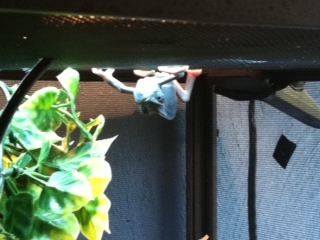
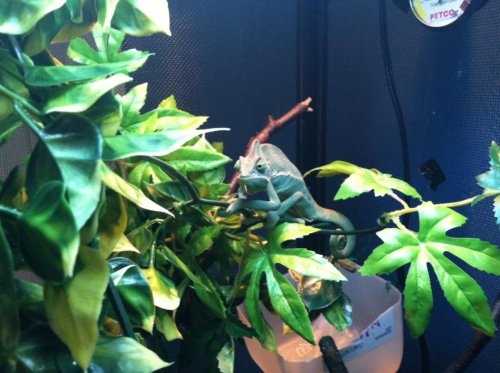
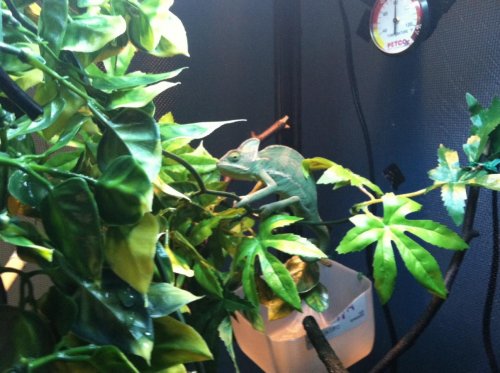
I'm a fairly new cham owner and I was wondering If some of you cham experts could read over my "How to ask for help" and give me any tips or advice, and look at the pictures and see how my little guy looks 
Chameleon Info:
Your Chameleon - Veiled, male 3 1/2-4 1/2 months I've had him for about three weeks
Handling - Couple times a week mainly to take him outside
Feeding - I feed him about 20 small crickets a day with a mixture of meal worms and wax worms I tried Dubia Crickets but he ate one and then showed no interest in the rest. I feed them fluckers dry and orange cube gutload with some carrots apples oranges and every now and then some romaine lettuce
Supplements -I use Zoo Med Repti calcium w/o d3, and Rep-Cal Calcium w d3 and multivit, I use calcium w/o d3 everyday and multi and Cal w d3 i rotate every saturday
Watering - I have a dripper constantly and mist 3-5 times a day, rarely do i see him drink
Fecal Description -His droppings are large and solid and urate is a good white
History - N/A
Cage Info:All screen, 18x18x36
Cage Type - Lighting - 50 watt basking bulb 5.0 repti glow uvb light, both come on at 7 AM and go off at 8 PM
Temperature - His basking spot ranges between 78-85 depending on outside temps
Plants - I'm trying to nurse a pothos plant back to life to put in his cage
Placement - My cage is in my room low traffic and the top of the cage is over my head and I'm 6'2
Location - I live in Virginia Beach, Virginia.
Chameleon Info:
Your Chameleon - Veiled, male 3 1/2-4 1/2 months I've had him for about three weeks
Handling - Couple times a week mainly to take him outside
Feeding - I feed him about 20 small crickets a day with a mixture of meal worms and wax worms I tried Dubia Crickets but he ate one and then showed no interest in the rest. I feed them fluckers dry and orange cube gutload with some carrots apples oranges and every now and then some romaine lettuce
Supplements -I use Zoo Med Repti calcium w/o d3, and Rep-Cal Calcium w d3 and multivit, I use calcium w/o d3 everyday and multi and Cal w d3 i rotate every saturday
Watering - I have a dripper constantly and mist 3-5 times a day, rarely do i see him drink
Fecal Description -His droppings are large and solid and urate is a good white
History - N/A
Cage Info:All screen, 18x18x36
Cage Type - Lighting - 50 watt basking bulb 5.0 repti glow uvb light, both come on at 7 AM and go off at 8 PM
Temperature - His basking spot ranges between 78-85 depending on outside temps
Plants - I'm trying to nurse a pothos plant back to life to put in his cage
Placement - My cage is in my room low traffic and the top of the cage is over my head and I'm 6'2
Location - I live in Virginia Beach, Virginia.