
Search results
-

Kinyongia boehmei question
I created a topic and shared most of my experience with this species, it's in the Kinyongia section. As for dietary preferences, try small beetles. Good chance they'll go crazy for them ;)- Ferdy Timmerman
- Post #12
- Forum: General Discussion
-
what type of chameleon is this?
Both 0, so any captives will (probably) be illegal. You can check export quota on http://www.cites.org/eng/resources/quotas/index.php- Ferdy Timmerman
- Post #11
- Forum: Chameleon Identification
-
Fischers chameleon care
Maybe, but the internet also makes people lazy, plus there's too much useless information around. A book (or scientific paper etc.) will tell you where different chameleon species are from, and should give you a much wider view on them as a group. Some people tend to just buy a few chameleons...- Ferdy Timmerman
- Post #14
- Forum: General Discussion
-
Fischers chameleon care
Would these chameleons be the first ones you'd keep? There are easier species to start of with. And no offense, but buying and reading a good chameleon book might be a better strategy than trying to find everything on the internet...- Ferdy Timmerman
- Post #11
- Forum: General Discussion
-
-
Kinyongia boehmei
Here's a few photo's of my young male :)- Ferdy Timmerman
- Post #71
- Forum: Kinyongia
-
Kinyongia boehmei
They're higher temps than I would use as well. Anyway, it was a bad idea to buy them, cause I lost the second female today. The male still looks like a champion though... If the seller doesn't answer my email, I'll confront him next time I see him.- Ferdy Timmerman
- Post #68
- Forum: Kinyongia
-
T quadricornis eggs :D
Congrats on the eggs! Hope they'll hatch!- Ferdy Timmerman
- Post #11
- Forum: Chameleon Breeding
-
Kinyongia boehmei
All three boehmei's looked healthy when I bought them. I'm always very critical.- Ferdy Timmerman
- Post #65
- Forum: Kinyongia
-
Kinyongia boehmei
Yes, grams, but you made them a bit heavier than they are in fact ;) (You might have missed my earlier post on the previous page by the way, just to point it out)- Ferdy Timmerman
- Post #63
- Forum: Kinyongia
-
Sprite bottle insect feeder
Just found this thread. Smart idea! I like the fact that you used a green bottle, it blends in pretty well with the plants :)- Ferdy Timmerman
- Post #22
- Forum: Chameleon Food
-
Kinyongia boehmei
A little bit of extra info; I weighed all of them on 3 Jan. 13 and today (29 Jan.), the male went from 1,82 to 2,82 grams, the female I have left went from 1,50 to 1,30 grams... Bad news for her...- Ferdy Timmerman
- Post #61
- Forum: Kinyongia
-
Kinyongia boehmei
Here's some advice: don't incubate boehmei eggs at high temperatures. I lost one female, the second one is showing the same signs. I am 99,9% sure she won't make it either. The male is doing very well, however. The seller told me that the male was from a different clutch than the females...- Ferdy Timmerman
- Post #60
- Forum: Kinyongia
-
Kinyongia boehmei
I agree with you guys, in most cases you'll get healthier, stronger babies when using relatively lower incubation temperatures. Therefore I'd never experiment with such high incubation temps myself. My new boehmei's are doing well as far as I can see. Only one of the females had something in...- Ferdy Timmerman
- Post #59
- Forum: Kinyongia
-
Kinyongia boehmei
Found myself some new boehmei yesterday, this time they're CH. I talked to the seller, he told me the eggs were incubated in an incubator with some snake eggs, since he didn't have room anywhere else. As a result, the eggs were supposedly incubated at 28 degrees C and hatched after about 110...- Ferdy Timmerman
- Post #53
- Forum: Kinyongia
-
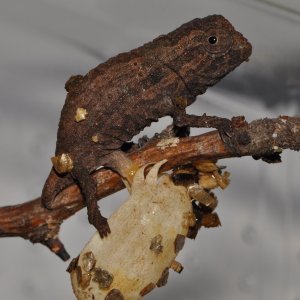
Trying To Lose The Egg...
A hatchling Rieppeleon brevicaudatus still attached to its egg- Ferdy Timmerman
- Media item
- brevicaudatus hatchling rieppeleon
- Comments: 0
- Category: June 2012
-
Kinyongia vosseleri hatchlings
A rare sight, congratulations! Do you still have adults too? Would love to see some photo's!- Ferdy Timmerman
- Post #8
- Forum: Kinyongia
-
May 2012 Photo Contest
Thanks for voting everyone! :D- Ferdy Timmerman
- Post #39
- Forum: Contest Archive
-
which hangplants are safe for in coconuts basks?
I believe you´re right, but the plant we´re talking about is also sold as Scindapsus (at least over here). I found this site: http://www.wimkap.nl/ It's a Dutch company that sells the plant, and they give it both names.- Ferdy Timmerman
- Post #13
- Forum: Enclosures And Supplies
-
which hangplants are safe for in coconuts basks?
Or Scindapsus :)- Ferdy Timmerman
- Post #7
- Forum: Enclosures And Supplies