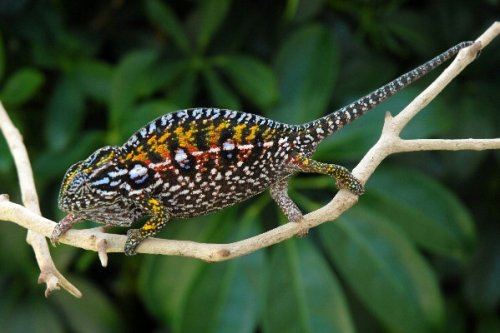
Chameleons can make rewarding captives when their needs are properly provided for and they are cared for appropriately. While their care can be more demanding then many other reptiles and some species are particularly difficult to keep, all keepers should be prepared with some basic information that will help them on their way.
Some of your first considerations should be about the appropriateness of a chameleon in your care. It is important to recognize that chameleons are shy, solitary animals that would much rather be left alone then frequently handled and otherwise harassed. They are prone to stress during such interactions which can lead to illnesses that are difficult to catch and treat. Further, similar stress can occur under inadequate husbandry conditions so it is important to provide an appropriate environment and consistent care.
Additionally, being solitary animals, true chameleons do not tolerate cohabitation with other animals, even their own species, very well. In most circumstances, your chameleon should be housed alone.
Enclosure:
Most true chameleons are easiest to keep in a screen or wire mesh enclosure. These are available in various forms for a variety of price points. Aluminum framed screen cages and PVC framed mesh enclosures are the most common but many keepers build their own wood framed enclosures with screen sides and top.
Chameleons do not do well with the stagnant air associated with most tanks. Further, there are occasionally issues with reflection and barrier confusion in glass enclosures. In general, it is easiest to keep chameleons in screen enclosures to eliminate these issues.
Many new keepers often worry about their ability to maintain humidity and temperature in mesh enclosures. Thankfully, there are various methods of doing so appropriately which make this concern less of an issue. These methods are mentioned in the “Internal Furnishing,” “Lighting” and “Hydration” sections of this sheet.
True chameleons are for the most part arboreal animals. When designing their enclosures, it is important to remember this and appropriately provide for this lifestyle. Enclosures should provide sufficient vertical space but not neglect horizontal room. Adult male Panther or Veiled Chameleons do well in cages 4’(tall)x2’x2’ with females doing well in somewhat smaller enclosures.
When placing your enclosure in your home, remember that chameleons live in trees and bushes and height is one of their protection mechanisms from predators. As a result, having the cage low to the ground can be potentially stressful for your chameleon and you should consider elevating the enclosure to provide for this comfort.
Internal Furnishing:
Chameleons require a decent amount of foliage cover to feel secure. While some keepers are inclined to provide fake plants, live plants are far superior and also have other benefits. To start with, live plants help maintain humidity in the enclosure which is important for chameleons. Further, some species, like Veiled Chameleons, are omnivores and will eat some of the leaves from the plants in their enclosure. Additionally, live plants provide excellent coverage and climbing area.
It is important to stick to nontoxic plant species in case your chameleon or its feeders should ingest any of the plant. Some commonly utilized species include various Ficus trees, Hibiscus, Pothos and Schefflera. These plants should be washed prior to being placed in the enclosure to remove any pesticides used by their supplier.
In addition to plants, both vertical and horizontal branches should be provided for the chameleon to use. Such branches should be of varying diameter to provide the chameleon with the ability to grasp surfaces of different dimensions.
Substrates should be avoided in true chameleon enclosures. They provide a risk of impaction to the animal, are a breeding ground for bacteria and fungus and are of little use to chameleons. Bare bottom enclosures or use of paper towels is recommended. It is, however, important to keep the bottom of the enclosure clean to prevent fungal and bacteria buildup.
Lighting:
Chameleons require UVB radiation to facilitate their calcium metabolic pathways. Many lights claim to provide UVB radiation for reptiles but these claims are often over stated or inaccurate. Even bulbs that claim to have equal UVB output to other recommended bulbs frequently do not test nearly as high in independent studies. In general, the Reptisun 5.0 is considered to be the best bulb for chameleons. It provides the appropriate amount of UVB lighting with generally good results for keepers. That said, your chameleon will need to be able to sit within12 inches of the bulb to properly utilize the rays and the bulb should be replaced every 6 months.
In addition to a UVB source, an incandescent light source should be provided for basking. Wattage will vary depending on desired basking spot temperature, distance from basking spot and ambient temperature. You will want to place the bulb in such a way as to provide a temperature gradient in the enclosure for your chameleon to vary its body temperature as it pleases. This gradient should range from areas in the mid 70s to a recommended basking temperature in the high 90s. Care should be taken to prevent your chameleon from being able to get too close to a basking light as serious burns can occur, seemingly without the chameleon becoming aware during occurrence.
Mercury vapor and other similar bulbs advertise their ability to provide both heat and UVB radiation in one. This should generally be avoided with most chameleon enclosures, however, as it fails to provide independent UVB and temperature gradients in most enclosures. The UVB radiance levels and radiance distances are simply too high to be used in most chameleon enclosures effectively and as such, should be avoided by new keepers.
Chameleons do best with a temperature drop at night and should not be provided with additional heating at night unless temperatures are reaching into the 50’s or low 60s. As a result, provided a basking bulb is provided, maintaining temperature in a screen enclosure is actually very simple.
Hydration:
Chameleons don’t tend to recognize standing water as a source of drinking water. As a result, and since water bowls can be a source of bacteria and fungal buildup, standing water sources are not recommended for chameleons. Instead, chameleons should be misted heavily a couple times a day for a minimum of 5 minutes each session. Many chameleons don’t begin drinking until they have been misted for a couple minutes and as a result, require misting sessions of this length. The chameleon will start to lick its lips and lap water off the leaves of the plants in its enclosure.
In addition to misting, you can provide a drip system whereby a container above the cage gradually drips water onto the leaves inside the enclosure over a period of a few hours a day. This can be accomplished by punching a small hole in the bottom of a clean milk jug, or other container until it is of appropriate size to gradually drip water into the cage.
Often, new keepers try to incorporate a waterfall into their enclosure on the recommendation of a pet store or the manufacturer. Unfortunately, while it eliminates the issue of the chameleon not recognizing standing water and helps humidity, it is also a breeding ground for bacteria and fungus that you are encouraging your chameleon to drink from. Further, chameleons tend to defecate in such devices only adding to the problem. It is best not to use these waterfalls and stick to misting and drippers.
In general, misting a few times a day, a drip system and live plants are sufficient to provide appropriate humidity in screen enclosures. If shedding issues occur or humidity otherwise seems too low, a humidifier aimed at the enclosure can be utilized as long as it is kept clean.
Feeding and Nutrition:
A varied diet is important for chameleons. It helps balance out their nutrition and prevents hunger strikes. Excellent staple feeders include well-fed crickets, silkworms and roach nymphs and treats include farm raised flies, hornworms, mantids, stick insects and superworms, among other things.
Your feeders should be well fed themselves to promote a well balanced diet. Providing them with a diet of various leafy green vegetables, fruits, etc., and a commercially available dry gutload for crickets is recommended. Broccoli, soy and spinach, however, should be avoided as it is known to block calcium absorption pathways.
In addition to providing your feeders with appropriate food, you’ll need to occasionally dust your feeders with vitamin and mineral supplements as you feed them to your chameleon. Vitamin supplements should be used less often then calcium mineral supplements and the frequency of each will vary based on the chameleon species, its sex and its age.
Recognizing Illness:
An important aspect of chameleon care is observation and noting changes in health and behavior early. Illness in chameleons progresses quickly and often once it is noticeable, it may be extremely difficult to treat. A healthy chameleon should not sleep during the day, should have full, open eyes with turrets that are not sunken in, should have a firm grip for its size, should not have extra bends or elbows in its limbs or a flexible casque and should not make crackling or popping sounds when it breaths. If you observe any inconsistencies or notice any behavior changes, you should seek out a qualified reptile vet for assistance.
---------------------------
This article was provided by Mike from FL Chams
click here to visit FL Chams
Some of your first considerations should be about the appropriateness of a chameleon in your care. It is important to recognize that chameleons are shy, solitary animals that would much rather be left alone then frequently handled and otherwise harassed. They are prone to stress during such interactions which can lead to illnesses that are difficult to catch and treat. Further, similar stress can occur under inadequate husbandry conditions so it is important to provide an appropriate environment and consistent care.
Additionally, being solitary animals, true chameleons do not tolerate cohabitation with other animals, even their own species, very well. In most circumstances, your chameleon should be housed alone.
Enclosure:
Most true chameleons are easiest to keep in a screen or wire mesh enclosure. These are available in various forms for a variety of price points. Aluminum framed screen cages and PVC framed mesh enclosures are the most common but many keepers build their own wood framed enclosures with screen sides and top.
Chameleons do not do well with the stagnant air associated with most tanks. Further, there are occasionally issues with reflection and barrier confusion in glass enclosures. In general, it is easiest to keep chameleons in screen enclosures to eliminate these issues.
Many new keepers often worry about their ability to maintain humidity and temperature in mesh enclosures. Thankfully, there are various methods of doing so appropriately which make this concern less of an issue. These methods are mentioned in the “Internal Furnishing,” “Lighting” and “Hydration” sections of this sheet.
True chameleons are for the most part arboreal animals. When designing their enclosures, it is important to remember this and appropriately provide for this lifestyle. Enclosures should provide sufficient vertical space but not neglect horizontal room. Adult male Panther or Veiled Chameleons do well in cages 4’(tall)x2’x2’ with females doing well in somewhat smaller enclosures.
When placing your enclosure in your home, remember that chameleons live in trees and bushes and height is one of their protection mechanisms from predators. As a result, having the cage low to the ground can be potentially stressful for your chameleon and you should consider elevating the enclosure to provide for this comfort.
Internal Furnishing:
Chameleons require a decent amount of foliage cover to feel secure. While some keepers are inclined to provide fake plants, live plants are far superior and also have other benefits. To start with, live plants help maintain humidity in the enclosure which is important for chameleons. Further, some species, like Veiled Chameleons, are omnivores and will eat some of the leaves from the plants in their enclosure. Additionally, live plants provide excellent coverage and climbing area.
It is important to stick to nontoxic plant species in case your chameleon or its feeders should ingest any of the plant. Some commonly utilized species include various Ficus trees, Hibiscus, Pothos and Schefflera. These plants should be washed prior to being placed in the enclosure to remove any pesticides used by their supplier.
In addition to plants, both vertical and horizontal branches should be provided for the chameleon to use. Such branches should be of varying diameter to provide the chameleon with the ability to grasp surfaces of different dimensions.
Substrates should be avoided in true chameleon enclosures. They provide a risk of impaction to the animal, are a breeding ground for bacteria and fungus and are of little use to chameleons. Bare bottom enclosures or use of paper towels is recommended. It is, however, important to keep the bottom of the enclosure clean to prevent fungal and bacteria buildup.
Lighting:
Chameleons require UVB radiation to facilitate their calcium metabolic pathways. Many lights claim to provide UVB radiation for reptiles but these claims are often over stated or inaccurate. Even bulbs that claim to have equal UVB output to other recommended bulbs frequently do not test nearly as high in independent studies. In general, the Reptisun 5.0 is considered to be the best bulb for chameleons. It provides the appropriate amount of UVB lighting with generally good results for keepers. That said, your chameleon will need to be able to sit within12 inches of the bulb to properly utilize the rays and the bulb should be replaced every 6 months.
In addition to a UVB source, an incandescent light source should be provided for basking. Wattage will vary depending on desired basking spot temperature, distance from basking spot and ambient temperature. You will want to place the bulb in such a way as to provide a temperature gradient in the enclosure for your chameleon to vary its body temperature as it pleases. This gradient should range from areas in the mid 70s to a recommended basking temperature in the high 90s. Care should be taken to prevent your chameleon from being able to get too close to a basking light as serious burns can occur, seemingly without the chameleon becoming aware during occurrence.
Mercury vapor and other similar bulbs advertise their ability to provide both heat and UVB radiation in one. This should generally be avoided with most chameleon enclosures, however, as it fails to provide independent UVB and temperature gradients in most enclosures. The UVB radiance levels and radiance distances are simply too high to be used in most chameleon enclosures effectively and as such, should be avoided by new keepers.
Chameleons do best with a temperature drop at night and should not be provided with additional heating at night unless temperatures are reaching into the 50’s or low 60s. As a result, provided a basking bulb is provided, maintaining temperature in a screen enclosure is actually very simple.
Hydration:
Chameleons don’t tend to recognize standing water as a source of drinking water. As a result, and since water bowls can be a source of bacteria and fungal buildup, standing water sources are not recommended for chameleons. Instead, chameleons should be misted heavily a couple times a day for a minimum of 5 minutes each session. Many chameleons don’t begin drinking until they have been misted for a couple minutes and as a result, require misting sessions of this length. The chameleon will start to lick its lips and lap water off the leaves of the plants in its enclosure.
In addition to misting, you can provide a drip system whereby a container above the cage gradually drips water onto the leaves inside the enclosure over a period of a few hours a day. This can be accomplished by punching a small hole in the bottom of a clean milk jug, or other container until it is of appropriate size to gradually drip water into the cage.
Often, new keepers try to incorporate a waterfall into their enclosure on the recommendation of a pet store or the manufacturer. Unfortunately, while it eliminates the issue of the chameleon not recognizing standing water and helps humidity, it is also a breeding ground for bacteria and fungus that you are encouraging your chameleon to drink from. Further, chameleons tend to defecate in such devices only adding to the problem. It is best not to use these waterfalls and stick to misting and drippers.
In general, misting a few times a day, a drip system and live plants are sufficient to provide appropriate humidity in screen enclosures. If shedding issues occur or humidity otherwise seems too low, a humidifier aimed at the enclosure can be utilized as long as it is kept clean.
Feeding and Nutrition:
A varied diet is important for chameleons. It helps balance out their nutrition and prevents hunger strikes. Excellent staple feeders include well-fed crickets, silkworms and roach nymphs and treats include farm raised flies, hornworms, mantids, stick insects and superworms, among other things.
Your feeders should be well fed themselves to promote a well balanced diet. Providing them with a diet of various leafy green vegetables, fruits, etc., and a commercially available dry gutload for crickets is recommended. Broccoli, soy and spinach, however, should be avoided as it is known to block calcium absorption pathways.
In addition to providing your feeders with appropriate food, you’ll need to occasionally dust your feeders with vitamin and mineral supplements as you feed them to your chameleon. Vitamin supplements should be used less often then calcium mineral supplements and the frequency of each will vary based on the chameleon species, its sex and its age.
Recognizing Illness:
An important aspect of chameleon care is observation and noting changes in health and behavior early. Illness in chameleons progresses quickly and often once it is noticeable, it may be extremely difficult to treat. A healthy chameleon should not sleep during the day, should have full, open eyes with turrets that are not sunken in, should have a firm grip for its size, should not have extra bends or elbows in its limbs or a flexible casque and should not make crackling or popping sounds when it breaths. If you observe any inconsistencies or notice any behavior changes, you should seek out a qualified reptile vet for assistance.
---------------------------
This article was provided by Mike from FL Chams
click here to visit FL Chams
Last edited: